City of Cyrene: History, Bible References, and Ruins
City of Cyrene: History, Bible References, and Ruins
Cyrene was an ancient Greek city in northeastern Libya, near the modern town of Shahhat. Founded by Greek settlers from the island of Thera in the seventh century BC, it became the leading city of the region known as Cyrenaica and appears several times in the New Testament.
The city was built on a fertile plateau close to the Mediterranean coast, near the Gulf of Syrtis. Its ruins include temples, a theater, public buildings, tombs, and streets that show how Greek, Roman, Jewish, and local North African communities shaped its long history.
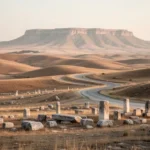
The city of Cyrene stood in the Green Mountain region of northeastern Libya, known in antiquity as the Jebel Akhdar. It was located roughly inland from the Mediterranean coast, on a high plateau with access to springs, farmland, and routes leading toward the port of Apollonia.
That position gave Cyrene a useful combination of defensible high ground and agricultural wealth. The surrounding region received more rainfall than much of the Libyan coast, and its fertile soil supported grain, olives, livestock, and the valuable plant called silphium.
Modern visitors generally identify the archaeological site with the ruins near Shahhat, Libya. The ancient city and its nearby harbor formed part of a wider urban network. Apollonia served as Cyrene’s seaport, while other cities in the region supported trade, administration, and farming.
Geographic distinction: Cyrene was not the same city as Cyrene’s port, Apollonia, although the two places were closely connected. Cyrene occupied the plateau, while Apollonia lay on the coast and handled maritime traffic.
How Greek settlers founded Cyrene
Ancient tradition connects the foundation of Cyrene with Thera, the Greek island now commonly called Santorini. According to the historian Herodotus, Thera experienced a period of hardship and drought before its people sent settlers to North Africa, following guidance associated with the oracle of Apollo at Delphi.
The first settlers were traditionally led by Battus, the founder and first king of Cyrene. Greek accounts preserve several versions of his name and story, and later writers treated him as a heroic founder. The city’s royal dynasty became known as the Battiad dynasty, after Battus.
Cyrene was established in the seventh century BC, commonly dated to around 631 BC. The settlement expanded as Greek colonists claimed land, developed agriculture, and established institutions modeled partly on those of the Greek world. Local populations also lived in the region, so Cyrene’s development involved interaction, competition, and cultural exchange rather than simple settlement on empty land.
The city’s founding story helped its residents explain their place in the Mediterranean world. Cyrenians viewed themselves as Greek in language and political tradition, yet their society was deeply shaped by the North African environment and by relationships with neighboring peoples.
Why silphium made Cyrene wealthy
Cyrene became famous for silphium, a plant that grew in the region and was prized in the ancient Mediterranean. People used it as a seasoning, medicinal ingredient, and possibly contraceptive substance. Its image appeared on Cyrenian coins, making the plant one of the clearest symbols of the city’s identity and prosperity.
Silphium was so valuable that it supported trade across the Greek and Roman worlds. The plant seems to have grown naturally within a limited area around Cyrene, and attempts to cultivate it elsewhere were reportedly unsuccessful or unreliable. Heavy harvesting, changing land use, and growing demand may have contributed to its eventual disappearance.
Cyrene’s economy did not depend on silphium alone. Grain, olive oil, livestock, wine, and other agricultural goods also supported the city. The fertile plateau allowed Cyrene to produce more than it needed locally, while Apollonia provided access to maritime commerce.
Silphium: a highly valued plant used for food, medicine, and trade.
Grain and livestock: staples that supported the urban population and regional commerce.
Olive products: agricultural goods suited to the Mediterranean climate.
Port access: Apollonia connected inland Cyrene with ships and overseas markets.
Ancient coins also reveal Cyrene’s economic confidence. Alongside images of silphium, coin designs could feature gods, rulers, animals, and symbols connected with the city’s religious traditions. These objects provide evidence of both commerce and civic self-presentation.
How Cyrene developed as a Greek city
Cyrene grew from a colony into the political and cultural center of Cyrenaica. It developed public spaces, sanctuaries, theaters, roads, fountains, and administrative buildings. Like many Greek cities, it had institutions that reflected civic participation, although political power was not shared equally among all residents.
The early city was governed by kings from the Battiad line. Over time, conflict between rulers, aristocratic families, ordinary citizens, and neighboring communities changed the political system. Cyrene eventually moved toward forms of government influenced by wider Greek political developments, including periods of oligarchic and more broadly civic rule.
The city’s religious life centered on Apollo, whose sanctuary at Cyrene became one of the most important sacred places in the region. Other Greek gods were also worshiped, and local religious customs influenced the city’s practices. Temples and sacred precincts were not only places for private devotion; they also expressed civic identity and public authority.
Cyrene produced several notable thinkers. The philosopher Aristippus of Cyrene founded the Cyrenaic school, which emphasized immediate pleasure as a central concern in human life. His grandson, Aristippus the Younger, was also associated with the school. The mathematician and scholar Eratosthenes, who later led the Library of Alexandria, was born in Cyrene.
These figures show that Cyrene was connected to the intellectual networks of the wider Greek world. Its location in North Africa did not isolate it from major centers such as Athens, Alexandria, and the Aegean islands.
Cyrene under Egypt and the Roman Republic
After the Battiad monarchy weakened, Cyrene entered periods of political uncertainty. The region came under the influence of Egyptian rulers, particularly during the era of the Ptolemies. Because Cyrenaica lay across the sea from Egypt and shared commercial connections with Alexandria, Egyptian control affected the city’s administration and trade.
Roman power gradually expanded into the eastern Mediterranean. In the first century BC, the last Ptolemaic ruler of Cyrenaica left the territory to Rome. The Roman Senate accepted the arrangement, and Cyrenaica became connected to the Roman system of provincial government.
Roman rule brought new forms of taxation, administration, road building, and military oversight. Cyrene continued to function as an important city, but its political position changed. It was no longer an independent Greek kingdom; it became part of a larger imperial structure whose priorities were set beyond the region.
Roman influence also changed the city’s appearance. Existing Greek buildings were repaired or adapted, while new Roman baths, civic structures, roads, and monuments appeared. The result was a layered urban landscape rather than a completely Roman replacement of the earlier city.
What the archaeological ruins reveal
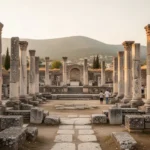
The ruins of Cyrene spread across a broad area and preserve evidence from several centuries. The site includes an agora, or public marketplace, where commercial, political, and social activities took place. Nearby structures show how the city organized movement and public life.
One of the most recognizable monuments is the Sanctuary of Apollo. Springs and sacred areas were incorporated into the religious complex, and successive building phases reflect the city’s changing fortunes. The sanctuary suffered damage from earthquakes and later rebuilding, but its remains still show the scale of Cyrene’s religious architecture.
The city also had a Greek theater, later modified during the Roman period. The theater served for performances and public gatherings, while its hillside position helped provide seating and a wide view. Changes to the structure illustrate how Roman tastes and practical needs influenced an older Greek venue.
Other important remains include the Temple of Zeus, Roman baths, civic buildings, streets, and monumental gateways. The Temple of Zeus was especially large, reflecting the resources available to Cyrene during periods of prosperity. Like many ancient monuments, it was altered, damaged, and reused over time.
Outside the central urban area, visitors can find extensive rock-cut tombs and funerary monuments. These burial sites help archaeologists understand family identity, artistic styles, social rank, and religious beliefs. Their decoration combines Greek traditions with regional characteristics.
The Sanctuary of Apollo: a major religious complex tied to Cyrene’s founding traditions.
The agora: a central public space for commerce and civic activity.
The theater: a performance venue with Greek origins and Roman alterations.
The Temple of Zeus: a monumental expression of civic wealth and religious devotion.
The necropolis: a large burial area containing tombs from different periods.
Archaeology also shows that Cyrene was not built all at once. Walls, temples, streets, and public buildings were repaired or reconstructed after fires, political disruptions, and earthquakes. The visible site is therefore a record of repeated adaptation.
Cyrene had a substantial Jewish population during the Hellenistic and Roman periods. Jewish residents participated in regional trade and maintained religious and communal institutions. Their presence connected Cyrene to Jewish communities in Alexandria, Jerusalem, and other Mediterranean cities.
Ancient sources describe tensions between Jewish communities and Greek or Roman authorities in parts of the region. These conflicts should not be treated as a single uninterrupted pattern; relationships varied according to time, leadership, economic conditions, and local politics. Still, the evidence indicates that identity and civic belonging could become contested issues.
The Jewish population of Cyrene is especially relevant to the New Testament. People from Cyrene appear among the visitors in Jerusalem at Pentecost, and a synagogue associated with Cyrenians is mentioned in Acts. These references show that Cyrene’s Jewish community was known beyond North Africa.
Some Cyrenian Jews may have traveled regularly between Cyrene, Alexandria, Jerusalem, and other ports. Religious pilgrimage, business, family ties, and migration all helped create a connected Mediterranean world in which a person’s city of origin remained an important part of identity.
What the Bible says about the city of Cyrene
The most familiar biblical reference to Cyrene concerns Simon of Cyrene. The Synoptic Gospels identify him as the man compelled to carry Jesus’ cross or crossbeam on the way to the crucifixion. Matthew 27:32, Mark 15:21, and Luke 23:26 all mention him, with Mark also identifying Simon as the father of Alexander and Rufus.
The Gospel accounts do not provide a full biography of Simon. They do establish that he came from Cyrene, which suggests that his place of origin was meaningful to the people who preserved the tradition. He may have been in or near Jerusalem for pilgrimage, business, or another purpose, but the texts do not say why he was there.
Cyrene also appears in the early Christian community described in Acts. Acts 2:10 includes visitors from parts of North Africa among those present in Jerusalem. Acts 6:9 refers to a synagogue connected with people from Cyrene, and Acts 11:20 describes believers from Cyprus and Cyrene speaking to Greek-speaking people in Antioch about Jesus.
These passages portray Cyrene as part of the early Christian Mediterranean network. The city was distant from Jerusalem, but its residents and diaspora were present in major Jewish and Christian centers.
Simon of Cyrene is remembered in the Gospel narratives because the city’s name remains attached to his identity, even though the texts give few personal details about him.
Acts 13:1 also names Lucius of Cyrene among the leaders or prophets in the church at Antioch. The passage does not explain whether Lucius was born in Cyrene, descended from Cyrenians, or simply identified with the city. It does show that people associated with Cyrene held visible roles in an early Christian community.
How earthquakes and political change affected Cyrene
Cyrene suffered several destructive earthquakes. The most severe known disaster occurred in AD 365, when a major earthquake affected much of the eastern Mediterranean. The event damaged cities across the region and likely caused extensive destruction at Cyrene and its port, Apollonia.
Earthquake damage did not automatically end urban life. Communities often repaired buildings, changed their uses, or moved activity to less damaged areas. At Cyrene, however, the disaster came after centuries of political and economic change, and the city did not fully regain its earlier importance.
Other pressures also contributed to decline. Regional conflict, changes in trade routes, reduced agricultural output, and instability in the Roman world affected Cyrenaica. The city’s distance from major political centers made recovery more difficult when infrastructure and administration weakened.
By late antiquity, parts of Cyrene were abandoned or used less intensively. Some buildings were dismantled for stone, while others were buried or left standing. The remains visible today reflect both sudden destruction and gradual contraction.
Do not confuse abandonment with a single event: Cyrene declined over time. Earthquakes were significant, but political, economic, environmental, and demographic changes also shaped the city’s fate.
How to understand Cyrene when studying history or the Bible
Cyrene can be approached through several kinds of evidence, and each one answers different questions. Biblical references preserve the memory of people from the city, while archaeology reveals buildings, burial customs, trade, and urban development. Classical historians provide additional information but often wrote from outside the region and through the assumptions of Greek or Roman culture.
When reading about the city, keep ancient place names separate from modern geography. Cyrenaica was a wider region, Cyrene was its principal inland city, and Apollonia was its coastal port. Confusing these names can make historical descriptions seem contradictory.
It also helps to distinguish between a person who was from Cyrene and someone who lived there permanently. Ancient writers often identified people by city of origin, especially when they were living elsewhere. A reference to a Cyrenian does not necessarily tell us the person’s ethnicity, occupation, or religious affiliation.
For biblical study, avoid adding details that the Gospel and Acts passages do not provide. The texts do not explain Simon of Cyrene’s motives, later life, or exact relationship with Alexander and Rufus. They identify him through his city, leaving the historical setting to provide context rather than a complete biography.
Common mistakes when researching the city of Cyrene
Calling Cyrene a Roman foundation: Rome ruled the city later, but Greek settlers founded it centuries earlier.
Placing Cyrene directly on the coast: The main city stood inland on a plateau; Apollonia was the nearby port.
Assuming silphium was the only crop: The plant was famous, but grain, olives, livestock, and other products also supported the economy.
Treating all Cyrenians as one religious group: The city included Greek, local North African, Jewish, and later Christian communities.
Assuming one earthquake ended the city immediately: Cyrene declined through a combination of disaster and longer-term changes.
Inventing details about Simon of Cyrene: The Gospels identify his origin and action but provide limited personal information.
Ignoring the port of Apollonia: Maritime trade was essential to understanding how inland Cyrene connected with the wider Mediterranean.
What remains of Cyrene today
The archaeological site remains one of the most important ancient landscapes in Libya. Its temples, theaters, public spaces, tombs, and views across the Green Mountain region make it possible to see how a Greek colony developed into a major city of Roman North Africa.
Preservation has been affected by weather, earthquakes, stone reuse, limited resources, and periods of political instability. Archaeological work requires careful protection because exposed ruins can deteriorate quickly. Visitors should follow local guidance, avoid climbing fragile structures, and never remove pottery, stones, or other material.
Cyrene’s significance extends beyond individual monuments. The site preserves evidence for Greek colonization, North African agriculture, Hellenistic politics, Roman administration, Jewish diaspora life, and early Christianity. Few places connect these subjects so clearly across such a long period.
Its biblical importance is similarly tied to a wider history. Simon of Cyrene was named by his city because Cyrene was a recognizable place in the ancient Mediterranean. The references to Cyrenians in Acts show that the city’s people traveled, worshiped, traded, and participated in communities far from the Libyan plateau.
Understanding Cyrene therefore means seeing more than a ruined city. It means recognizing a North African center that remained connected to the Greek world, the Roman Empire, Jewish communities, and the earliest Christian movement for many centuries.
Frequently asked questions
Is Cyrene the same as modern-day Benghazi?
No. Cyrene was an ancient city in northeastern Libya near modern Shahhat, in the Green Mountain region. Benghazi is farther west and developed from a different ancient settlement, Euesperides, later known as Berenice. Both cities belonged to the broader region of Cyrenaica, but they were separate urban centers with different histories.
Why was Simon called Simon of Cyrene?
Ancient people were often identified by their city of origin, especially when they lived or traveled away from home. The Gospel accounts use “of Cyrene” to distinguish Simon from others named Simon. The phrase indicates his connection with the North African city, but the texts do not explain whether he was a permanent resident or a visitor in Jerusalem.
What happened to silphium from Cyrene?
Silphium eventually disappeared from the historical record, probably because of intensive harvesting, limited natural habitat, and environmental or agricultural changes. Ancient writers described it as difficult to cultivate elsewhere. Although its exact botanical identity remains debated, its image on Cyrenian coins confirms how strongly the plant was associated with the city’s wealth.
Can people visit the ruins of Cyrene?
The ruins are located near Shahhat in northeastern Libya, but access, transportation, security, and preservation conditions can change. Anyone considering a visit should check current official travel guidance and arrange local assistance. At the site, respectful behavior is essential: do not climb unstable structures, remove artifacts, or enter restricted areas.









Leave a Reply