Thessalonica: Its biblical history and modern significance
Thessalonica: Its biblical history and modern significance
When you read Paul’s letters to the Thessalonians, you may wonder where this church was, why Paul cared so deeply about it, and what happened to the city. Thessalonica was a major port and commercial center in ancient Macedonia, and its location made it one of the most strategically important places Paul visited. Today, the city is called Thessaloniki and remains Greece’s second-largest city.
In the New Testament, Thessalonica is significant for three connected reasons. It was a crossroads of trade and travel, it became home to an early Christian congregation under difficult circumstances, and it was the setting for two letters that address faith, suffering, work, holiness, and the return of Jesus. Understanding the city’s geography and social setting makes those letters easier to read.
Where Thessalonica was and why its location mattered
Ancient Thessalonica stood on the Thermaic Gulf in northeastern Greece, within the region of Macedonia. Its natural harbor connected it with maritime trade, while the Via Egnatia linked it by road with other important settlements across the Balkans. Travelers, merchants, soldiers, officials, and religious teachers passed through the city regularly.
The city was founded in the fourth century BC by Cassander of Macedon, who named it after Thessalonike, a member of the Macedonian royal family. After Rome defeated the Macedonian kingdom, Thessalonica became an important Roman center. It served as the capital of the Roman province of Macedonia and benefited from both political influence and commercial activity.
That background explains why Paul’s visit mattered. He was not preaching in an isolated village. He was speaking in a city where news, ideas, and people could travel outward quickly. A congregation established there could influence surrounding communities, which helps explain why Paul’s reputation and concern for the Thessalonian believers appear so prominently in his correspondence.
Geographical point: Thessalonica was more than a place name on a map. Its port, roads, Roman administration, and diverse population made it a natural center from which religious ideas could spread through Macedonia.
How to understand Thessalonica in the New Testament
A useful way to study Thessalonica is to connect the city, Paul’s visit, the church’s difficulties, and the two letters associated with the congregation. These points provide a clear framework:
Locate the city. Place Thessalonica in Roman Macedonia, on the Thermaic Gulf and along the Via Egnatia.
Read Acts 17. This chapter describes Paul, Silas, and Timothy preaching there and the opposition that followed.
Consider the church’s composition. The congregation included people from different religious and social backgrounds, including Gentile converts.
Read 1 Thessalonians as pastoral correspondence. Paul encourages believers who have remained faithful under pressure.
Read 2 Thessalonians alongside the first letter. It addresses confusion and anxiety connected with the day of the Lord.
Compare ancient and modern Thessaloniki carefully. The present city occupies the same broad location, but its visible remains come from several different periods.
This approach keeps historical details from becoming disconnected facts. Thessalonica’s setting helps explain the church’s opportunities, while Acts and the letters show the personal cost of becoming Christian in a competitive and religiously varied urban environment.
What happened when Paul visited Thessalonica
Paul reached Thessalonica during what Acts presents as his second missionary journey. He traveled with Silas, and Timothy was also associated with the mission. After leaving Philippi, they followed the road westward through Macedonia and arrived in Thessalonica.
According to Acts 17, Paul went to the Jewish synagogue and reasoned from the Scriptures over three Sabbaths. He explained that the Messiah had to suffer and rise from the dead, then identified Jesus as the Messiah. Some Jewish hearers were persuaded, along with many Gentiles who worshiped God and a number of prominent women.
The phrase “three Sabbaths” describes the period specifically mentioned in the synagogue account, not necessarily the entire time Paul spent in the city. Paul’s letters indicate that he worked to support himself and that the believers had opportunities to receive substantial teaching. The congregation may therefore have continued developing beyond the synagogue discussions recorded in Acts.
The response was divided. Some people welcomed the message, while others became hostile. Acts says opponents gathered a crowd and attacked the house of Jason, where Paul and his companions had been staying. Unable to find Paul and Silas, they brought Jason and other believers before the city authorities.
The accusation had a political edge. The opponents claimed that the Christians were acting against Caesar’s decrees by recognizing another king, Jesus. The charge was not simply about private religious belief; in a Roman city, language about kingship could raise concerns about public order and loyalty to the emperor.
The officials required security from Jason and the others before releasing them. Paul and Silas then left for Berea, where the reception was more receptive. When opponents from Thessalonica followed them there, Paul continued on to Athens while Silas and Timothy remained in Macedonia for a time.
What the first Christian community in Thessalonica was like
The Thessalonian congregation appears to have been socially and religiously mixed. Acts mentions Jewish hearers, Gentiles who already worshiped Israel’s God, and prominent women. Paul’s first letter also speaks to believers who had turned from idols to serve the living God, suggesting that many members came from non-Jewish backgrounds.
This diversity created both strength and tension. People who had once followed different religious customs now belonged to one community centered on Jesus. They had to learn new patterns of worship, sexual ethics, work, mutual responsibility, and hope. They also had to maintain unity while facing criticism from people who did not share their beliefs.
Paul’s letters show that the church was not simply a group of isolated individuals. Believers were expected to care for one another, respect their leaders, encourage the discouraged, help the weak, and pursue peace. The instructions assume a congregation learning how to live as a visible community in a busy city.
The church also had a strong relationship with other Christian communities. The Thessalonians had received the message from Paul’s team, but they became an example to believers in Macedonia and Achaia. Their faith was not presented as a private experience; it became known through their endurance and changed conduct.
Why Paul’s letters to the Thessalonians are important
First Thessalonians is often regarded as one of Paul’s earliest surviving letters. It has the tone of a pastor writing to people he loves but cannot currently visit. Paul remembers their response to the gospel, explains why he has not returned, and sends Timothy to learn how they are doing.
The letter begins with gratitude for their faith, love, and hope. Paul describes how the message reached them not only through speech but also through conviction and the evident work of the Holy Spirit. He presents their acceptance of the message as a costly decision because they endured opposition while becoming an example to other believers.
Paul also defends the character of his ministry. He says that he did not approach them with deceptive motives, greed, or a desire for human praise. The letter portrays his relationship with the congregation through several images: a nursing mother caring for children and a father urging his children to live in a way that honors God.
Those images reveal an important feature of the letter. Paul is not addressing the Thessalonians as a distant authority issuing abstract rules. He is responding to a young congregation whose members have faced pressure, lost fellow believers, and raised questions about the future.
What 1 Thessalonians teaches about Christian living
Several themes run through the letter. Paul praises the Thessalonians for turning from idols, but he also urges them to keep growing. Their conversion is not treated as the end of moral formation. They are called to live in holiness, control their bodies, show brotherly and sisterly love, and continue working responsibly.
The letter’s teaching about sexuality appears in a setting where the surrounding culture did not share the same Christian expectations. Paul connects sexual conduct with holiness and respect for others. He does not present private behavior as morally insignificant; he treats it as part of faithfulness to God and care for the community.
Work is another practical concern. Paul tells the believers to live quietly, mind their own affairs, and work with their hands. The instruction appears connected with the congregation’s public reputation and with the need to avoid dependence that could burden other members. Christian hope was not meant to remove ordinary responsibility.
Paul also addresses grief. Some Thessalonians had died, and the surviving believers were concerned about their place in the future resurrection and the Lord’s coming. Paul does not tell them to avoid mourning. Instead, he gives them hope grounded in the belief that death does not separate believers from God’s future purposes.
The exact sequence and timing of future events remain a subject of interpretation, but the pastoral point is clear. Paul wants the Thessalonians to encourage one another rather than live in despair. Hope about the future is intended to shape present faithfulness, mutual comfort, and steady expectation.
Faithfulness under pressure: The Thessalonians are commended for remaining committed despite opposition.
Holiness in ordinary life: Moral conduct, work, and relationships are treated as expressions of worship.
Care for the grieving: Christian hope addresses death without denying the pain of loss.
Mutual responsibility: The church is expected to encourage, warn, help, and patiently support its members.
Readiness without speculation: Believers are urged to remain alert and self-controlled rather than fixating on dates.
How 2 Thessalonians addresses confusion and fear
The second letter associated with Thessalonica also speaks to persecution and the future, but its emphasis is different. Some believers appear to have been unsettled by claims that the day of the Lord had already arrived. Paul responds by urging them not to be quickly shaken or alarmed by reports, messages, or supposed letters claiming apostolic authority.
The letter connects endurance with God’s just judgment. Those suffering for their faith are encouraged to see that their present hardship does not mean God has abandoned them. At the same time, the letter warns against assuming that the future can be reduced to an immediate prediction or a sensational announcement.
A second practical problem concerns idleness. Some members were apparently refusing ordinary work, perhaps because of their expectations about the Lord’s return. The letter insists that Christian hope does not justify disorderly behavior or dependence on others. Those who can work should do so, while the community should continue treating people with discipline and compassion.
Questions about the authorship, date, and relationship between 1 and 2 Thessalonians have been discussed by scholars for a long time. Readers can recognize those debates without losing sight of the letters’ central concerns: perseverance, discernment, responsible living, and confidence in God’s justice.
Reading tip: Passages about the end times should be read with the letters’ practical commands in view. In Thessalonians, future hope is repeatedly connected with steady work, moral conduct, encouragement, and calm discernment.
How Roman Thessalonica shaped the church’s challenges
Thessalonica’s Roman identity helps explain why opposition could become politically charged. The city operated within imperial structures, and public stability mattered to local authorities. A movement announcing Jesus as Lord could be heard as a challenge to the loyalty normally expressed toward Roman power, even when Christians did not organize an armed revolt.
The city’s religious life was also varied. Traditional Greek and Roman worship existed alongside Jewish synagogue life and other practices common in a major Mediterranean city. Converts who left idol worship could face tension within households, workplaces, trade networks, and civic relationships.
Social status mattered as well. Acts mentions prominent women among those who responded, while Paul’s letters address ordinary labor, leadership, generosity, and community discipline. The church brought people together across some social boundaries, but it still had to learn how to practice equality, responsibility, and mutual care.
The accusation against Jason illustrates the danger of belonging to a new religious movement in a politically sensitive setting. The Christians’ opponents framed their message as a threat to imperial order. Even if the charge distorted the believers’ intentions, it could expose them to public suspicion and pressure.
What ancient Thessalonica looked like
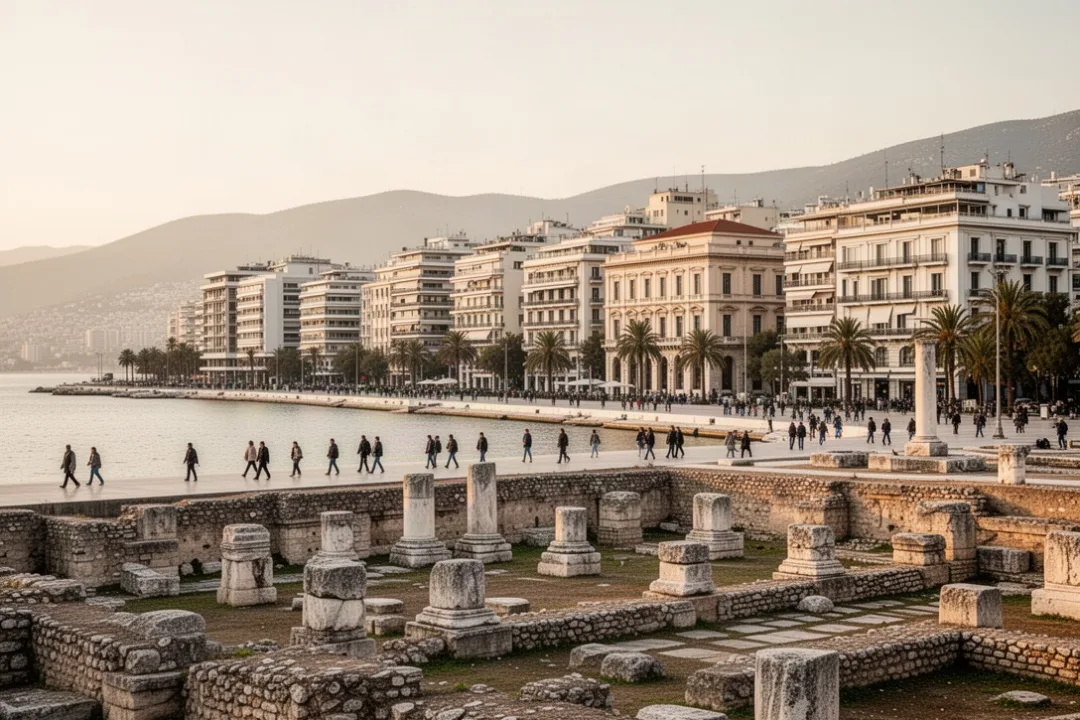
Much of ancient Thessalonica lies beneath the modern city, which has been continuously occupied and rebuilt across many centuries. Archaeological evidence nevertheless reveals important parts of its Roman and later history. Visitors can see remains of the Roman Forum, including public architectural features associated with civic life.
The city also contains the Arch of Galerius and the Rotunda, monuments connected with the Roman imperial period. These structures belong to a later era than Paul’s visit, so they should not be treated as buildings Paul personally saw in their present form. They do, however, help visitors understand the city’s continuing importance under Roman rule.
Modern Thessaloniki is also known for Byzantine churches, Ottoman-era remains, museums, and its waterfront. The White Tower is one of the city’s best-known landmarks, but it comes from a much later period than the New Testament. A thoughtful visit separates Roman, Byzantine, Ottoman, and modern layers rather than blending them together.
For biblical study, the city’s location matters more than finding a single surviving house or synagogue associated with Paul. Archaeology can illuminate urban scale, public life, roads, and political history, but it cannot identify every place mentioned in Acts with certainty.
How to study Thessalonica through Acts and the letters
A focused reading plan can help you connect historical setting with the New Testament text. Begin with Acts 17:1–9 to follow Paul’s arrival, synagogue teaching, the response to the message, and the accusations brought against Jason.
Then read 1 Thessalonians in one sitting if possible. Notice the emotional movement of the letter: thanksgiving, defense of Paul’s ministry, concern for the congregation, teaching about holiness, grief, the Lord’s coming, and practical instructions for community life.
Read 2 Thessalonians afterward, paying attention to both its continuity and its differences. Ask how the letter speaks to fear, persecution, disputed claims about the day of the Lord, and unwillingness to work. The practical commands show that the church’s future hope was meant to produce order rather than panic.
Mark every reference to suffering or opposition. This reveals the pressure the congregation faced.
Circle instructions about relationships. These include encouragement, patience, respect for leaders, and care for weaker members.
Track references to work and daily conduct. They show how theology affected ordinary life.
Observe the language of imitation and example. Paul presents both his team and the Thessalonians as models of faithful behavior.
Compare comfort with correction. The letters encourage the church while still addressing real problems.
This method prevents the letters from being reduced to isolated discussions about prophecy. Thessalonica was a real congregation with real grief, conflict, work, public pressure, and hope. The historical city and the pastoral letters belong together.
What Thessalonica can teach readers today
The Thessalonian correspondence speaks to communities trying to remain faithful under social pressure. The believers did not have complete security, perfect understanding, or freedom from disagreement. They were learning how to practice a new way of life while surrounded by people who did not share their convictions.
The letters also model a balanced response to uncertainty. Paul does not dismiss questions about the future, but he resists fear-driven claims and insists on responsible conduct. His guidance joins hope with patience, expectation with work, and confidence in God with care for other people.
Another lasting lesson is the value of pastoral encouragement. Paul remembers specific qualities in the congregation and gives thanks for their faithfulness before addressing their concerns. Correction is more credible when it is joined with affection, truthfulness, and recognition of what people are already doing well.
Finally, Thessalonica shows how a local community can have influence beyond its immediate setting. The church began in a city shaped by roads, shipping, commerce, and imperial administration. Its message traveled through the same connected world that had made the city important in the first place.
Thessalonica and Thessaloniki today
The ancient name Thessalonica remains familiar in biblical and historical writing, while Thessaloniki is the modern Greek name commonly used for the city. Both names refer to the same broad urban location, although the present city contains layers from many periods and does not reproduce the ancient landscape exactly.
A visit can combine biblical study with broader historical exploration. The Roman Forum provides insight into civic life, the Arch of Galerius shows imperial architecture, and the city’s museums preserve objects from Macedonia and Thessaloniki’s long history. Churches and later monuments demonstrate that the city remained significant long after the apostolic period.
For readers studying Paul, the most useful question is not simply, “Where did he stand?” It is also, “What kind of city did he enter?” Thessalonica was connected, diverse, commercially active, politically sensitive, and religiously plural. Those conditions help explain both the rapid spread of the Christian message and the strong resistance it encountered.
Frequently asked questions
Is Thessalonica the same city as Thessaloniki?
Yes. Thessalonica is the ancient and commonly used biblical form of the city’s name, while Thessaloniki is the modern Greek name. The city is located in northern Greece on the Thermaic Gulf. Modern Thessaloniki occupies the same general area as ancient Thessalonica, but centuries of rebuilding mean that the present urban landscape includes Roman, Byzantine, Ottoman, and modern layers.
How long did Paul stay in Thessalonica?
Acts 17 specifically describes Paul reasoning in the synagogue for three Sabbaths, but that does not necessarily define the entire length of his stay. His letters indicate that he worked, taught, and developed close relationships with the believers. Many readers therefore understand his ministry in Thessalonica to have continued beyond the three Sabbaths mentioned in Acts.
Who wrote the letters to the Thessalonians?
First Thessalonians identifies Paul, Silvanus, and Timothy in its opening, although Paul is generally understood as the principal author. Second Thessalonians also bears Paul’s name, but its authorship and relationship to the first letter have been debated by scholars. The letters were addressed to the Christian community in Thessalonica and reflect its concerns about persecution and the future.
What is the main message of 1 Thessalonians?
First Thessalonians encourages a young church to remain faithful while facing opposition. It emphasizes holiness, love within the community, responsible work, comfort for those grieving, and hope in Christ’s future coming. The letter does not treat future expectation as an excuse for speculation or idleness. Instead, it connects hope with steady conduct, mutual encouragement, and perseverance.









Leave a Reply