Philippi: history, Bible meaning, and ancient ruins
Philippi: history, Bible meaning, and ancient ruins
Philippi was the first place in Europe where Paul established a Christian community, according to the New Testament account. The ancient city stood in eastern Macedonia, near the modern Greek city of Kavala, and connected Greek, Roman, Jewish, and early Christian history.
Philippi matters for more than one reason. It was founded by King Philip II of Macedon, shaped by Rome after a decisive civil-war battle, and remembered in Acts for the conversion of Lydia, Paul’s imprisonment, and the earthquake that opened the prison doors. The city also gave its name to the Letter to the Philippians, a New Testament book centered on joy, humility, endurance, and faithful service.
Where Philippi was located and why its position mattered
Ancient Philippi was located in the region of eastern Macedonia, in what is now northern Greece. It occupied a strategic position on the Via Egnatia, the Roman road that crossed the Balkans and linked the Adriatic coast with Byzantium. The city also stood near important routes through the mountains and close to the Aegean coast.
This location gave Philippi military and commercial value. Travelers, soldiers, officials, merchants, and religious communities passed through the area. Nearby plains provided agricultural resources, while gold and silver deposits in the surrounding mountains helped attract early settlers and rulers.
The ruins are found approximately east of Kavala, near the modern village of Krinides. The surrounding landscape still helps explain the city’s importance: open farmland lies near rugged hills, and the road network made the settlement easier to reach than many inland communities.
Geographical clue: Philippi was not an isolated biblical village. It was a strategically placed city on a major road, which helps explain why Paul traveled there and why Rome valued it.
The city’s name also reflects its political history. Before it was called Philippi, the settlement was known as Krenides, a name associated with springs or small fountains. Philip II of Macedon captured and refounded it in the fourth century BC, giving it the name Philippi in his own honor.
Its position near mines and transport routes made it useful to Macedonia’s rulers. The city could serve as a military base, a source of revenue, and a stronghold over the surrounding region. Those advantages continued after Macedon came under Roman control.
How Philippi developed from a Macedonian settlement into a Roman colony
Thasian colonists founded Krenides around the middle of the fourth century BC. The settlement was close to the older Thracian population and to mineral resources. In 356 BC, Philip II took control of the town, strengthened its defenses, and renamed it Philippi.
Philip’s expansion into the region formed part of his broader effort to extend Macedonian power eastward. Philippi’s location allowed him to control access between the interior and the coast. The city remained connected to the Macedonian kingdom until Rome defeated King Perseus at the Battle of Pydna in 168 BC.
After Macedonia became a Roman province, Philippi continued as a significant regional center. Its most famous political transformation came after the Battle of Philippi in 42 BC, fought during the Roman civil wars that followed the assassination of Julius Caesar.
Mark Antony and Octavian defeated the forces of Brutus and Cassius near the city. Brutus and Cassius had been leading figures among Caesar’s assassins. Cassius died after the first battle, and Brutus took his own life after the second defeat.
The victory changed Philippi’s status. Veterans of the Roman armies were settled there, and the city became a Roman colony. Later, after Octavian became Augustus, Philippi received additional privileges and developed a strong Roman identity. Latin inscriptions, Roman institutions, and veteran settlement all influenced public life.
Fourth century BC: Philip II of Macedon captured and renamed the settlement.
Second century BC: Rome absorbed Macedonia after defeating the Macedonian kingdom.
42 BC: Antony and Octavian defeated Brutus and Cassius near Philippi.
Roman imperial period: Philippi functioned as a colony with civic institutions and veteran residents.
Late antiquity: Churches and Christian buildings became prominent within the city.
Being a Roman colony affected the way residents understood themselves. Philippi had civic privileges associated with Roman citizenship, and the local population included people shaped by military service, Roman administration, Greek culture, and older Macedonian traditions.
That background adds depth to Paul’s ministry there. The community he encountered was not culturally uniform. It included people connected to local traditions, Roman authority, commerce, household networks, and different religious practices.
What Acts says happened when Paul visited Philippi
Paul’s visit to Philippi is recorded primarily in Acts 16. The narrative places the visit during Paul’s missionary travels, after he and his companions crossed from Asia Minor into Macedonia. The text presents this move as a significant development in the spread of the Christian message.
Paul and his companions first encountered a group of women gathered for prayer near a river. The passage identifies Lydia, a seller of purple cloth from Thyatira, as one of the people listening. She accepted Paul’s message, was baptized with members of her household, and offered hospitality to the missionaries.
Lydia is one of the best-known figures connected with Philippi. Her work with purple textiles suggests involvement in a valuable trade, although the text does not provide enough information to reconstruct her exact business scale or social status. The account does show her as a household leader, convert, patron, and host.
Her home appears to have become an important meeting place for the growing Christian community. This detail illustrates how early Christian groups often formed through household relationships rather than through dedicated church buildings.
Paul’s ministry then brought him into conflict with people who exploited a slave girl believed to have a spirit of divination. According to Acts, Paul expelled the spirit from her. Her owners, who had profited from her condition, then dragged Paul and Silas before the city authorities.
The accusation focused on public disorder and customs that Roman citizens were allegedly not permitted to adopt. The officials ordered Paul and Silas beaten and imprisoned. Acts later emphasizes that Paul was a Roman citizen, making the public beating without a proper hearing especially serious.
During the night, Paul and Silas prayed and sang hymns while other prisoners listened. An earthquake shook the prison, opened the doors, and loosened the prisoners’ restraints. The jailer, fearing that the prisoners had escaped, prepared to take his own life, but Paul stopped him by showing that the prisoners remained there.
The jailer then asked what he should do. Acts presents Paul and Silas as explaining the Christian message, after which the jailer and his household received baptism. The story highlights perseverance under suffering, concern for an enemy, and the formation of a new household of faith.
Paul’s departure from Philippi was also marked by a legal confrontation. When the officials sent word that Paul and Silas should be released quietly, Paul objected that they had been publicly beaten and imprisoned despite being Roman citizens. The officials came personally, escorted them out, and asked them to leave the city.
Before departing, Paul visited Lydia’s home and encouraged the believers. The account suggests that the Philippian community continued after the missionaries left and that it became one of Paul’s most trusted relationships.
Historical caution: A traditional site called Paul’s prison is shown at Philippi, but archaeology cannot prove that a particular surviving structure was the exact prison described in Acts.
Why Philippi is important in the New Testament
Philippi is connected with Christianity through both Acts and the Letter to the Philippians. Acts tells the story of the community’s beginnings. Philippians reveals the warmth and mutual support that developed between Paul and the believers there.
Paul describes the Philippians as partners in his work. The letter refers to their financial and practical support, showing that the relationship was not merely symbolic. They appear to have helped sustain Paul during periods of imprisonment and missionary activity.
The letter’s tone is notably personal. Paul addresses conflict, suffering, humility, generosity, and perseverance while expressing deep affection for the congregation. Philippi’s believers were not portrayed as perfect, but as a community being shaped through shared commitment and service.
A central passage in Philippians describes Jesus’ humility and willingness to accept suffering before exaltation. Rather than reproducing the passage, its main point can be stated simply: believers are urged to reject selfish ambition, value others, and adopt a pattern of humble service.
The letter also returns repeatedly to joy. In Philippians, joy does not depend on comfortable circumstances. Paul writes from imprisonment and still presents joy as a disciplined response rooted in faith, partnership, prayer, and hope.
Several themes make Philippians especially meaningful to readers today:
Partnership: Christian work is presented as something shared rather than carried by one person alone.
Humility: The community is urged to place the good of others above status and rivalry.
Steadfastness: Opposition and uncertainty do not automatically mean that a mission has failed.
Generosity: Material support is treated as a genuine expression of fellowship.
Joy in hardship: Joy is connected to faithfulness and relationship, not simply to pleasant circumstances.
Philippians also contains references to several members of the community, including Euodia and Syntyche, whom Paul urges to work toward agreement. The mention of these women shows that they held recognized roles in the congregation, even though they were experiencing a dispute.
Paul’s reference to the “citizenship” of believers also carries particular resonance in a Roman colony. Philippi’s residents were familiar with the privileges and identity associated with Roman citizenship. Paul uses citizenship language to direct attention toward a different kind of allegiance and community.
The city’s Roman identity therefore provides useful cultural context for reading the letter. Words about citizenship, honor, status, public conduct, and loyalty would have had concrete meaning for people living in Philippi.
What visitors can see at the archaeological site of Philippi
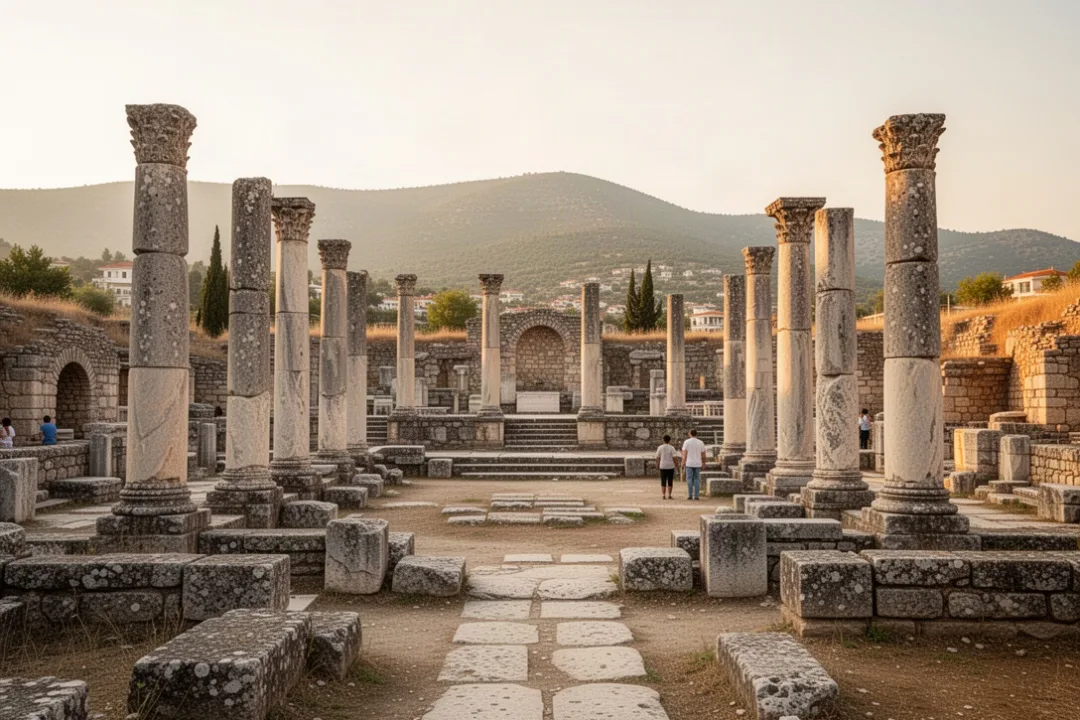
The archaeological site preserves remains from several periods, including the Hellenistic, Roman, and early Christian eras. Visitors can see how the city changed over centuries rather than viewing it as a place connected to only one event.
The ancient theater is one of the most recognizable structures. It was built during the Hellenistic period and later modified under Roman influence. Like theaters in other ancient cities, it served as a venue for performances and public gatherings.
The Roman forum formed the civic center of the later city. Its remains help visitors imagine Philippi as an organized Roman colony with public buildings, administrative activity, and commercial life. Streets, columns, foundations, and architectural fragments reveal the scale of the urban center.
The site also includes remains associated with early Christian worship. Several large basilicas were built during the period when Christianity had become publicly established in the Roman world. Their presence shows that Philippi remained important to Christian communities long after Paul’s visit.
Other features include city walls, a possible marketplace area, baths, roads, and residential remains. The acropolis and fortifications reflect the settlement’s earlier defensive role, while later buildings show the influence of Roman planning and Christian patronage.
Visitors should distinguish between what archaeology demonstrates and what later tradition preserves. The ruins can identify the city’s streets, civic spaces, religious buildings, and general historical development. They cannot always identify the exact location of an event described in Acts.
The archaeological site is part of the UNESCO World Heritage property known as the Archaeological Site of Philippi, inscribed in 2016. Its significance includes the interaction of different cultures and the city’s role in political, economic, and religious history.
How to read the ruins alongside the biblical account
Start with the city’s public spaces. The forum, roads, and civic buildings show the Roman environment in which Paul’s trial and imprisonment were said to occur. The scale of the colony helps explain why local officials cared about public order and Roman legal status.
Next, consider the city’s religious diversity. Philippi included traditional Greek and Roman practices, local customs, Jewish prayer gatherings, and eventually Christian communities. Acts’ references to prayer by the river and conflict over religious activity fit a setting where multiple identities existed side by side.
Finally, remember the difference between a modern visitor’s route and an ancient resident’s experience. The visible ruins are often monumental, but much of daily life took place in homes, workshops, streets, and small gathering spaces that have not survived as clearly.
How Philippi’s history helps explain its lasting meaning
Philippi brings together several turning points in Mediterranean history. Philip II used it to expand Macedonian power. Rome used the region as part of its imperial network. Antony and Octavian fought a decisive battle nearby, and later Roman settlers reshaped the city’s identity.
Paul’s visit added another layer. The Christian community began among people connected through prayer, work, household relationships, and the pressures of Roman public life. The stories of Lydia, the slave girl, the jailer, and the imprisoned missionaries show different ways that power and vulnerability appeared in the city.
That variety is one reason Philippi remains so significant. It was not simply the setting for one sermon or one conversion. It was a real city where political authority, economic interests, social status, religious conviction, and personal hospitality affected one another.
For Bible readers, Philippi offers a setting for understanding several passages more concretely. Acts 16 becomes a story about mission in a Roman colony, while Philippians becomes a letter to a community with a history of hardship, generosity, and close partnership with Paul.
For travelers and history students, the site offers a compact view of long-term change. Macedonian foundations, Roman urban planning, and Christian basilicas stand within the same archaeological landscape. The result is a place where political history and religious history can be studied together.
Philippi also invites careful reading of ancient sources. Acts presents the city through the experiences of missionaries and converts. Archaeology presents streets, buildings, inscriptions, and layers of occupation. Neither source answers every question by itself, but together they create a fuller picture of life in the ancient city.
Its enduring message is therefore both historical and spiritual: communities are formed through relationships, tested by pressure, and remembered through the choices people make under difficult conditions. That insight connects the ruins of Philippi with the letter that still bears its name.
Frequently asked questions
Is Philippi the same place mentioned in the Bible?
Yes. Philippi is the city described in Acts 16 and addressed in the New Testament Letter to the Philippians. It was an ancient Roman colony in Macedonia, located in present-day northern Greece. The biblical account connects it with Lydia, Paul and Silas’s imprisonment, the Philippian jailer, and the beginnings of a Christian congregation.
Did Paul write Philippians from Philippi?
The letter was written to the Christians in Philippi, but Paul was probably imprisoned somewhere else when he wrote it. Scholars have proposed Rome, Caesarea, and Ephesus as possible locations. The letter itself does not identify the place with certainty, so it is safer to say that Philippi was the destination, not the confirmed place of composition.
Can you visit the ruins of Philippi today?
Yes. The archaeological site is open to visitors near Krinides in northern Greece, not far from Kavala. It includes the theater, Roman forum, streets, fortifications, baths, and early Christian basilicas. A museum near the site contains additional finds. Opening hours and access arrangements can change, so check current local information before traveling.
Why is Lydia important in the story of Philippi?
Lydia is presented as the first named convert in Philippi. She was a seller of purple goods from Thyatira who listened to Paul, was baptized with her household, and hosted the missionaries. Her story highlights the importance of women, household networks, commerce, and hospitality in the formation of the early Christian community.






Leave a Reply