The New Testament names James, Joses, Judas, and Simon as Jesus’ brothers and refers to unnamed sisters, but Christians disagree about whether they were his younger biological siblings, stepbrothers, or cousins.
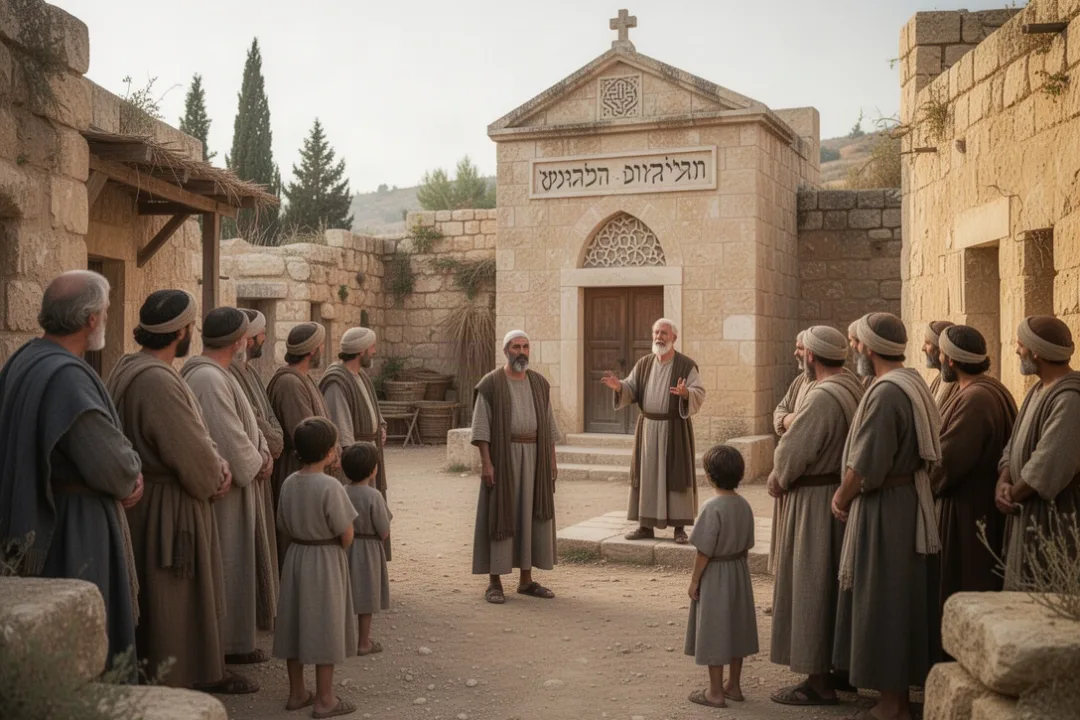
The clearest references appear when Jesus returns to his hometown and teaches in the synagogue. People who know his family ask how he gained such wisdom and identify him as the son of Mary. They also name several men as his brothers and mention sisters whose names are not given.
Matthew 13:55–56 lists James, Joseph or Joses, Simon, and Judas. Mark 6:3 gives the same basic list, using the form Joses and again referring to unnamed sisters. The wording presents these people as members of Jesus’ local family and helps explain why some townspeople found his public authority surprising.
The New Testament does not provide a complete family tree. It never gives the names of Jesus’ sisters, never states their number, and does not directly explain whether the brothers were Mary’s other children. That lack of detail is why later Christian traditions developed different interpretations.
The central distinction: Most readers agree that the New Testament speaks of a close family relationship, but churches differ over whether “brothers” means biological siblings, stepbrothers, or cousins.
The names traditionally associated with Jesus’ brothers
The four male names connected with Jesus are not equally prominent in the New Testament. James becomes the most visible figure, while Joses, Simon, and Judas appear less often and are harder to identify with certainty.
James: He is called “the Lord’s brother” in Galatians 1:19 and becomes a leading figure among believers in Jerusalem.
Joses: This is a form of Joseph, and some translations use “Joseph” rather than “Joses” in Matthew’s list.
Simon: He is named among Jesus’ brothers, but the New Testament gives little additional information about him.
Judas: He is named in the family list. The writer of Jude identifies himself as “a brother of James,” though the text does not explicitly say that this Judas is Jesus’ brother.
Unnamed sisters: Mark and Matthew refer to Jesus’ sisters in the plural, indicating at least two, but neither Gospel supplies their names.
These names should not be confused with every person in the New Testament who has the same name. James the son of Zebedee and James the son of Alphaeus, for example, are members of the Twelve and are not identified as Jesus’ brothers. Likewise, Judas Iscariot is not the same person as the Judas named in Jesus’ family list.
What “brothers” means in the Gospel passages
The Greek word translated “brothers” is adelphoi. In ordinary settings, it can refer to male siblings, but its meaning depends on context. Biblical family language can also describe wider relatives, fellow members of a community, or people connected through a shared relationship.
Matthew and Mark place the word in a family setting alongside Mary, Jesus’ mother, and unnamed sisters. That setting naturally leads many readers to understand the men as Jesus’ brothers in the familiar sense. The passages, however, do not include a sentence such as “these were Mary’s other sons,” so the exact relationship remains open to interpretation.
The word itself cannot settle the dispute. A translation that says “brothers” accurately reflects the Greek, but it does not tell the reader whether the relationship was biological, marital, or extended-family. The surrounding teachings of a particular church often guide how the passages are read.
A step-by-step way to evaluate the biblical evidence
A careful reading works best when it separates what the text states from what later traditions infer. The following approach keeps the main evidence in view without forcing the passages to answer questions they do not directly address.
Read the family lists first. Matthew 13:55–56 and Mark 6:3 name four men and mention sisters.
Identify the strongest individual reference. Galatians 1:19 calls James “the Lord’s brother,” giving him a special connection to Jesus.
Track James in the early church. Acts and Paul’s letters show James exercising significant leadership in Jerusalem.
Check the passages about Jesus’ family during his ministry. Mark 3:20–35 and John 7:1–10 portray Jesus’ brothers in ways that reveal their reactions to his work.
Compare Christian interpretations. Biological-sibling, stepbrother, and cousin readings each depend on how the reader understands family terminology and related traditions.
Keep uncertain identifications separate. The James who led Jerusalem is strongly connected to Jesus, but identifying every named Judas or Joses with another New Testament figure requires caution.
This method produces a balanced result: the New Testament clearly refers to people called Jesus’ brothers and sisters, James is an important early Christian leader associated with Jesus, and the precise family structure is not stated in one unambiguous passage.
Why many Christians understand them as biological siblings
Many Protestant readers and some other Christians take the most direct reading of Matthew 13:55–56 and Mark 6:3. On this view, Mary and Joseph had additional children after Jesus’ birth, making James, Joses, Simon, Judas, and the unnamed sisters Jesus’ younger siblings.
This interpretation fits the ordinary use of brothers and sisters in a household. It also gives a straightforward explanation for the order of the family references: Jesus is identified as Mary’s son, and other children from the same family are named alongside him. The references to Jesus as Mary’s firstborn in Luke 2:7 are sometimes considered compatible with later children, since “firstborn” identifies the first child without necessarily stating that more children followed.
Those who hold this view often point to the way Jesus’ brothers appear as a recognizable group during his ministry. In John 7:3–5, his brothers urge him to show his works publicly, and the passage says that they did not believe in him at that stage. The scene can be read naturally as a disagreement among close family members who know Jesus personally but have not accepted his mission.
Biological-sibling interpreters do not all draw identical conclusions about every person named in the New Testament. Some identify James with the James who later led the Jerusalem church, while others distinguish among different men named James. The main claim is about the family references in the Gospels, not necessarily about every later tradition attached to those names.
Why Catholic and Orthodox traditions read the passages differently
The Catholic and Eastern Orthodox churches traditionally affirm Mary’s perpetual virginity: Mary was a virgin before Jesus’ birth, remained a virgin when he was born, and did not have other biological children. Because of this teaching, these traditions do not normally understand Jesus’ “brothers” as younger sons born to Mary and Joseph.
The difference is not based only on a preferred translation. It is connected to longstanding Christian teaching about Mary, the way early interpreters read Scripture, and the importance assigned to church tradition. The same Gospel passages are therefore read within a larger theological framework.
Two main explanations have been especially influential. One says that the brothers were Joseph’s children from an earlier marriage, which would make them Jesus’ stepbrothers. Another says that “brothers” refers to close relatives, often described as cousins. These explanations are not identical, and Catholic and Orthodox writers have not always expressed the details in the same way.
The stepbrother explanation
Some early Christian writings portray Joseph as an older widower who already had children before becoming betrothed to Mary. On that account, James, Joses, Simon, and Judas were older children connected to Joseph, and Jesus was their younger household relation through Joseph’s marriage to Mary.
This explanation preserves Mary’s perpetual virginity while allowing “brothers” to describe actual members of Jesus’ household. It is especially associated with traditions that understand Joseph as older than Mary and as previously married, although those details are not supplied by the canonical Gospels.
The stepbrother view depends partly on sources outside the New Testament. Those writings can help explain the development of early Christian tradition, but they should not be treated as if they were direct statements from Matthew, Mark, Luke, or John.
The cousin explanation
Another interpretation holds that the named men were Jesus’ cousins or other close relatives. This approach argues that biblical languages and Jewish family usage could use “brother” in a broader sense, particularly when describing members of an extended family.
Jerome strongly defended a cousin interpretation in the fourth century. His argument connected Jesus’ brothers with other women named in the Gospel accounts, especially by comparing the family references in Matthew, Mark, and John. The details of that argument are debated, but it became influential in Western Christian tradition.
The cousin explanation faces a textual question: the Gospel writers could use more specific terms for relatives in some contexts, and the family scenes sound quite immediate. Supporters respond that ancient kinship language was not always as narrowly defined as modern English family vocabulary. The debate therefore involves both language and inherited interpretation.
What happened to Jesus’ brothers during his ministry
The Gospels do not present Jesus’ brothers as committed disciples from the beginning. Mark 3:20–35 includes a scene in which Jesus’ family seeks him while he is surrounded by a crowd. The passage emphasizes a broader spiritual family defined by doing God’s will, though it does not give a complete account of each relative’s motives.
John 7:1–10 describes Jesus’ brothers encouraging him to go publicly to Judea. The writer presents their words as showing that they did not yet believe in him. This detail matters because it shows that Jesus’ close relatives were not automatically persuaded by their relationship to him.
The Gospel accounts also show that biological or household closeness did not determine discipleship. Jesus’ family members had access to his ordinary life, but recognition of his identity as Messiah required a response of faith. The narrative leaves room for that response to develop later.
James became a major leader in Jerusalem
James is the sibling connected with the most substantial later evidence. Paul says in Galatians 1:19 that, during an early visit to Jerusalem, he met James, the Lord’s brother. This is one of the strongest New Testament references linking a named family member to Jesus.
Paul also includes James among those to whom the risen Jesus appeared in 1 Corinthians 15:7. The passage does not explain the circumstances of that appearance, but it indicates that James held recognized importance in the early Christian movement.
In Acts 15, James speaks during the Jerusalem meeting about how Gentile believers should be received. His role in the discussion and the decision that follows suggest that he was a respected authority among Jerusalem believers. Acts 21:18 likewise places Paul with James and the elders in Jerusalem.
Paul’s letters reinforce this picture. In Galatians 2:9, James is named alongside Cephas, also known as Peter, and John as a recognized “pillar” of the community. The evidence supports the view that James became one of the most influential leaders of the earliest church, even though the New Testament gives relatively little information about his earlier relationship with Jesus.
What can be said with confidence: James was known as “the Lord’s brother” and became a leader in Jerusalem. The text is much less certain about whether every person named in Jesus’ family list can be identified with another New Testament figure.
Was James the writer of the Letter of James?
The Letter of James begins by identifying its author as “James, a servant of God and of the Lord Jesus Christ.” It does not call him “the Lord’s brother,” and the New Testament contains more than one prominent James. For that reason, the letter’s authorship is discussed rather than treated as an unquestioned identification.
Many Christian readers connect the author with James, the leader of the Jerusalem church, because that James had a strong connection to Jesus and held a prominent position among early believers. Others consider the date, style, level of Greek, and historical setting when evaluating the question.
The letter itself focuses on practical Christian faith: endurance under trial, care for the poor, control of speech, wisdom, and actions that demonstrate genuine belief. Its teachings can be read profitably even when a reader recognizes that the exact authorship question is not resolved by the opening line alone.
Was Judas, the brother of Jesus, the author of Jude?
The Letter of Jude begins with a writer who identifies himself as “a servant of Jesus Christ and a brother of James.” Since the Gospels name Judas among Jesus’ brothers, many readers connect the writer with that Judas. The connection is possible, but the letter does not explicitly say, “I am Jesus’ brother.”
The author may have chosen to identify himself through James rather than claim a special status based on his relationship to Jesus. That would fit the letter’s humble description of himself as a servant. Still, the identification remains an interpretation rather than a statement made in full detail.
Jude’s brief letter warns against teachers whose conduct contradicts their claims and urges believers to preserve the faith handed down to them. Its opening provides a valuable connection among James, Judas, and the early Christian community, but it does not settle the larger debate over what “brothers” means in the Gospel family lists.
How the sisters fit into the evidence
Matthew and Mark both use the plural when referring to Jesus’ sisters. That detail means the Gospel writers were not speaking only of one unnamed female relative. At least two sisters are implied by the grammar, although the text does not provide their names, ages, marital status, or later history.
The sisters are mentioned in the same hometown setting as the brothers. People ask where Jesus received his wisdom and power while recalling the family they know. This strengthens the impression that the references describe a familiar local household rather than an abstract group of spiritual associates.
At the same time, the wording does not explain whether the sisters were Mary’s daughters, Joseph’s daughters from an earlier marriage, or close female relatives. The same three broad interpretations used for the brothers can therefore be applied to the sisters, though the New Testament gives even less information about them.
Common mistakes when identifying Jesus’ family
Several assumptions can make the evidence appear clearer than it is. Keeping the names and passages separate helps avoid conclusions that go beyond the text.
Do not confuse James the Lord’s brother with every James. The New Testament names multiple men called James, and their identities must be distinguished by their parents, companions, and locations.
Do not assume the Judas in Jude is certainly the Judas in the family list. The connection is plausible but not stated in a full identifying formula.
Do not treat later traditions as Gospel quotations. Stories about Joseph’s earlier marriage and the names of Jesus’ sisters come from later sources or traditions, not from clear statements in the canonical Gospels.
Do not claim that the Bible names Jesus’ sisters. Matthew and Mark mention them without giving their names.
Do not present one church’s interpretation as the only Christian reading. Biological-sibling, stepbrother, and cousin explanations have all been defended within Christian history.
What the different interpretations have in common
Despite their disagreement about family structure, the major interpretations agree on several points. Jesus was known in Nazareth as a member of a recognizable family, and the people around him knew men identified as his brothers and women identified as his sisters. The family references are part of the Gospels’ picture of Jesus’ ordinary human setting.
They also agree that James became a significant leader after Jesus’ death and resurrection. Whether James was Jesus’ biological brother, stepbrother, or cousin, the New Testament presents him as a trusted figure in Jerusalem and a person associated closely with the Lord.
Finally, the different readings agree that family connection did not replace faith. Jesus’ relatives appear in the story as real people who had to respond to his teaching and resurrection for themselves. Their later importance comes not simply from their household connection but from the roles they took in the early Christian movement.
What can be stated without overstating the evidence
The safest answer to the question “Who were Jesus’ siblings?” is that the Gospels name James, Joses, Simon, and Judas as his brothers and mention unnamed sisters. James is later identified as “the Lord’s brother” and is shown as a leading figure in Jerusalem.
The New Testament does not directly explain whether these brothers and sisters were Mary’s other biological children. Christians who affirm Mary’s perpetual virginity interpret the terms as referring to stepbrothers or cousins, while many other Christians understand them as younger biological siblings of Jesus.
That distinction is central, but it does not erase the shared biblical evidence. A careful answer acknowledges both what the texts say clearly and what remains dependent on theological tradition, language, and historical interpretation.
Frequently asked questions
Did Mary have other children besides Jesus?
The New Testament does not state this directly. Matthew and Mark name Jesus’ brothers and mention his sisters, but they do not explain their exact relationship to Mary. Many Christians understand them as Mary’s other children, while Catholic and Orthodox traditions teach Mary’s perpetual virginity and interpret the references as stepbrothers or cousins.
How many siblings did Jesus have?
The Gospels name four men—James, Joses, Simon, and Judas—and refer to Jesus’ sisters in the plural. This indicates at least two sisters if the wording is read in its ordinary grammatical sense. The Bible does not give a total number, names for the sisters, or their birth order.
Was James the brother of Jesus also an apostle?
James, the Lord’s brother, was a major leader in the Jerusalem church and is mentioned by Paul and Acts. He is not normally counted among the Twelve apostles, who included other men named James. Paul does describe James as someone who saw the risen Jesus, and some traditions apply the title apostle to him in a broader sense.
Are Jesus’ brothers the same people as the writers of James and Jude?
The connections are possible and widely accepted in some Christian traditions, but the New Testament does not identify them with complete certainty. The Letter of Jude is written by a man who calls himself James’s brother, and the Letter of James names its author simply as James. Identifying both with Jesus’ family depends on interpretation.











Leave a Reply