Ezra in the Bible: His life, book, and lasting message
Ezra in the Bible: His life, book, and lasting message
Ezra in the Bible was a priest, scribe, and religious leader who returned from Babylon to Jerusalem after the Jewish exile. He taught the Law of Moses, led the people in confession, and helped restore faithful worship and community life. His story appears mainly in the Book of Ezra, especially chapters 7–10.
Ezra lived during the Persian period, when Judah was a small province under foreign rule. The temple had already been rebuilt before his arrival, but Jerusalem’s religious and social life still needed renewal. His work connected Scripture, worship, leadership, and repentance in a community trying to live faithfully after national disaster.
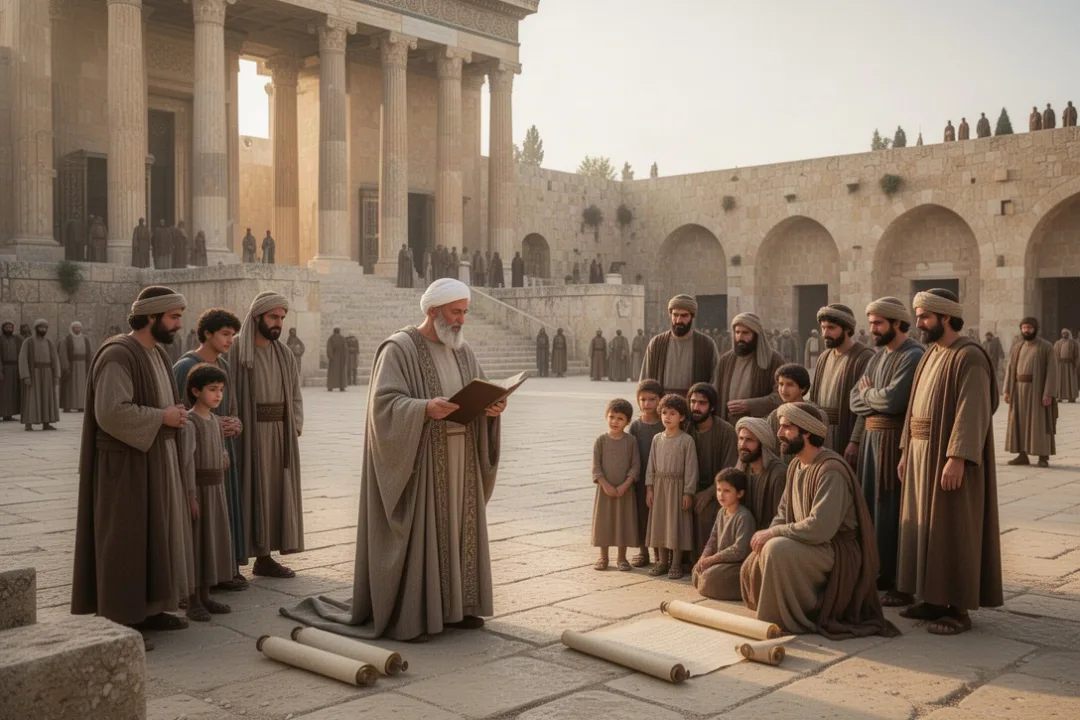
Ezra is identified as a priest descended from Aaron and as a skilled scribe in the Law of Moses. Ezra 7 traces his priestly family line through several generations back to Aaron, Israel’s first high priest. The title “scribe” meant more than someone who copied documents. Ezra was trained in the study, interpretation, and teaching of God’s law.
The Bible describes Ezra as a man who had prepared himself to study the law of the Lord, practice it, and teach it to Israel. That three-part pattern helps explain his influence. He did not treat religious knowledge as merely academic. His authority came from learning Scripture, obeying it personally, and helping other people understand how it applied to their shared life.
Ezra arrived in Jerusalem during the reign of Artaxerxes, king of Persia. Many traditional timelines place his journey around 458 BC, although the relationship between Ezra’s and Nehemiah’s journeys is discussed by biblical scholars. The text itself presents Ezra as arriving after the first groups of exiles had returned and after the Jerusalem temple had been completed.
The larger setting began when Babylon destroyed Jerusalem and the temple, carried many people into exile, and ended the kingdom of Judah. Later, Persia conquered Babylon. The Persian ruler Cyrus allowed exiled Jewish people to return to Jerusalem and rebuild their temple, an event described at the beginning of Ezra.
Several stages shaped the restoration:
The first return took place under Sheshbazzar and Zerubbabel after Cyrus issued permission for exiles to go back.
The temple rebuilding faced opposition but eventually reached completion during the reign of Darius.
Ezra’s arrival brought renewed attention to the Law, worship, and the moral condition of the community.
Nehemiah’s later leadership focused strongly on Jerusalem’s walls, civic order, and further reforms.
Ezra therefore was not the person who initially rebuilt the temple. His distinctive role came later. He helped a restored but vulnerable population understand that returning to the land was not enough by itself. The people also needed to return to covenant faithfulness.
Helpful distinction: Zerubbabel is associated with the first return and the rebuilding of the temple, while Ezra is especially associated with teaching the Law and addressing the community’s covenant failures.
What happens in the Book of Ezra
The Book of Ezra records the return from exile, the reconstruction of the temple, and Ezra’s later mission. It combines official Persian documents, narrative history, lists of returnees, and Ezra’s own first-person account. The book is part of the historical material that describes how the Jewish community was reestablished in Jerusalem.
The first return and the rebuilding of the temple
Ezra begins with Cyrus’s decree permitting the Jewish exiles to return. Cyrus also returned temple vessels that Babylon had taken from Jerusalem. This detail shows that restoration involved more than people traveling home. The sacred objects were returned, worship could be renewed, and the temple could once again serve as the center of the community’s religious life.
Zerubbabel and Jeshua, the high priest, led the early restoration. The returning people rebuilt the altar first and began offering sacrifices. They then laid the foundation of the temple. Older people who remembered the former temple wept, while others shouted for joy. The mixed response reflects both grief over what had been lost and gratitude for a new beginning.
Local opposition interrupted the work for a period. The people opposing the project appealed to Persian officials and argued that Jerusalem had a history of rebellion. The rebuilding eventually resumed through prophetic encouragement from Haggai and Zechariah and through renewed authorization under King Darius.
The second temple was completed during Darius’s reign. The people celebrated its dedication with sacrifices and observed Passover. Ezra emphasizes that the restored temple was not simply a construction project. Its completion represented the recovery of public worship, priestly service, and communal identity after exile.
Ezra’s journey to Jerusalem
Ezra 7 introduces Ezra directly. The Persian king granted him permission to travel to Jerusalem with other exiles. The king’s authorization allowed Ezra to investigate conditions in Judah, teach the Law, appoint officials, and administer justice according to the law of God and the law of the empire.
The Persian document in Ezra 7 portrays Ezra as a trusted religious and administrative representative. It recognizes the God of Israel and provides support for temple worship. This does not mean Persia adopted Israel’s faith. It reflects the empire’s policy of supporting local religious institutions and maintaining order among its many peoples.
Ezra gathered the returning group near the river Ahava and proclaimed a fast. The travelers asked God for protection because they had spoken to the king about divine care but had not requested a military escort. Ezra then organized the transport of silver, gold, and temple equipment, assigning trusted priests and Levites to guard the valuables.
When Ezra reached Jerusalem, he delivered the king’s orders to the Persian officials and offered sacrifices. The people also celebrated Passover. These actions established Ezra as a leader responsible for both religious teaching and practical administration.
The community’s covenant crisis
Soon after his arrival, Ezra learned that some Israelites, priests, and Levites had married people from surrounding nations. The leaders reported that the community had not kept itself distinct from the peoples around it. Ezra reacted with grief, tearing his clothing, pulling hair from his head and beard, and sitting in shock.
The issue requires careful reading. Ezra’s concern was not a general statement that every person from another ethnic group was morally inferior. The biblical context focuses on the danger that the restored community would adopt religious practices contrary to Israel’s covenant with God. The concern was therefore tied to idolatry, faithfulness, and communal identity, not simply ancestry.
Ezra prayed publicly, confessing the community’s guilt before God. He recognized that the people had already experienced judgment through exile and yet had repeated behavior that threatened their restored relationship with God. His prayer does not place all blame on one group of individuals. Ezra speaks as part of the community and accepts shared responsibility.
The people responded by gathering in Jerusalem and agreeing to address the problem. Ezra 10 describes a process in which men who had taken foreign wives separated from them. The chapter includes names and a detailed list of families involved. The passage is difficult for modern readers because it describes painful family separations and does not provide every personal circumstance.
Responsible interpretation should acknowledge both the historical setting and the human cost. Ezra’s reforms were intended to protect a fragile covenant community after exile, but the narrative also presents a severe response to that crisis. Readers should not use this passage to justify racial prejudice, hostility toward immigrants, or coercive treatment of spouses. Its central concern is the community’s relationship with God in its own ancient covenant setting.
Why Ezra’s leadership mattered after the exile
Ezra’s leadership mattered because the exile had damaged more than Jerusalem’s buildings. It had disrupted worship, public authority, family structures, and the people’s understanding of their identity. Rebuilding the temple restored a physical center, but the community also needed shared instruction and moral direction.
Ezra brought attention back to the Law of Moses as the foundation for public life. The book does not portray him as creating a new religion. Instead, he sought to renew obedience to the covenant already given to Israel. His work joined the priest’s concern for worship with the scribe’s concern for careful teaching.
His leadership included several practical responsibilities:
Teaching Scripture: Ezra was prepared to explain God’s law and help the people understand its demands.
Leading confession: He modeled honest acknowledgment of communal sin rather than minimizing failure.
Supporting worship: He helped organize sacrifices, temple service, and celebrations such as Passover.
Working within government: He used the authorization of the Persian king while serving the religious needs of Judah.
Preserving communal identity: He addressed practices that he believed threatened Israel’s covenant faithfulness.
Ezra also demonstrates that religious leadership requires both conviction and preparation. The book presents him as someone who studied before he taught, acted before he demanded action, and prayed before making major decisions. These details make his leadership more substantial than public authority alone.
Central idea: Ezra shows that restoration is not complete when people recover a place or institution. Faithful restoration also requires truth, repentance, instruction, and daily obedience.
The book also highlights the importance of cooperation. Ezra did not restore Jerusalem by himself. Priests, Levites, family leaders, returning exiles, Persian officials, prophets, and local workers all appear in the wider story. The community’s survival depended on people accepting different responsibilities rather than expecting one leader to solve every problem.
Ezra’s major themes and spiritual meaning
God’s faithfulness during political change
The Book of Ezra repeatedly places Israel’s restoration within the actions of Persian kings. Cyrus, Darius, and Artaxerxes issue decrees or provide support for the Jewish community. At the same time, the book presents God as directing events and keeping promises made through the prophets.
This does not mean every Persian official understood Israel’s God in the same way. It means the narrative sees God working through changing empires and unexpected political decisions. The people who had lost their land and temple were not abandoned. Their restoration unfolded through ordinary administrative orders, financial support, travel permissions, and human cooperation.
Repentance as a community responsibility
Ezra’s prayer teaches that repentance can be communal. He confesses the sins of the people even though the text does not say he personally committed the offenses under discussion. His response reflects solidarity: leaders do not stand outside the moral condition of the people they serve.
That approach differs from blame shifting. Ezra does not make excuses based on political pressure, recent suffering, or the behavior of previous generations. He recognizes the seriousness of disobedience while also remembering God’s mercy. The tension between guilt, judgment, mercy, and hope is one of the book’s central spiritual features.
Scripture and practice belong together
Ezra’s example emphasizes that studying the Bible should lead to action. The biblical description of his preparation moves from study to practice to teaching. Knowledge that never affects worship, ethics, relationships, or decisions has not yet accomplished the purpose Ezra’s life represents.
His method also suggests that teaching requires care. A scribe had to preserve the text, understand its meaning, and communicate it to people who needed guidance. Ezra’s model is not merely “know more Bible.” It is learn accurately, live consistently, and teach responsibly.
Restoration can expose new problems
The returning exiles had reason to celebrate, yet the restored community still faced serious failures. The Book of Ezra does not present return from exile as an instant cure. New buildings, renewed ceremonies, and political stability did not remove the need for correction.
This theme gives the book a realistic view of renewal. A fresh start can reveal problems that were hidden during crisis. Once the community had a temple and organized leadership, questions about worship, marriage, identity, justice, and obedience became unavoidable. Restoration created opportunities, but it also created responsibilities.
How Ezra relates to Nehemiah and the rest of the Bible
Ezra and Nehemiah are closely connected. In the Hebrew Bible, they were traditionally treated as one continuous work, although modern Bibles usually print them as two books. Ezra emphasizes temple restoration and covenant teaching, while Nehemiah focuses more heavily on rebuilding Jerusalem’s walls and organizing the city.
The two leaders served in different ways. Ezra was primarily a priest and teacher; Nehemiah was a royal cupbearer who became a governor and civic leader. Their ministries overlapped, and both addressed problems within the restored community. Together, their books show that religious renewal and public reconstruction needed to support one another.
Ezra also belongs to the larger biblical story of exile and return. The books of Kings explain why Judah went into exile. The prophets, including Isaiah, Jeremiah, Ezekiel, Haggai, Zechariah, and Malachi, speak about judgment, restoration, worship, and the future of God’s people. Ezra records part of the historical outworking of those themes.
The Book of Ezra contains passages in both Hebrew and Aramaic. Aramaic was widely used in the Persian Empire and appears especially in official correspondence and administrative material. The language shifts reinforce the book’s setting within an international empire where local religious life was regulated through imperial documents.
The identity of the book’s final compiler or author is not stated with certainty. Because large portions of Ezra 7–10 are written in the first person, many readers connect the narrative closely with Ezra’s own records or memoirs. Still, the Bible does not explicitly claim that Ezra wrote every part of the book, so it is best to distinguish the historical figure from questions about the book’s complete composition.
Ezra’s influence continues in later Jewish tradition, where he is remembered as a major teacher and guardian of the Torah. The biblical account itself keeps the focus on his work in Jerusalem: restoring understanding of the Law, leading confession, and helping a vulnerable community live as God’s people.
What readers can learn from Ezra today
Ezra’s story offers practical lessons for anyone involved in teaching, worship, or community leadership. His example begins with preparation rather than visibility. He studied the Law before attempting to instruct others, and his personal practice gave weight to his public teaching.
His response to communal failure also offers a model of responsible leadership. Ezra did not treat sin as someone else’s problem. He grieved, prayed, confessed, and helped the community take concrete action. At the same time, modern readers should apply the narrative with care, recognizing the ancient covenant setting and refusing to turn its concerns into ethnic hostility.
Several principles stand out:
Build on truth: Lasting renewal requires honest engagement with Scripture and reality, not selective memory.
Let knowledge shape conduct: Study becomes meaningful when it influences decisions and relationships.
Accept shared responsibility: Leaders can confess communal problems without pretending they are personally blameless.
Expect restoration to require work: A new beginning often brings difficult questions that must be addressed patiently.
Use authority carefully: Ezra worked within political structures but kept his central responsibility focused on God’s law.
Protect people from harmful applications: Ancient passages about covenant boundaries must not be used to promote racism or abuse.
Ezra’s story is especially relevant when a community is rebuilding after loss. Institutions may need repair, but people also need shared standards, trustworthy teaching, honest repentance, and wise leadership. The book insists that spiritual renewal is not merely emotional or architectural. It involves the difficult work of aligning community life with deeply held convictions.
The most concise description of Ezra’s contribution is this: he helped a displaced people become a taught and accountable community again. He did so through study, obedience, worship, prayer, and reform. His story remains significant because it shows how restoration depends not only on returning home, but also on learning how to live faithfully there.
Frequently asked questions
Was Ezra a prophet in the Bible?
Ezra is not usually classified as one of Israel’s writing prophets. The Bible presents him primarily as a priest and scribe who taught the Law, led worship, and guided reforms in Jerusalem. Prophets such as Haggai and Zechariah supported the earlier temple rebuilding, while Ezra’s main work involved Scripture, confession, and covenant practice.
Did Ezra rebuild the temple in Jerusalem?
No. The first group of returning exiles rebuilt the temple under leaders including Zerubbabel and Jeshua. The temple was completed before Ezra arrived in Jerusalem. Ezra’s later contribution was to strengthen the community through teaching the Law, organizing worship, and confronting practices he believed threatened Israel’s covenant identity.
What is the main message of the Book of Ezra?
The book emphasizes that God restored the Jewish people after exile and enabled them to rebuild the temple. It also shows that physical restoration needed to be followed by spiritual renewal. Worship, Scripture, repentance, and faithful community life were essential parts of returning to Jerusalem and living there responsibly.
Why is Ezra’s response to intermarriage difficult for modern readers?
Ezra’s reforms arose in the ancient setting of a small postexilic community concerned about religious assimilation and covenant identity. The passage is painful because it describes family separations and gives limited personal detail. It should not be used to support racism, ethnic hatred, or coercion. Careful interpretation distinguishes its historical concern from modern prejudice.







Leave a Reply