If you searched for “jérémiah”, you are probably looking for Jeremiah, the biblical prophet and the book named after him. In standard English, the name is spelled without an accent: Jeremiah. The accented form may reflect a pronunciation, transliteration, or spelling used in another language, but it generally points to the same person and biblical text.
Jeremiah lived during one of Judah’s most unsettled periods. He warned that Jerusalem would fall because the nation had abandoned faithfulness to God, yet he also proclaimed forgiveness, a new covenant, and restoration. His message is not simply about disaster. It holds together public responsibility, personal grief, honest prayer, and the possibility of renewal after judgment.
Quick answer: Jeremiah was a prophet from Anathoth who served Judah before and during the destruction of Jerusalem by Babylon. His book explains why that catastrophe came and points toward a future in which God would restore his people.
Jeremiah came from Anathoth, a priestly town in the territory of Benjamin near Jerusalem. The opening chapter identifies him as the son of Hilkiah and describes his prophetic calling as beginning during the reign of King Josiah. His ministry continued through the reigns of several kings, including Jehoahaz, Jehoiakim, Jehoiachin, and Zedekiah.
His lifetime overlapped with the rise of the Babylonian Empire. Assyria had dominated the region, but Babylon eventually became the major power in the ancient Near East. Judah found itself caught between competing empires, while its leaders debated whether to resist Babylon, seek help from Egypt, or submit temporarily.
Jeremiah did not treat the political crisis as only a military problem. He argued that Judah’s social injustice, idolatry, corruption, and refusal to change had created a deeper spiritual crisis. Foreign invasion was presented as judgment for persistent unfaithfulness, not as proof that Babylon’s gods were stronger than the God of Israel.
According to the book, Jeremiah was called while he felt too young and unprepared for public responsibility. God’s response was not that Jeremiah would find the work easy. Instead, he was told that his authority would come from the message entrusted to him. The calling included both destructive and constructive work: tearing down and uprooting, but also building and planting.
Why Jeremiah warned Jerusalem about Babylon
Jeremiah’s central warning was that Jerusalem could not depend on its temple, royal traditions, or military alliances while continuing to practice injustice. In the Temple Sermon in chapter 7, he challenged people who treated the temple as a guarantee of safety while exploiting vulnerable people and worshiping other gods.
His criticism was direct. He condemned the mistreatment of foreigners, orphans, and widows, along with violence and dishonest conduct. Religious rituals did not cancel out harmful behavior. For Jeremiah, genuine devotion had to appear in ethical treatment of neighbors and in loyalty to God.
Many people wanted a message of national security. Some prophets claimed that Babylon would soon be defeated and that Jerusalem would remain safe. Jeremiah opposed those assurances. He used a wooden yoke as a visible sign of Babylon’s temporary authority, while another prophet, Hananiah, dramatically broke it and predicted a quick reversal.
The conflict showed why Jeremiah was unpopular. He was not comforting people with the outcome they wanted. He believed that false optimism could cause greater harm by preventing the nation from facing reality. His warnings were sometimes interpreted as treason because they challenged resistance to Babylon and questioned the decisions of Judah’s leaders.
Jeremiah’s position was not admiration for Babylon. He did not present the empire as morally innocent. The book later announces judgment against Babylon as well. His point was that Judah needed to understand the consequences of its own choices and accept a period of discipline rather than assume that political defiance would solve everything.
What the book of Jeremiah contains
The book of Jeremiah is not arranged like a modern biography. It combines prophetic speeches, symbolic actions, prayers, historical scenes, poetic warnings, and promises of restoration. Events and messages are sometimes presented in an order that differs from the sequence of the kings’ reigns.
Jeremiah 1 describes the prophet’s calling. Chapters 2 through 6 contain accusations against Judah and warnings about approaching disaster. The Temple Sermon appears in chapter 7, followed by reflections on judgment, leadership, and the stubbornness of the people.
Chapters 11 through 20 include some of Jeremiah’s most personal prayers, often called his confessions. He speaks openly about rejection, fear, loneliness, and anger. These passages help readers see that prophetic faithfulness did not remove emotional pain.
Chapters 21 through 29 focus heavily on kings, false prophets, Babylonian rule, and the experience of exile. Chapter 29 contains Jeremiah’s letter to the people already taken to Babylon. He tells them to establish ordinary lives there, seek the welfare of the city, and wait for God’s appointed restoration rather than trusting sensational predictions.
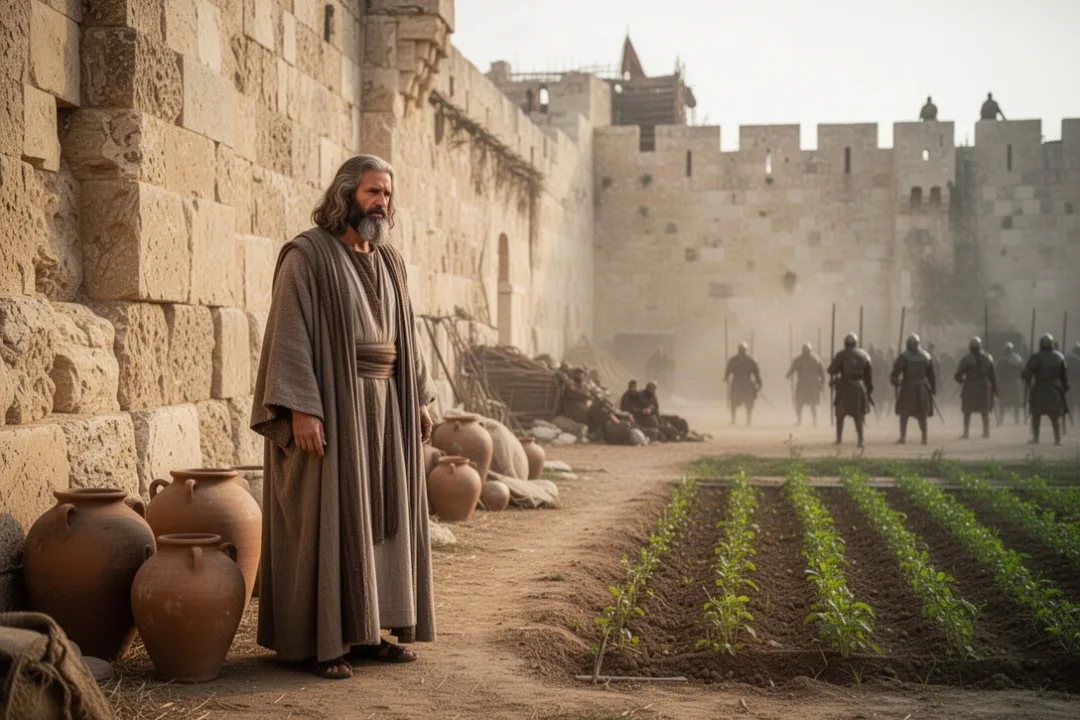
Chapters 30 through 33 are often called the Book of Consolation. They contain promises concerning the return of exiles, the rebuilding of the nation, renewed joy, restored land, and a new covenant. Jeremiah 32 includes the surprising account of the prophet buying a field while Jerusalem was under siege, turning a real estate purchase into a sign of future hope.
Chapters 34 through 45 return to the final years of Judah, the fall of Jerusalem, Jeremiah’s imprisonment, and the aftermath of the catastrophe. The final chapters pronounce judgment on several nations, including Babylon, and chapter 52 provides a historical account of Jerusalem’s fall and the later release of King Jehoiachin.
How Jeremiah’s major themes speak to readers
Judgment includes moral responsibility
Jeremiah does not describe judgment as random bad luck. His message connects national collapse with idolatry, exploitation, violence, dishonest leadership, and broken promises. The prophet repeatedly rejects the idea that public worship can excuse private or political wrongdoing.
This theme remains relevant whenever people separate religious identity from conduct. Jeremiah asks difficult questions: Are the vulnerable protected? Are leaders truthful? Are promises kept? Does worship produce justice, humility, and mercy? His criticism reaches both institutions and individuals, but it especially confronts those with authority.
Religious symbols cannot replace faithfulness
The people of Judah trusted the presence of the temple in Jerusalem. Jeremiah challenged that confidence because sacred places and ceremonies had become a substitute for changed behavior. The temple itself was not the problem. The problem was using it as a guarantee against consequences while ignoring the demands of covenant faithfulness.
That warning can apply to any religious community. A building, title, tradition, membership, or public identity may have genuine value, but none automatically proves that a community is living well. Jeremiah directs attention away from appearances and toward the character of everyday life.
Honest prayer can include protest
Jeremiah’s prayers are unusually candid. He asks why the wicked seem to prosper, complains about hostility, describes his isolation, and expresses deep exhaustion. These passages do not present faith as constant emotional calm. They show a person bringing confusion and pain into conversation with God.
The prophet’s example gives readers permission to pray honestly without pretending that suffering is easy. His prayers are not casual complaints detached from faith. They arise from his commitment to his calling and from his struggle to understand what that calling is costing him.
Hope can exist during a long crisis
Jeremiah’s hope is not based on an immediate escape from trouble. The letter to the exiles assumes that displacement will last for a substantial period. The people are told to build houses, plant gardens, form families, and seek the peace of the place where they live.
This message corrects a common misunderstanding of Jeremiah 29. The promise in that chapter was given to a community in exile, not as a simple guarantee of quick personal success. Its hope concerns God’s continuing purpose over time, even when the present situation cannot be changed quickly.
The new covenant addresses the heart
Jeremiah 31 contains the book’s best-known promise about a new covenant. In paraphrase, the promise says that God’s instruction will no longer remain only as an external command; it will be written within the people, and they will know God in a deeper and more direct way.
The passage also emphasizes forgiveness. Restoration is not merely a return to land or political stability. It involves an inner renewal that changes the relationship between God and the people. Later Jewish and Christian traditions have interpreted this promise in different ways, but its basic theme is clear: lasting restoration requires more than repairing outward circumstances.
Jeremiah often communicated through visible actions that made an abstract warning concrete. These actions were not theatrical decoration. They gave people images they could remember, especially when spoken words were ignored.
The almond branch: In chapter 1, Jeremiah sees an almond branch in a vision. The Hebrew wordplay connects the tree with the idea of watching, pointing to God’s alertness and active attention to events.
The boiling pot: Another vision in chapter 1 depicts danger coming from the north. It represents the direction from which invasion would threaten Judah.
The linen belt: In chapter 13, a ruined belt illustrates how pride and disobedience had spoiled the closeness Judah was meant to have with God.
The potter’s work: Chapter 18 describes a potter reshaping clay. The image highlights God’s authority to respond to a nation’s conduct and to reshape his purposes rather than treating history as fixed.
The broken jar: In chapter 19, a shattered jar represents the severity of coming judgment and the consequences of refusing correction.
The wooden yoke: Chapters 27 and 28 use a yoke to represent Babylonian control and to challenge popular predictions of a rapid national victory.
The purchased field: In chapter 32, Jeremiah buys land during the siege. The deed becomes a sign that houses, fields, and vineyards will again have a future in the land.
These signs also show that Jeremiah’s message was not limited to speeches. His life, possessions, and public behavior became part of the communication. The field purchase is especially striking because it joins clear-eyed realism with durable hope: the city is in danger, but the future is not erased.
How Jeremiah suffered for delivering his message
Jeremiah faced opposition from priests, officials, prophets, kings, and members of his own community. He was threatened in Anathoth, rejected by influential people, placed in stocks, confined in the palace complex, and lowered into a muddy cistern. His opponents sometimes treated him as a danger to national morale.
His imprisonment was not always a single continuous experience. The narrative describes different settings and forms of restriction as the crisis developed. At one point, officials accused him of weakening the soldiers and the people because he urged surrender to Babylon. He was eventually rescued from the cistern by Ebed-melech, an official from Cush.
Jeremiah’s suffering gives the book a personal dimension that many prophetic texts do not emphasize as strongly. He did not deliver warnings from a safe distance. He experienced the rejection, danger, and uncertainty produced by the message he carried.
At the same time, the book does not portray him as emotionally detached or perfectly confident. His prayers reveal moments when he wanted to stop speaking. Yet he continued because silence did not resolve the calling. His faithfulness consisted partly in bringing his distress to God rather than hiding it.
What happened when Jerusalem fell
Jerusalem was eventually captured by Babylon, and the temple was destroyed. King Zedekiah was taken captive after attempting to escape. Many people were killed, deported, or displaced, while others remained in the land under Babylonian administration.
The fall of Jerusalem could have been interpreted as the end of Judah’s relationship with God. Jeremiah’s message rejects that conclusion. Judgment is severe, but it is not the final word. The book preserves promises that exiles will return, the land will be restored, and the relationship between God and the people will be renewed.
After the Babylonian governor Gedaliah was appointed, he was assassinated. The remaining people feared Babylonian retaliation and asked Jeremiah to seek God’s guidance. Although they promised to obey the answer, they later rejected it and fled to Egypt, taking Jeremiah with them. The book ends this part of his story in Egypt, amid continued conflict and warnings.
The narrative therefore avoids a neatly resolved ending. Jeremiah does not receive a comfortable retirement after his predictions come true. His life remains complicated even after Jerusalem falls. That unfinished quality reflects the book’s larger message: historical judgment can occur, but restoration and obedience still require time and response.
Read Jeremiah in context: A promise of restoration should not be separated from the chapters about injustice, exile, repentance, and patient waiting. Jeremiah’s hope is substantial, but it is not a shortcut around accountability or suffering.
Common mistakes when reading Jeremiah
Jeremiah is a long and emotionally intense book, so readers can easily misunderstand individual passages by isolating them. These practical guidelines help keep the prophet’s words connected to their setting and purpose.
Do not treat Jeremiah as a chronological biography. The book gathers messages and events by theme as well as by time. Use the reigns of the kings as historical markers, but expect the sequence to move.
Do not reduce the book to bad news. Warnings dominate many chapters, yet the promises of return, forgiveness, a new covenant, and restored community are central to its message.
Do not read Jeremiah 29 as an instant prosperity promise. The original audience was living in exile and was told to wait, work, and seek the welfare of its surrounding city.
Do not assume Jeremiah enjoyed predicting disaster. His prayers show grief, loneliness, and anguish. He warned because he believed the people needed truth, not because he welcomed their suffering.
Do not ignore the social dimension of sin. The book repeatedly connects faithfulness with justice, honest leadership, care for the vulnerable, and rejection of violence.
Do not confuse Jeremiah with the book of Lamentations. The two works share themes of Jerusalem’s destruction, and tradition has associated Lamentations with Jeremiah, but they are separate biblical books.
Do not read every promise as addressed directly to one modern individual. Many passages speak first to Judah, Jerusalem, or the exiled community. Application requires attention to the original audience.
Do not overlook the symbolic actions. The belt, yoke, potter, jar, and field are not side details. They often explain the message more clearly than a speech alone.
A practical way to study the book of Jeremiah
Reading Jeremiah from beginning to end is worthwhile, but its length and changing style can make sustained attention difficult. A simple plan can help you notice both the historical movement and the repeated themes.
Start with the calling in chapter 1. Notice the images of the almond branch and boiling pot, along with the commission to uproot, tear down, build, and plant.
Read the Temple Sermon in chapters 7 and 26 together. One presents the message; the other shows the danger Jeremiah faced after delivering it.
Compare Jeremiah with the kings’ responses. Watch how Josiah, Jehoiakim, and Zedekiah respond differently to reform, warning, and political pressure.
Read the personal prayers in chapters 11 through 20. Mark the places where Jeremiah expresses fear, anger, exhaustion, or renewed commitment.
Study chapters 27 through 29 as a group. This makes the dispute over Babylon, the false promises of quick deliverance, and the letter to the exiles easier to understand.
Read chapters 30 through 33 slowly. Look for the relationship between judgment, return, forgiveness, restored land, and the new covenant.
Finish with chapters 34 through 52. These chapters connect the prophet’s warnings with the fall of Jerusalem and the political consequences that followed.
As you read, keep a two-column note: one side for what the people are doing, and the other for what God promises or requires. This makes it easier to see that Jeremiah’s message is not only prediction. It is an argument about responsibility, repentance, justice, and hope.
How Jeremiah applies to personal and public life
Jeremiah can challenge personal habits, but the book should not be reduced to private inspiration. Its strongest concerns include leaders, institutions, public trust, economic behavior, and the treatment of people with less power. The prophet asks what happens when a society uses religious language while tolerating exploitation.
For personal reflection, Jeremiah invites you to examine the difference between outward identity and inward faithfulness. It is possible to rely on labels, routines, or associations while resisting correction. The book calls for a more serious kind of self-examination: What practices shape your decisions? Whose interests do your choices protect? Where have you confused comfort with peace?
For communities, Jeremiah encourages truthful speech during a crisis. Leaders may prefer reassuring predictions, but responsible guidance sometimes requires acknowledging loss, delay, and limits. The prophet’s example does not authorize harshness for its own sake. It supports honest words that are directed toward repentance and the common good.
For people living through displacement or uncertainty, the letter to the exiles offers a grounded pattern. Build a life where you are, seek the welfare of the wider community, and do not let false promises control your expectations. Hope can be active and patient rather than passive or sensational.
Jeremiah’s lasting force comes from the way it holds difficult truths together. A community can be accountable and still be loved. A prophet can be faithful and still be afraid. A nation can experience judgment and still have a future. A person can pray with pain and remain in relationship with God.
Why Jeremiah remains a significant biblical book
Jeremiah speaks to readers who have seen institutions fail, leaders make harmful decisions, or cherished assumptions collapse. It refuses easy explanations, but it also refuses despair. The book recognizes that destruction can be deserved, that suffering can be real, and that restoration may take longer than anyone wants.
The name Jérémiah may be spelled differently in your search or tradition, but the biblical figure it identifies is the same Jeremiah whose life bridged warning and hope. He called Judah to face the truth about its actions, endured rejection for doing so, and preserved a vision of renewal that extended beyond the crisis of his own generation.
When you read Jeremiah, pay attention to the movement from corruption to accountability, from exile to return, and from external religion to a transformed heart. Those movements explain why the book remains both demanding and hopeful.
Frequently asked questions
Is Jérémiah the same name as Jeremiah?
Yes. “Jeremiah” is the standard English spelling of the biblical prophet’s name. “Jérémiah” may reflect a language-specific spelling, an accent added for pronunciation, or a personal naming preference. Both forms generally refer to the prophet from Anathoth and the biblical book associated with his ministry.
What is Jeremiah best known for?
Jeremiah is best known for warning Judah that Jerusalem would fall to Babylon because of persistent injustice, idolatry, and unfaithfulness. He is also remembered for his personal prayers, his opposition to false prophets, the letter to the exiles, the promise of a new covenant, and his symbolic purchase of a field during the siege.
Did Jeremiah write the entire book named after him?
The book identifies Jeremiah as the source of many messages and names Baruch as a scribe who wrote or preserved prophetic material. The book also includes historical narratives and an appendix, so its final form reflects collected traditions and editorial arrangement rather than necessarily being a single work written personally by Jeremiah from beginning to end.
Where should someone begin reading Jeremiah?
Begin with chapters 1, 7, 18, 29, 31, and 32. These passages introduce Jeremiah’s calling, his temple warning, the potter image, his message to exiles, the new covenant, and the field purchase that symbolizes future restoration. Afterward, read the book in larger sections to understand its historical development.








Leave a Reply