Why the books of the Old Testament are arranged in this order
The order of the Old Testament is not simply a timeline from the beginning of the world to the end of Israel’s history. It combines historical sequence, literary genre, and long-established biblical traditions. The first five books establish creation, covenant, law, and Israel’s identity; the books that follow describe the nation’s history, poetry, and prophetic ministry.
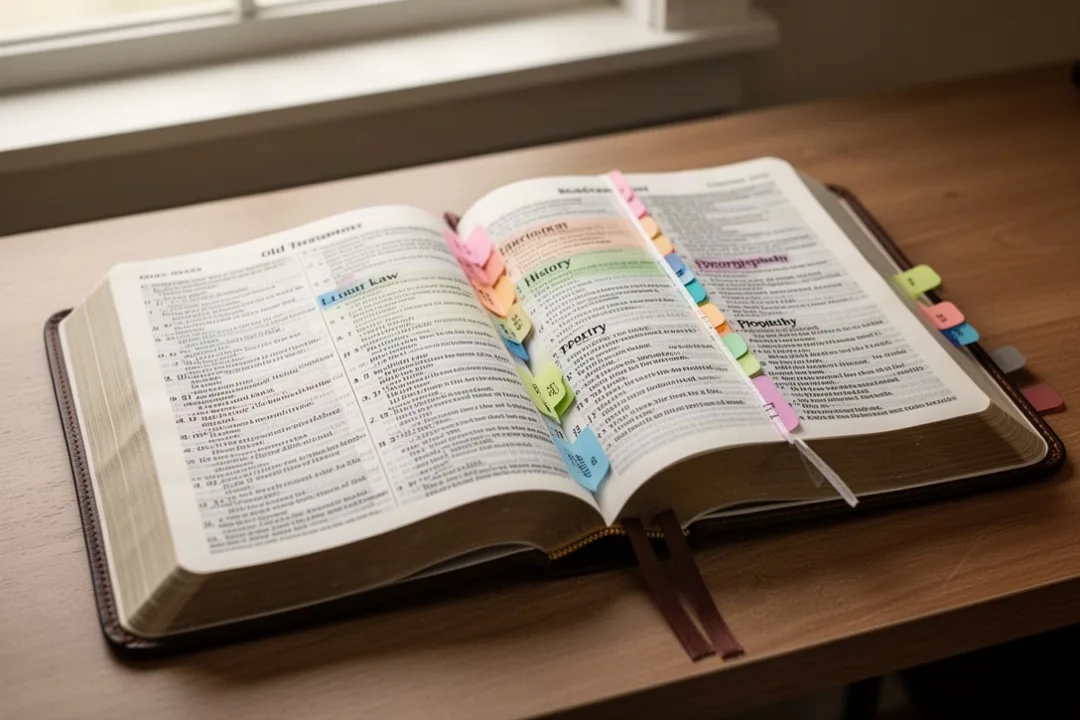
Most English Protestant Bibles use the same 39-book arrangement. The books are commonly grouped into five sections: the Pentateuch, historical books, wisdom and poetry, the Major Prophets, and the Minor Prophets. “Major” and “Minor” refer mainly to the length of the books, not to their spiritual importance.
Important distinction: Protestant Bibles list 39 Old Testament books, while Catholic and Orthodox Bibles include additional books or passages known as the Deuterocanonical or Anagignoskomena books. The order below follows the standard Protestant arrangement.
The 39 books of the Old Testament in order
Here is the complete list in the order used by most Protestant English Bibles:
Genesis
Exodus
Leviticus
Numbers
Deuteronomy
Joshua
Judges
Ruth
1 Samuel
2 Samuel
1 Kings
2 Kings
1 Chronicles
2 Chronicles
Ezra
Nehemiah
Esther
Job
Psalms
Proverbs
Ecclesiastes
Song of Solomon
Isaiah
Jeremiah
Lamentations
Ezekiel
Daniel
Hosea
Joel
Amos
Obadiah
Jonah
Micah
Nahum
Habakkuk
Zephaniah
Haggai
Zechariah
Malachi
Books 1–5: the Pentateuch
The first five books are called the Pentateuch, a term meaning “five books.” They are also known as the Torah, especially in Jewish tradition. Together, they describe the origins of the world, the ancestors of Israel, the exodus from Egypt, the covenant at Sinai, and Israel’s preparation to enter the promised land.
Genesis: Covers creation, the fall of humanity, the flood, the tower of Babel, and the lives of Abraham, Isaac, Jacob, and Joseph. Its central movement is from the universal story of humanity to the family through which God’s covenant purposes continue.
Exodus: Tells how God delivers the Israelites from slavery in Egypt. It also presents the Sinai covenant, the Ten Commandments, instructions for worship, and the construction of the tabernacle.
Leviticus: Focuses on sacrifices, priesthood, ritual cleanness, holy living, and the relationship between God’s presence and Israel’s worship. The book emphasizes that the covenant community is to be set apart.
Numbers: Follows Israel’s journeys and repeated failures in the wilderness. Its name comes from the censuses recorded in the book, while its broader story concerns rebellion, judgment, leadership, and preparation for a new generation.
Deuteronomy: Records Moses’ final speeches before Israel enters Canaan. It reviews the law, renews the covenant, calls Israel to faithful obedience, and ends with Moses’ death.
These books provide the foundation for the rest of the Old Testament. Later historical books assume the importance of the exodus, the covenant, the law, and the land promised to Israel’s ancestors.
Books 6–17: the historical books
The next twelve books describe Israel’s life in the land, the rise and division of the monarchy, the exile, and the return. They are historical in subject, but they also interpret events through the themes of faithfulness, justice, leadership, and covenant responsibility.
Joshua: Describes Israel’s entrance into Canaan under Joshua’s leadership, including major battles, the distribution of the land, and a covenant renewal.
Judges: Presents a repeating pattern of Israel’s disobedience, oppression, cries for help, deliverance through a judge, and renewed disobedience. The judges include Deborah, Gideon, Jephthah, and Samson.
Ruth: Tells the story of Ruth, Naomi, and Boaz during the period of the judges. It highlights loyalty, redemption, family responsibility, and Ruth’s place in the ancestry of King David.
1 Samuel: Covers Samuel’s leadership, Israel’s demand for a king, Saul’s reign, and David’s emergence as Saul’s successor.
2 Samuel: Focuses on David’s reign as king, his successes, his serious moral failure, and the political and family turmoil that follows.
1 Kings: Begins with Solomon’s reign and the building of the temple, then describes the kingdom’s division into Israel in the north and Judah in the south. The prophet Elijah is a major figure.
2 Kings: Continues the histories of the divided kingdoms and ends with the fall of Israel and Judah, including Jerusalem’s destruction and the Babylonian exile.
1 Chronicles: Retells Israel’s story with special attention to genealogies, David’s reign, worship, the priesthood, and preparations for the temple.
2 Chronicles: Continues the account through Solomon and the kings of Judah. It ends with the exile and the decree allowing the people to return and rebuild.
Ezra: Describes the return from exile, the rebuilding of the temple, and Ezra’s efforts to teach and restore the law among the returned community.
Nehemiah: Tells how Nehemiah leads the rebuilding of Jerusalem’s walls and helps renew the community’s covenant commitments.
Esther: Takes place among Jews living in the Persian Empire. Esther and Mordecai act to prevent the destruction of their people, and the book explains the origin of the festival of Purim.
Several books overlap in time or retell earlier events from a different perspective. 1 and 2 Chronicles, for example, cover much of the same broad period as Samuel and Kings, but they emphasize Judah, the temple, worship, and the Davidic line.
The five books from Job through Song of Solomon are often called wisdom literature or poetry. They do not continue Israel’s national story in a straightforward way. Instead, they explore suffering, worship, wise conduct, mortality, love, justice, and the meaning of life.
Job: Examines the suffering of a righteous man and the limits of human understanding. Its speeches wrestle with questions about justice, grief, and God’s sovereignty.
Psalms: A collection of songs and prayers used in worship and personal devotion. The Psalms include praise, lament, thanksgiving, confession, wisdom, and confidence in God.
Proverbs: Offers practical wisdom about speech, work, money, relationships, discipline, integrity, and the fear of the Lord. Many sections use short sayings designed for reflection and instruction.
Ecclesiastes: Reflects on work, pleasure, achievement, injustice, aging, and death. Its observations press readers to recognize the limits of earthly pursuits and the importance of reverence before God.
Song of Solomon: Uses poetic language to celebrate love, desire, beauty, and marital affection. It is also called the Song of Songs.
The position of these books helps explain why the Old Testament does not read like one continuous biography. After the historical narrative reaches the postexilic period, the wisdom books turn toward human experience and worship rather than following a single national timeline.
Reading tip: Poetry often uses images, parallel lines, and emotional language. Read a psalm or proverb by asking what kind of writing it is before treating every line as a direct historical statement.
Books 23–27: the Major Prophets
The Major Prophets are Isaiah, Jeremiah, Lamentations, Ezekiel, and Daniel. Their writings are longer than those of the Minor Prophets, but “major” does not mean more authoritative. These books address judgment, repentance, exile, restoration, God’s holiness, and hope for the future.
Isaiah: Combines warnings of judgment with promises of restoration. It addresses Judah’s sin, the threat from foreign powers, God’s holiness, the future of Zion, and the hope of a servant who brings salvation.
Jeremiah: Proclaims judgment on Judah while calling the people to repentance. The book also contains promises of restoration and a renewed covenant, alongside accounts of Jeremiah’s opposition and suffering.
Lamentations: A collection of poetic grief over Jerusalem’s destruction. It gives structured expression to sorrow while continuing to seek God’s mercy in the midst of devastation.
Ezekiel: Ministers among the exiles in Babylon through visions, symbolic actions, and prophetic messages. Major themes include God’s glory, personal responsibility, judgment, restoration, and a renewed temple vision.
Daniel: Combines stories of faithful living in exile with visions about kingdoms, conflict, judgment, and God’s ultimate rule. Daniel and his companions face pressure to abandon their loyalty to God.
The prophets should not be read only as predictions of distant events. They also spoke directly to real communities facing idolatry, injustice, political crisis, and exile. Their messages often move between immediate historical judgment and broader promises of restoration.
Books 28–39: the Minor Prophets
The final twelve books are known collectively as the Minor Prophets, or the Twelve. They are shorter than the Major Prophets, but they cover substantial themes: oppression, false worship, pride, foreign nations, repentance, restoration, and the day of the Lord.
Hosea: Uses Hosea’s troubled marriage as a sign of Israel’s unfaithfulness and presents God’s persistent love alongside a call to return.
Joel: Reflects on a devastating crisis and connects it with the day of the Lord, repentance, restoration, and the outpouring of God’s Spirit.
Amos: Condemns exploitation, corruption, empty religious ritual, and injustice against the poor. It calls for genuine righteousness and ends with a promise of restoration.
Obadiah: Announces judgment against Edom for its hostility and arrogance toward Judah, while affirming the Lord’s rule over the nations.
Jonah: Tells of a reluctant prophet sent to Nineveh. The book explores mercy, repentance, prejudice, and the breadth of God’s compassion.
Micah: Condemns corrupt leaders and exploitation while promising restoration. It calls for justice, faithful love, and humble walking with God.
Nahum: Announces the fall of Nineveh and presents judgment against a violent imperial power.
Habakkuk: Brings questions about violence and injustice before God. The prophet moves from confusion toward trust in God’s faithfulness.
Zephaniah: Warns of the day of the Lord, addresses sin in Judah and the nations, and promises purification and restoration for a humble remnant.
Haggai: Encourages the returned exiles to rebuild the temple and place the community’s worship at the center of its renewed life.
Zechariah: Uses visions and prophetic messages to encourage the postexilic community and speak of Jerusalem’s restoration, God’s rule, and future hope.
Malachi: Challenges careless worship, corrupt priestly practice, faithlessness, and injustice while calling the people back to covenant faithfulness.
Malachi is the last book in the usual Protestant Bible order. That placement gives the Old Testament a strong forward-looking ending, with unresolved expectations about renewal, judgment, faithful worship, and the Lord’s coming intervention.
How the Old Testament order differs from a timeline
If you arrange the books by the period they describe, you will find that the biblical order is not strictly chronological. For example, Job may reflect a setting associated with the patriarchal period, yet it appears after Esther because it belongs to the wisdom and poetry section. The Psalms were written and collected over a long period, although they are placed together as a poetry collection.
The prophetic books also fit into different historical settings. Isaiah and Micah ministered before Judah’s exile, Jeremiah lived through the crisis surrounding Jerusalem’s fall, Ezekiel spoke from Babylon, and Haggai, Zechariah, and Malachi addressed the postexilic community. Their location in the Bible reflects literary grouping more than exact chronology.
Chronicles also illustrates the difference between biblical order and historical sequence. It retells events found in Samuel and Kings, so it appears later in the canon even though much of its content describes earlier periods.
A simple way to memorize all 39 books
Memorizing the books is easier when you learn them in groups instead of as one uninterrupted list. Start with the five major sections, then practice each section aloud in order.
Learn the Pentateuch: Genesis, Exodus, Leviticus, Numbers, Deuteronomy.
Learn the historical books: Joshua through Esther.
Learn the wisdom books: Job, Psalms, Proverbs, Ecclesiastes, Song of Solomon.
Learn the Major Prophets: Isaiah, Jeremiah, Lamentations, Ezekiel, Daniel.
Learn the Minor Prophets: Hosea through Malachi.
Within the historical books, use smaller sequences: Joshua–Judges–Ruth, then 1 and 2 Samuel, 1 and 2 Kings, and 1 and 2 Chronicles. Finish with Ezra, Nehemiah, and Esther. This approach reduces the number of separate groups you need to recall.
For the last twelve books, practice the names in several short sets: Hosea through Jonah, Micah through Habakkuk, and Zephaniah through Malachi. Writing the list from memory, checking it, and repeating the exercise over several days usually works better than trying to memorize every name in one sitting.
How Catholic and Orthodox Old Testament lists compare
The number and arrangement of Old Testament books depend on the Christian tradition. A Catholic Bible normally includes 46 Old Testament books, counting Tobit, Judith, 1 Maccabees, 2 Maccabees, Wisdom, Sirach, and Baruch, along with additional sections in Esther and Daniel.
In a Catholic Bible, Tobit and Judith generally appear among the historical books, and 1 and 2 Maccabees follow them. Wisdom and Sirach appear among the wisdom writings, while Baruch is commonly placed after Lamentations. The additions to Esther and Daniel are included within those books rather than usually listed as separate books.
Orthodox traditions may include a somewhat different collection and order. Depending on the tradition, books such as 1 Esdras, 3 Maccabees, Psalm 151, or the Prayer of Manasseh may appear. Because these lists vary, the table of contents in a particular Bible is the best guide for that edition.
These differences do not change the order of the 39 books listed above in standard Protestant Bibles. They explain why two Bibles may have different total counts or place additional books in different locations.
The sequence creates a broad literary movement. Genesis through Deuteronomy establishes the covenant story; Joshua through Esther follows Israel’s life in the land and exile; Job through Song of Solomon gives poetic and wisdom reflection; and the prophets interpret Israel’s failures while pointing toward restoration.
The order also places the final prophetic voices after the histories and poetry. By the time you reach Malachi, the reader has encountered creation, covenant, kingship, worship, exile, suffering, wisdom, judgment, and hope. The final position of the Minor Prophets leaves the story open toward God’s future purposes rather than ending with a simple historical resolution.
When you read the books in order, pay attention to recurring themes rather than expecting each book to function in the same way. Look for covenant faithfulness, the meaning of holiness, the consequences of injustice, the role of worship, and the promise of restoration. Those themes connect books that differ greatly in style and historical setting.
Frequently asked questions
How many books are in the Old Testament?
Most Protestant Bibles contain 39 Old Testament books. Catholic Bibles generally contain 46 Old Testament books because they include seven additional books and additions to Esther and Daniel. Orthodox Bibles may contain a somewhat different collection, so the exact number depends on the biblical tradition and edition.
What is the first book of the Old Testament?
Genesis is the first book. It describes creation, the origins of humanity, the flood, the patriarchs, and Joseph’s family in Egypt. Genesis introduces the covenant promises that shape the rest of the Old Testament, especially the promises associated with Abraham, Isaac, and Jacob.
What is the last book of the Old Testament?
Malachi is the last book in the standard Protestant arrangement. It addresses careless worship, covenant unfaithfulness, and injustice, while also expressing hope for the Lord’s future work. Catholic and Orthodox Bibles may place different books last because their collections and canonical orders vary.
Why are the prophets not arranged in chronological order?
The biblical order groups the prophets largely by literary size and tradition rather than placing them in exact historical sequence. Isaiah, Jeremiah, Ezekiel, and the Twelve appear as major prophetic collections, even though they ministered during different periods. Reading their historical setting alongside the books of Kings and Chronicles can clarify when they spoke.







Leave a Reply