Ezekiel the prophet: visions, message, and meaning
Ezekiel the prophet: visions, message, and meaning
When you read Ezekiel and encounter wheels, strange creatures, dramatic actions, and a temple measured in detail, you may wonder what any of it has to do with ordinary faith. Ezekiel was a prophet who spoke to Jewish exiles in Babylon, warning them about the consequences of Jerusalem’s rebellion while also assuring them that God had not abandoned his people.
His message moves through judgment, grief, responsibility, hope, and restoration. Ezekiel does not present a simple prediction chart. He uses visions, parables, symbolic actions, and poetic accusations to explain why disaster came and what renewed life with God could eventually look like.
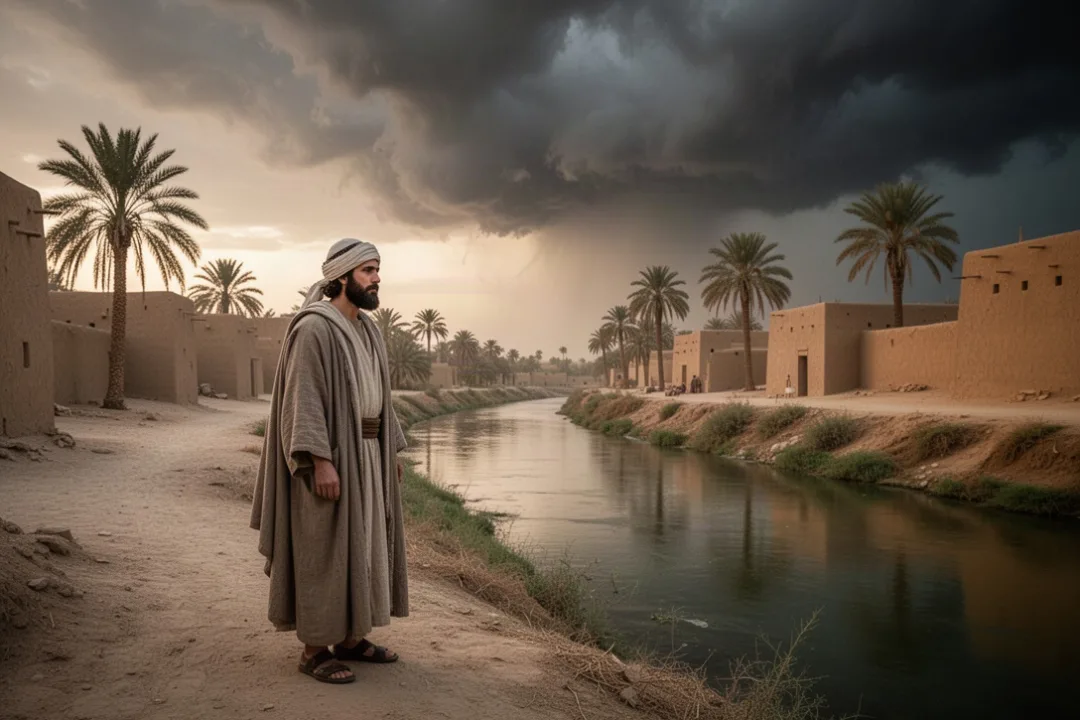
Ezekiel was a priest and prophet among the people of Judah. The opening of his book places him beside the Kebar Canal in Babylon during the fifth year of King Jehoiachin’s exile, generally dated to the early sixth century BCE. The book gives several dated messages, allowing readers to follow his ministry across the years of national upheaval.
Babylon had already captured Jerusalem’s king and taken many Judeans into exile when Ezekiel began speaking. A later Babylonian campaign brought the destruction of Jerusalem and its temple. Ezekiel’s work therefore took place among people who had lost their homeland, political independence, familiar worship, and confidence that the city could survive.
His priestly background helps explain the book’s strong interest in holiness, the temple, ritual boundaries, and God’s presence. Yet Ezekiel was not speaking only to priests. His audience included exiles, elders, community leaders, and ordinary families trying to understand whether their identity and relationship with God could continue outside Jerusalem.
Historical setting: Ezekiel spoke from Babylonian exile, not from a comfortable distance after the crisis had ended. His warnings addressed people who still hoped Jerusalem would escape destruction.
Why Ezekiel’s prophecies were difficult for his audience
Many exiles believed Jerusalem’s survival was still possible. False confidence could rest on several ideas: the city contained the temple, David’s royal line remained significant, and earlier promises seemed to protect the capital. Some people also assumed that the exiles were being punished while those who stayed in Jerusalem were the favored survivors.
Ezekiel challenged these assumptions. He argued that religious symbols could not protect a people committed to injustice and idolatry. The temple was not a magical shield. God’s presence was not a possession that Jerusalem could claim while ignoring covenant responsibilities.
At the same time, Ezekiel had to explain why the exiles should not give up hope. If the city fell and the temple was destroyed, would God still be present? Could the people become a people again? His prophecies answer yes, but only through a deep transformation rather than a quick return to former conditions.
This combination makes Ezekiel challenging. His message is severe because he addresses corruption that has become normal, but it is not hopeless. Judgment clears away false security, while restoration depends on renewed hearts, renewed worship, and a renewed community.
What Ezekiel’s opening vision reveals about God’s presence
The book begins with Ezekiel seeing a stormy manifestation of divine glory. The vision includes living beings, wheels associated with movement in every direction, and a radiant throne-like appearance above them. Readers often call these figures the cherubim, although Ezekiel’s description is more elaborate than the familiar decorative images associated with that word.
The vision’s purpose is larger than producing an unusual picture. It shows that God’s glory is not trapped in Jerusalem. The divine presence appears in Babylon, among displaced people, challenging the assumption that exile means God has become unreachable.
The wheels suggest mobility and purposeful movement. Ezekiel sees a glory that can move, observe, and act beyond the boundaries of the temple. The vision does not turn Babylon into a new holy city, but it does show that geography cannot limit God.
Ezekiel responds with fear and humility before receiving his commission. He is told to speak to a rebellious people whether they listen or refuse. That instruction defines much of his ministry: the prophet’s responsibility is faithful speech, not control over the audience’s response.
How Ezekiel’s symbolic actions communicate his warnings
Ezekiel often communicates through actions as well as words. These actions are not random performances. They make an invisible crisis visible and force the audience to confront the seriousness of what is happening.
Lying on his side: Ezekiel’s extended posture represents the accumulated guilt associated with Israel and Judah, presenting national wrongdoing as a burden that must be confronted.
Eating a scroll: The prophet receives God’s message inwardly before speaking it outwardly. The image connects prophecy with obedience, digestion, and personal absorption.
Shaving his hair: The divided hair represents the coming fate of Jerusalem’s inhabitants through violence, scattering, and survival by the narrowest margin.
Packing belongings for exile: Ezekiel acts out the forced departure of a people who may still believe they will remain safely in the city.
Refusing ordinary mourning: After the death of his wife, Ezekiel’s unusual response becomes a sign of the stunned grief that will follow Jerusalem’s fall.
These actions can seem harsh when separated from their historical setting. They belong to a world in which prophetic signs were used to interrupt denial. Ezekiel’s goal was not theatrical shock for its own sake; it was to make the coming catastrophe impossible to dismiss as someone else’s problem.
Reading tip: Before treating an action as a personal instruction, ask what public sign it served in Ezekiel’s original setting. Most of his symbolic acts communicate a message to the exiled community rather than prescribe behavior for readers today.
What Ezekiel says about idolatry and injustice
Ezekiel’s criticism is directed at more than the use of statues or foreign religious objects. He presents idolatry as divided loyalty: the people claim a relationship with God while organizing their worship, politics, and daily life around other powers and desires.
In a vision of the temple, Ezekiel sees practices that represent the corruption of worship in Jerusalem. The details are disturbing because the temple, which should embody holiness, has become a place where competing loyalties and offensive practices are tolerated. The message is that sacred space cannot compensate for moral betrayal.
The prophet also condemns leaders who exploit their position. In chapters addressing shepherds, rulers are portrayed as feeding themselves rather than protecting the flock. Ezekiel connects bad leadership with social harm: vulnerable people are scattered, neglected, and exposed when those with authority pursue their own interests.
His concern extends to personal conduct. Ezekiel 18 rejects the idea that a child automatically bears the guilt of a parent. The chapter describes a person who turns away from violence, exploitation, adultery, and dishonest gain as accountable for that person’s own choices. It also insists that someone who abandons wrongdoing can live differently.
This does not erase the effects of communal sin. Families and societies can inherit damaged systems, fear, poverty, and distrust. Ezekiel’s point is that individual responsibility remains real within a damaged community. A person is not required to repeat the past, and a parent’s wrongdoing does not determine a child’s moral destiny.
How Ezekiel explains the fall of Jerusalem
For Ezekiel, Jerusalem’s fall is not a random defeat or merely a military event. It is the result of persistent rebellion, injustice, corruption, and false worship. He describes the city in vivid metaphors, sometimes as an abandoned child who receives care and later becomes unfaithful, and sometimes as a condemned city filled with violence.
These metaphors are emotionally intense and can be difficult to read. They reflect the ancient prophetic practice of describing a city or nation as a woman, spouse, mother, or sister. Readers should recognize the literary convention without ignoring the troubling way sexualized language can be used to portray communal betrayal.
The central theological argument is that judgment begins with the people who claim to belong to God. Jerusalem cannot appeal to its religious reputation while its leaders and citizens tolerate oppression. Ezekiel refuses to separate worship from public ethics.
Once Jerusalem falls, the prophet’s role changes. Before the city’s destruction, he warns that disaster is coming. After a survivor brings news of the fall, the tone turns toward explanation and hope. His message is no longer designed to persuade people that catastrophe is possible; it addresses what faithful life can mean after catastrophe has arrived.
What Ezekiel teaches about the prophet’s responsibility
Ezekiel is appointed as a watchman for the house of Israel. The watchman image describes a person responsible for sounding a warning when danger appears. If the watchman speaks and people refuse to respond, the people bear responsibility for their choice. If the watchman refuses to speak, the watchman is accountable for the silence.
This image does not give every religious speaker permission to make threats. In Ezekiel’s setting, it emphasizes the seriousness of delivering a message faithfully. The prophet cannot soften a warning merely because the audience dislikes it, and the audience cannot claim innocence simply because the message was uncomfortable.
Ezekiel also warns against prophets who offer reassurance without truth. They are compared with people who cover a weak wall with a thin coating, making it look sound until a storm exposes the damage. False peace is not the same as genuine healing.
At the same time, Ezekiel’s watchman imagery should not be used to excuse cruelty. A warning is meant to prevent destruction, not to humiliate people. The book holds together honesty about wrongdoing and hope for change, two qualities that are often separated in public religious speech.
How the book moves from judgment to restoration
The first major portion of Ezekiel focuses on judgment against Judah and Jerusalem. The next section turns toward neighboring nations, including Ammon, Moab, Edom, Philistia, Tyre, Sidon, and Egypt. These messages show that Judah’s enemies are not automatically righteous simply because Judah has been judged.
Ezekiel condemns surrounding nations for arrogance, violence, exploitation, and delight in Jerusalem’s collapse. A nation may become an instrument in a larger historical event without becoming morally innocent. Power does not erase accountability, whether it belongs to Jerusalem, Babylon, or another kingdom.
After these judgments, the book’s tone changes sharply. Ezekiel announces that Israel will be gathered, cleansed, and given a new heart and a new spirit. The promise is not merely that exiles will return geographically. It is that the people will receive inner renewal that makes faithful living possible.
Ezekiel 36 links restoration with God’s reputation among the nations. The people’s failure has profaned the divine name, while their restoration will demonstrate God’s holiness. This emphasis can sound different from modern individual-centered spirituality, but it reflects the book’s communal concern: God’s actions are seen through the life of a people.
What the valley of dry bones means
The vision of the dry bones in Ezekiel 37 is one of the book’s best-known passages. Ezekiel sees a valley filled with bones and is asked whether they can live. The bones come together, receive sinews and flesh, and are eventually animated by breath.
The vision’s immediate explanation identifies the bones with the whole house of Israel, a people who believe their hope has dried up. The image therefore speaks first about national restoration after exile, not simply about an individual’s life after death.
That original meaning does not prevent later readers from finding broader hope in the image. The vision has become a powerful way to speak about God bringing life to communities that seem beyond repair. Still, interpretation is strongest when it begins with Ezekiel’s own explanation rather than jumping directly to unrelated applications.
The Hebrew imagery connects breath, wind, and spirit through related language. God’s breath gives life where there is only organized but lifeless form. The vision therefore joins two promises found throughout the book: the people will be restored outwardly and renewed inwardly.
How Ezekiel describes the reunion of Israel and Judah
Another symbolic action uses two pieces of wood to represent the divided kingdoms of Israel and Judah. Ezekiel holds them together as a sign that the separated people will become one under one king. The vision reaches backward to the political division that followed Solomon’s reign and forward to a future of restored unity.
This promise matters because exile had not created only a geographic problem. It exposed fractures of history, identity, leadership, and worship. Ezekiel’s hope includes reconciliation between divided communities, not merely the rebuilding of walls.
The promised ruler is described in Davidic terms, connecting restoration with Israel’s earlier royal traditions. Yet the future king is not presented as a license for domination. The surrounding promises emphasize one people, a covenant of peace, God’s dwelling among them, and an end to the defilement that caused earlier judgment.
What the final temple vision is trying to communicate
The final chapters of Ezekiel describe a visionary temple, its courts, boundaries, worship, priests, offerings, land, and city. The level of detail has led readers to debate whether the vision should be understood as a literal architectural blueprint, a symbolic picture, or a combination of both.
The text itself presents the vision as a revelation given to Ezekiel on a high mountain. Its primary purpose is to show ordered holiness and restored divine presence. The measured spaces distinguish what is holy from what is common, reversing the disorder and defilement condemned earlier in the book.
The temple vision also includes a life-giving stream flowing from the sanctuary. As the water moves outward, it transforms the surrounding land and supports abundant life. This image presents the restored temple not as an isolated monument but as a source of renewal for the wider world.
The book ends with a city bearing the name “The Lord Is There,” as described in Ezekiel 48. That ending answers the fear raised at the beginning. The most important feature of restoration is not simply a rebuilt structure or a returned population. It is the continuing presence of God among the people.
Common mistakes when reading Ezekiel
Ezekiel rewards careful reading, but several habits can distort its message. Use these checks when working through difficult passages:
Do not treat every vision as a coded modern prediction. Begin with the exile, Jerusalem, Babylon, and the historical audience before asking about later significance.
Do not isolate the strange images from their explanations. Ezekiel frequently interprets his own symbols, especially the dry bones and the two pieces of wood.
Do not reduce the book to punishment. Judgment occupies much of the first half, but cleansing, new life, unity, and restored presence shape the second half.
Do not assume “Israel” always has one narrow reference. The book may speak about Judah, the northern kingdom, the whole covenant people, or a restored united community depending on the passage.
Do not use Ezekiel’s warnings to avoid self-examination. The prophet criticizes leaders, worshipers, institutions, and individuals rather than offering a simple accusation aimed at outsiders.
Do not ignore literary form. Symbolic action, lament, allegory, vision, oracle, and architectural description each communicate differently.
Do not build an exact end-times timetable from isolated details. Later religious traditions interpret Ezekiel in different ways, and the book’s original setting remains essential.
Practical steps for studying Ezekiel responsibly
A long prophetic book becomes easier to understand when you read it in sections rather than trying to solve every image at once. Keep a basic timeline beside you and mark whether a passage comes before or after Jerusalem’s fall.
Read the opening chapters first. Note Ezekiel’s location, calling, audience, and first vision.
Identify the repeated themes. Watch for God’s glory, rebellion, responsibility, judgment, the nations, cleansing, and restoration.
Separate the symbol from its stated meaning. Write down what Ezekiel says the image represents before consulting later interpretations.
Track changes in tone. Notice the movement from warnings to laments, from judgment to hope, and from scattered people to restored community.
Read difficult passages with context. The temple vision, prophetic actions, and sexual metaphors require attention to ancient literary conventions and historical setting.
Ask what kind of hope is offered. Ezekiel’s hope includes moral renewal, communal unity, just leadership, worship ordered around holiness, and God’s presence.
A study Bible or a reliable commentary can help with geography, ancient customs, Hebrew wordplay, and the relationship between Ezekiel and other prophetic books. Compare interpretations carefully rather than assuming that one modern diagram or theory settles every question.
Why Ezekiel still matters to readers today
Ezekiel speaks to people who feel displaced, disappointed by leaders, or uncertain whether a damaged community can recover. His audience had lost familiar institutions and questioned whether their identity still had a future. The book does not dismiss that grief, but it refuses to make loss the final word.
Its warnings remain relevant wherever people use religious identity to excuse injustice. Holy language cannot substitute for honest conduct, and public worship cannot make exploitation harmless. Ezekiel repeatedly brings spiritual claims back to how people treat the vulnerable, exercise authority, and respond to wrongdoing.
The book also offers a demanding form of hope. Restoration is not presented as a return to the old arrangement with every failure preserved. It includes a new heart, a new spirit, responsible leadership, a reunited people, purified worship, and a life-giving presence that reaches outward.
For that reason, Ezekiel is neither merely a book of frightening visions nor merely a source of comforting promises. It is a sustained account of how truth, judgment, renewal, and presence belong together. The prophet’s message begins in exile but reaches toward a community made capable of living differently.
Frequently asked questions
Was Ezekiel one of the major prophets?
Yes. In Christian Bibles, Ezekiel is grouped with Isaiah, Jeremiah, and Daniel among the major prophets because of the book’s length and significance. “Major” refers to the size and prominence of the biblical book, not to a higher spiritual rank. In the Hebrew Bible, Ezekiel belongs to the collection known as the Latter Prophets.
Did Ezekiel prophesy before or after Jerusalem was destroyed?
He prophesied both before and after Jerusalem’s destruction. Early messages warned that the city and temple would fall despite popular confidence that they were secure. After the catastrophe, Ezekiel’s preaching shifted toward explaining the judgment and announcing restoration, renewed worship, and the reunification of the people.
Are Ezekiel’s wheels a description of a spacecraft?
The wheels belong to Ezekiel’s opening throne vision, where they symbolize the mobility and authority of God’s glory. The passage uses ancient prophetic imagery connected with divine presence, living creatures, and a heavenly throne. Reading the vision as a modern spacecraft description moves it away from its literary and historical setting.
What is the main message of Ezekiel?
Ezekiel’s central message is that God judges persistent rebellion and injustice but promises restoration through inner renewal and renewed communal faithfulness. The book stresses that God’s presence is not confined to Jerusalem, that individuals remain responsible for their choices, and that genuine restoration includes holiness, unity, just leadership, and life among the people.







Leave a Reply