Daniel in the Bible: His Story, Visions, and Meaning
Daniel in the Bible: His Story, Visions, and Meaning
Daniel in the Bible is a Jewish exile who serves in the royal courts of Babylon and Persia while remaining devoted to God. He is best known for surviving the lions’ den, interpreting dreams and signs, and receiving visions about kingdoms, judgment, and God’s everlasting rule.
The Book of Daniel presents him as a person of integrity, wisdom, prayer, and courage. Its first six chapters tell stories about Daniel and his friends, while chapters 7–12 record symbolic visions that look beyond his own time. Together, these passages encourage faithfulness when political powers appear strong and God’s people face pressure.
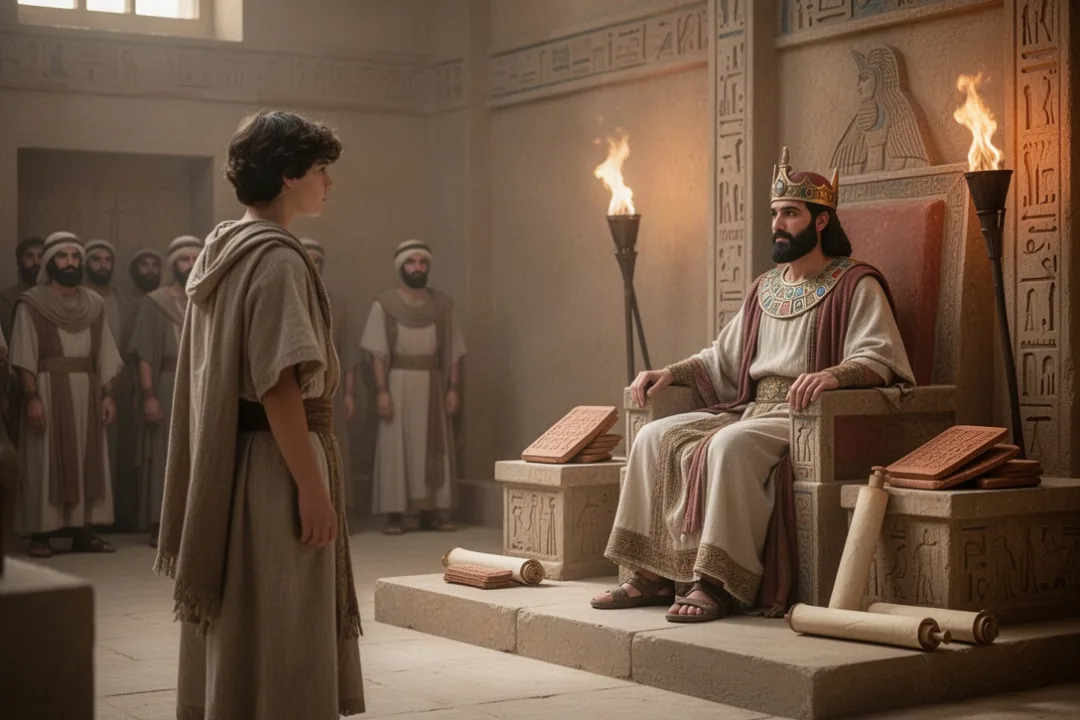
Daniel’s story begins when Jerusalem comes under Babylonian control. According to Daniel 1, the Babylonian king Nebuchadnezzar orders young people from Judah’s royal or noble families to be brought to Babylon and trained for service in the palace. Daniel is among those taken from his homeland, along with Hananiah, Mishael, and Azariah.
The four young men receive Babylonian names. Daniel’s friends become known as Shadrach, Meshach, and Abednego, names more familiar to many readers than their Hebrew names. The renaming reflects an attempt to reshape their identity, but the narrative shows that their loyalty to the God of Israel remains stronger than the culture surrounding them.
Daniel’s Hebrew name is commonly understood to mean “God is my judge.” The name fits the book’s central message: human rulers make decisions and issue decrees, but God remains the ultimate judge over kings, nations, and individuals. Daniel serves foreign governments without treating them as the highest authority.
The book describes Daniel as capable of learning the language and literature of Babylon. He is not portrayed as rejecting every aspect of education or public service. Instead, he gains knowledge while drawing a firm line at practices that would compromise his worship and obedience.
Central idea: Daniel lives faithfully inside a powerful foreign culture without allowing that culture to determine whom he worships or what convictions he will abandon.
How the Book of Daniel is organized
The book has two major parts, although both parts develop the theme of God’s authority over earthly kingdoms. The stories in the first half show faithfulness under pressure. The visions in the second half use vivid symbols to address suffering, power, judgment, and hope.
Daniel 1: Daniel and his friends begin their training in Babylon and refuse the royal food and wine.
Daniel 2: Daniel explains Nebuchadnezzar’s troubling dream of a large statue representing successive kingdoms.
Daniel 3: Shadrach, Meshach, and Abednego refuse to worship the king’s image and survive the fiery furnace.
Daniel 4: Daniel interprets a dream warning Nebuchadnezzar about pride and humiliation.
Daniel 5: Daniel interprets the writing on the wall during Belshazzar’s feast.
Daniel 6: Daniel is thrown into the lions’ den because he continues to pray to God.
Daniel 7–12: Daniel receives visions concerning beasts, rulers, persecution, judgment, resurrection, and the future.
The change from stories to visions also changes the reading experience. Chapters 1–6 focus on recognizable events and personal decisions. Chapters 7–12 require greater care because they use apocalyptic symbolism, a style that communicates through beasts, horns, heavenly beings, numbers, and dramatic scenes.
What happens to Daniel in Babylon
Daniel and his three friends face their first test over the food assigned by the king. Daniel asks for permission to eat vegetables and drink water instead of consuming the royal provisions. The passage connects this choice with a desire not to defile himself, although it does not present every dietary decision as a universal rule for all believers.
After a short trial, Daniel and his friends appear healthy, and God gives them knowledge and understanding. Daniel receives a special ability to understand visions and dreams. The point is not that Daniel possesses independent magical power. The narrative repeatedly attributes his insight to God.
Daniel’s first major interpretation involves Nebuchadnezzar’s dream of a huge statue made from different materials. The king demands both the dream and its interpretation, placing the wise men of Babylon in an impossible position. Daniel prays with his friends, God reveals the mystery, and Daniel explains that the statue represents a succession of kingdoms.
The interpretation emphasizes that earthly empires rise and fall. A stone that destroys the statue becomes a mountain filling the earth, symbolizing a kingdom established by God that will not be replaced by another human empire. Readers differ on how each part maps onto historical kingdoms, but the broad message is clear: God’s kingdom outlasts political power.
Why Daniel’s friends matter to his story
Daniel’s friends do not merely appear as supporting characters. Their refusal to worship the king’s golden image gives one of the book’s clearest examples of faithful resistance. They acknowledge that God can rescue them from the furnace, but they also refuse to worship the image even if rescue does not come.
The story in Daniel 3 is often called the account of the fiery furnace. The king sees a fourth figure in the flames after the three men are thrown inside. The text describes this figure in unusual language, and interpretations differ among Jewish and Christian readers. Some understand the figure as an angel; some Christian interpretations connect it with a divine appearance.
Daniel himself is not present in the furnace episode. His friends demonstrate the same basic conviction that shapes Daniel’s life: obedience to God cannot depend entirely on whether faithfulness produces immediate safety. Their courage is grounded in worship rather than in a guaranteed outcome.
How Daniel responds to powerful kings
Daniel serves under several rulers, but he never treats their authority as absolute. He can interpret a king’s dream, explain a warning, or administer government responsibly while still announcing that the king is accountable to God. This balance makes Daniel different from both a rebel who seeks disorder and a court official who tells rulers only what they want to hear.
In Daniel 4, Nebuchadnezzar dreams about a great tree that is cut down. Daniel explains that the dream warns the king about pride and judgment. He urges Nebuchadnezzar to turn from wrongdoing and show mercy to the oppressed. The warning is not delivered as flattery; Daniel tells the king what the dream means even though the message is dangerous.
The chapter then portrays Nebuchadnezzar’s humiliation. The king loses his public position and lives in a degraded condition until he recognizes that heaven rules over earthly kingdoms. The details are presented as part of the story’s theological message: pride leads to downfall, and rulers are not self-sufficient.
Daniel 5 takes place at a feast held by Belshazzar. The king uses vessels taken from the Jerusalem temple for a celebration honoring Babylonian gods. A mysterious hand writes words on the wall, and Daniel is called to explain them.
Daniel does more than translate the writing. He reminds Belshazzar that Nebuchadnezzar had been humbled but that Belshazzar did not learn from that example. The message announces that the king has been weighed, found deficient, and is about to lose his kingdom. That night, according to the narrative, Babylon falls to the Medes and Persians.
What the lions’ den teaches about Daniel
Daniel 6 presents Daniel as an older and highly trusted administrator. His rivals cannot find corruption in his work, so they target his religious devotion. They persuade King Darius to approve a law forbidding anyone from petitioning a god or person other than the king for a set period.
Daniel does not organize a public protest, but he also does not hide his prayers. He continues praying toward Jerusalem as he had done before. His regular practice becomes the basis for his arrest, and he is thrown into a den of lions despite the king’s regret.
God shuts the lions’ mouths, and Daniel is found alive the next morning. The story does not suggest that Daniel trusted in his own bravery. Its emphasis falls on his consistent prayer and God’s ability to preserve a servant under an unjust decree.
The lions’ den also shows the cost of integrity. Daniel’s good work does not protect him from hostile people or unfair treatment. His faithfulness does not prevent a crisis; it determines how he responds when the crisis arrives.
What Daniel’s visions mean
Daniel’s visions are filled with symbols, and many details have been interpreted in different ways. The safest starting point is the message repeated throughout the visions: God sees history, judges oppressive power, and will establish lasting justice.
The four beasts in Daniel 7: These terrifying animals represent kingdoms or rulers. Their animal form contrasts with the human arrogance of empire.
The Ancient of Days: A heavenly court scene presents God as the eternal judge who holds authority over every temporary kingdom.
The humanlike figure: Daniel 7 describes one “like a son of man” receiving dominion and an enduring kingdom. Christian readers connect this image with Jesus, especially in the Gospels.
The ram and the goat in Daniel 8: These symbols represent conflicting powers and the overthrow of one kingdom by another. The vision also addresses a ruler who attacks the holy people and sanctuary.
The seventy weeks in Daniel 9: Daniel prays about Jerusalem’s desolation and receives a prophetic response involving a symbolic period of seventy sevens.
The final visions in Daniel 10–12: These passages describe conflict among rulers, persecution, deliverance, and the hope that the dead will be raised.
The book’s symbols should not be treated as a simple code in which every image has one universally agreed modern equivalent. Faithful interpreters have connected the visions with different historical empires and later events. Some readings emphasize events close to Daniel’s own historical setting, while others see patterns that extend toward the end of history.
Daniel 7 is especially significant because Jesus uses the title “Son of Man” for himself in the Gospels. Since Bible translations vary, it is better to focus on the reference and theme than to depend on one English wording. The connection presents Jesus as the figure who receives authority from God and exercises a kingdom unlike the violent beasts.
How Daniel 9 connects prayer and prophecy
Daniel 9 begins with Daniel studying the prophetic writings and recognizing that Jerusalem’s desolation should lead him to prayer. His response is not speculation alone. He confesses the sins of his people, acknowledges God’s justice, and asks for mercy on Jerusalem and the sanctuary.
This prayer is one of the book’s clearest pictures of Daniel’s spiritual life. He does not separate personal devotion from the larger condition of his community. Although Daniel is presented as faithful, he identifies himself with his people and asks God to act for the sake of God’s name and covenant.
The angel Gabriel then gives Daniel the vision commonly known as the seventy weeks or seventy sevens. Interpretations vary widely. Some readers understand the passage as a symbolic timeline focused on Jerusalem and the temple; others connect it to the coming of the Messiah, the death of an anointed figure, later persecution, or events still future.
Because the passage is highly symbolic and linked to a particular crisis, it should be read with humility. It can encourage hope and perseverance without being used to make confident predictions about a specific modern date or political event.
What Daniel says about resurrection and the end of history
Daniel 12 contains one of the Bible’s clearest Old Testament references to the resurrection of the dead. The passage describes people awakening from death to differing outcomes, including everlasting life for some and shame for others. It places personal destiny within God’s final judgment.
The chapter also speaks to people who suffer during a period of intense trouble. Daniel is told that the wise will shine and that those who lead others toward righteousness will have lasting honor. The language does not minimize persecution, but it refuses to let persecution have the final word.
Daniel is then told to seal the words until the appointed time. This instruction reminds readers that prophecy is not a tool for controlling the future. Some knowledge remains partial, and the proper response is faithful endurance rather than arrogant certainty.
What Daniel teaches about living in a foreign culture
Daniel offers a practical model for people who must live under institutions, governments, or cultural pressures that do not share their beliefs. He learns the language of Babylon, accepts public responsibilities, and works competently. At the same time, he refuses food practices, worship, and laws that would violate his loyalty to God.
The book does not give a single formula for every disagreement with society. Instead, it shows several kinds of response: respectful negotiation in chapter 1, truthful warning in chapters 4 and 5, steadfast worship in chapter 6, and prayerful dependence throughout. Daniel’s resistance is not driven by personal ambition.
Learn without surrendering your identity: Daniel gains knowledge from the surrounding culture while remembering whom he serves.
Work honestly: His opponents search for corruption and find none, which makes his professional integrity part of his witness.
Pray before acting: Daniel and his friends seek God when human wisdom cannot solve a crisis.
Speak truth to power: Daniel gives kings difficult messages without softening them into false reassurance.
Know where obedience stops: He serves rulers until their commands require worship or disobedience to God.
Accept that faithfulness may be costly: Daniel’s convictions lead to real danger rather than immediate comfort.
How Daniel’s prayer life shapes the book
Prayer appears at crucial turning points. When Nebuchadnezzar threatens the wise men, Daniel asks his friends to seek mercy from God. After receiving the mystery, Daniel blesses God rather than claiming credit for his own intelligence.
In Daniel 6, prayer becomes a public sign of continuity. Daniel prays because he has already been praying, not because the crisis suddenly makes him religious. His fixed practice gives him stability when a new law tries to separate him from God.
Daniel 9 shows another dimension of prayer: confession and intercession. Daniel studies, remembers God’s promises, admits communal failure, and asks for restoration. His prayer is thoughtful and scripturally grounded, but it is also emotionally serious.
Later visions leave Daniel troubled, weak, and unable to understand everything he sees. The book does not portray him as emotionally untouched by revelation. His faith includes confusion, grief, and dependence on heavenly help.
Historical and literary questions about Daniel
The Book of Daniel has generated substantial discussion about its historical setting, language, and composition. The narrative places Daniel in the sixth century BCE, during the Babylonian exile and the early Persian period. Many academic scholars, however, argue that the book reached its final form during the second century BCE, when Judea suffered under the Seleucid ruler Antiochus IV Epiphanes.
Traditional Jewish and Christian readings generally treat Daniel as a genuine sixth-century prophet whose visions reach forward to later events. Other scholars emphasize that biblical prophecy can be written in a way that speaks to a community through a figure from the past, especially during persecution. These positions affect how readers date individual passages and interpret the visions.
The book is written in both Hebrew and Aramaic. The Aramaic section runs through much of chapters 2–7, while Hebrew appears elsewhere. This linguistic pattern is one reason scholars pay close attention to the book’s literary design and historical development.
These debates do not erase the book’s religious message. They do mean that readers should avoid claiming certainty where interpreters disagree. Daniel itself encourages humility by showing that even a faithful prophet does not receive complete understanding of every vision.
Reading tip: Separate the central message from disputed details. Daniel clearly emphasizes God’s sovereignty, faithful endurance, judgment, and hope; interpretations of every symbol are less uniform.
How Daniel is different from the other prophets
Daniel is grouped with the prophetic books in many Christian Bibles, but the book differs from Isaiah, Jeremiah, and Ezekiel in its combination of court stories and apocalyptic visions. Daniel rarely addresses Israel through long public sermons. Instead, he appears as an exile who interprets events within imperial courts and receives revelations about world history.
His role resembles that of Joseph in Genesis in some respects. Both men live in a foreign land, interpret dreams, rise to administrative responsibility, and preserve their identity under pressure. Daniel’s visions, however, place stronger emphasis on future kingdoms, heavenly judgment, and the resurrection.
Daniel also differs from Revelation in setting and form, although the two books share symbolic imagery. Revelation draws on Daniel’s beasts, heavenly court, and kingdom themes. Reading Daniel helps explain some of the images used in the New Testament, but the books should not be collapsed into one identical prediction system.
Why Daniel still matters to readers
Daniel speaks to anyone who feels pressure to compromise faith, values, or conscience in order to succeed. The book recognizes that public institutions can offer opportunity and danger at the same time. Daniel neither escapes responsibility nor assumes that service to a government means approval of everything that government does.
His example is also relevant to leadership. Daniel’s influence comes from trustworthiness and wisdom, not self-promotion. He can work within a political system while remembering that no ruler is permanent and no empire is ultimate.
The visions offer a broader perspective when oppressive power seems invincible. Beasts may dominate for a time, but they remain subject to the heavenly court. The hope of Daniel is not that history will be painless; it is that suffering and tyranny will be judged and that God’s purposes will endure.
For Christian readers, Daniel points toward themes fulfilled or developed in the New Testament, especially the Son of Man, the kingdom of God, perseverance under persecution, and resurrection. For Jewish readers, the book remains a powerful witness to covenant faithfulness, divine judgment, and hope during foreign domination. Across traditions, Daniel calls readers to combine wisdom in public life with unwavering worship.
Frequently asked questions
Was Daniel a real person in the Bible?
Daniel is presented in the Bible as a Jewish exile and administrator who served in Babylon and Persia. Jewish and Christian traditions generally receive him as a historical prophet. Modern scholars debate when the book reached its final written form and how its stories and visions developed, but the biblical character remains central to the book’s narrative and message.
Did Daniel interpret every dream by his own ability?
No. Daniel’s ability to interpret dreams and visions is repeatedly described as a gift from God. He prays for understanding, gives God credit after receiving Nebuchadnezzar’s dream, and distinguishes divine revelation from human wisdom. The book portrays Daniel as intelligent and well educated, but not as someone who possesses supernatural insight independently.
Why was Daniel thrown into the lions’ den?
Daniel’s rivals persuaded King Darius to approve a temporary law restricting petitions to the king. Daniel continued his regular practice of praying to God, so his enemies reported him. Although the king regretted the decision, Daniel was placed in the lions’ den. The story emphasizes his consistent devotion and God’s power to preserve him.
What is the main message of the Book of Daniel?
The book teaches that God remains sovereign when kingdoms rise, rulers become proud, and faithful people face persecution. It calls readers to live with integrity, pray consistently, speak truthfully, and refuse worship that belongs to God alone. Its visions add the hope that evil will be judged and God’s lasting kingdom will prevail.








Leave a Reply