Church meaning: what the word means in Christianity
Church meaning: what the word means in Christianity
Church meaning depends on how the word is being used. In everyday speech, “church” may mean a building, a worship service, or a local congregation. In Christian teaching, it most broadly means the community of people who follow Jesus Christ, not merely a physical structure.
The word can describe one neighborhood congregation, all Christians across the world, or the spiritual people of God throughout history. Understanding these meanings helps explain why Christians may say they are “going to church” while also saying that the church is the people.
In ordinary American English, “church” commonly has several related meanings. Someone might say, “Our church meets on Sunday,” referring to a congregation. Another person may say, “The church is across from the library,” referring to a building. A third may speak of “the church’s response” and mean a wider Christian organization or tradition.
These uses are connected, but they are not identical. A church building is a place designed for worship and ministry. A local church is a group of Christians who gather in a particular area. The worldwide church includes Christians in many countries, cultures, and denominations.
Church building: the physical place where Christians meet for worship, teaching, prayer, and fellowship.
Local congregation: a specific community of believers led by pastors, elders, priests, or other recognized leaders.
Denomination: a network of churches that shares particular beliefs, practices, history, and governance.
Universal church: all people who belong to Christ, regardless of location or historical period.
Worship service: a gathered meeting that may include prayer, Scripture reading, preaching, singing, Communion, or baptism.
The intended meaning usually becomes clear from the surrounding words. “The church is welcoming new members” probably refers to a congregation. “The early church faced persecution” refers to the first Christian communities. “Church history” may include institutions, doctrines, leaders, buildings, and the experiences of Christian people over many centuries.
Simple definition: In its fullest Christian sense, the church is the people called together by God to worship, follow Christ, receive teaching, serve others, and live as a community of faith.
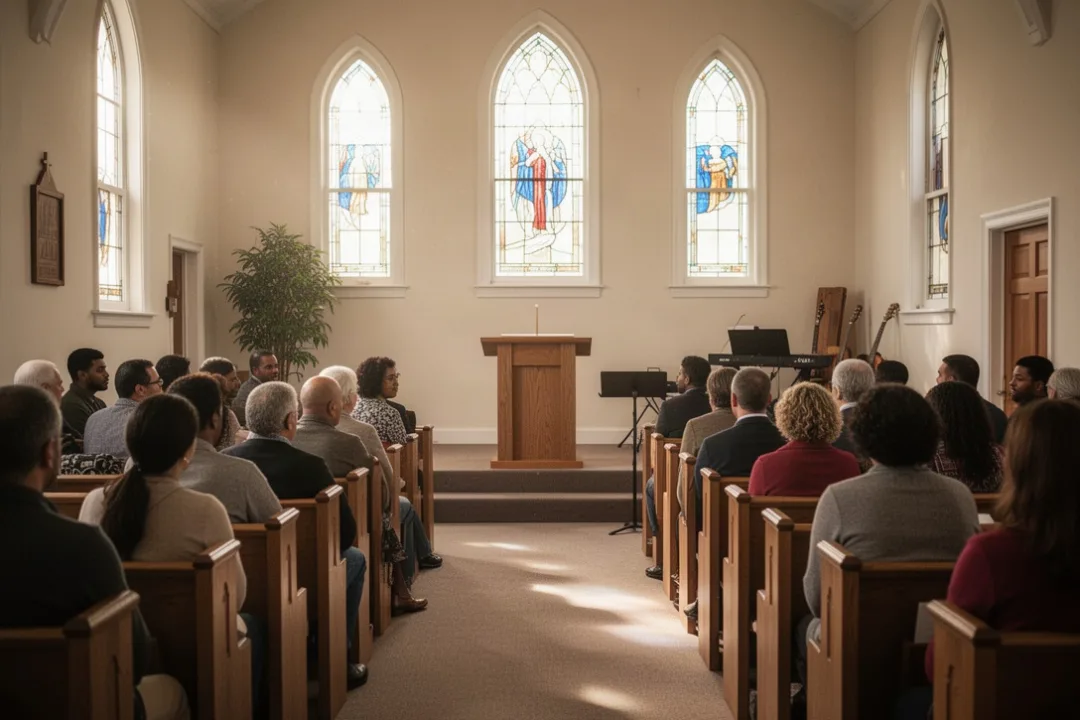
Churches differ greatly in size and style. A congregation may meet in a historic sanctuary, a rented school, a home, or an online-supported gathering with in-person worship. The setting can change, but the central idea remains a community assembled around Christian faith and practice.
What church means in the Bible
In the New Testament, the word translated as “church” comes from the Greek term ekklesia. It refers broadly to an assembly or gathering. The word does not originally mean a dedicated religious building, because the earliest Christians usually met in homes, public spaces, or other available locations rather than in church buildings.
In biblical usage, ekklesia can refer to a particular gathering of believers in a city or home. It can also describe the larger people of God united in Christ. The meaning comes from the context, so the Bible presents both local and universal dimensions of the church.
Jesus speaks about his church in Matthew 16:18, presenting it as a community that will endure. The wording points beyond a building or a single meeting. It expresses the idea that Jesus is forming a people who belong to him and participate in his mission.
The book of Acts shows the church taking shape after Jesus’ resurrection and the coming of the Holy Spirit. Christians gather for teaching, shared meals, prayer, fellowship, and practical care. Acts 2:42-47 describes a community that worships together and supports members who are in need.
The letters of the New Testament use several images to explain church meaning. Christians are described as a body with Christ as its head, as a household or family, as a temple of the Holy Spirit, and as a people called to represent God. Each image highlights a different part of the church’s identity.
The body of Christ: believers belong to one another and serve with different gifts, just as different parts of a body have different functions.
God’s household: Christians are brought into a spiritual family marked by belonging, responsibility, and mutual care.
A spiritual temple: God’s presence is associated with his people, not restricted to one sacred building.
A flock: believers need guidance, protection, and care under Christ, the chief shepherd.
A people on mission: the church is called to proclaim the gospel and reflect God’s character through its life.
Paul’s discussion in 1 Corinthians 12 emphasizes that the church is not meant to be uniform. Believers have different abilities and responsibilities, yet they are connected to one body. The chapter’s teaching challenges both individualism and the idea that one person’s role is more valuable than everyone else’s.
Ephesians 2 explains the church as a people brought together across divisions. In its original setting, this included deep separation between Jews and Gentiles. The message is that reconciliation through Christ creates a new community in which former barriers do not determine spiritual belonging.
Scripture also gives the church a moral and practical identity. It is expected to pursue truth, care for vulnerable people, correct wrongdoing with humility, forgive, practice hospitality, and preserve unity. These responsibilities show that church is more than attendance at a weekly event.
How Christians understand the church spiritually
For Christians, the church is first a people gathered by God. Its identity does not depend entirely on a pastor, a denomination, a style of music, or a particular building. These features can shape a congregation, but they do not by themselves define what makes the church Christian.
The church is centered on Jesus Christ. Christian communities may disagree about worship forms, leadership structures, or secondary doctrines, but historic Christianity understands the church as belonging to Christ and confessing him as Lord. The church receives its purpose from him rather than inventing its own spiritual identity.
The church is also connected with the work of the Holy Spirit. In Christian belief, the Spirit gives life to the church, equips believers for service, strengthens them in faith, and helps create unity. This does not mean every Christian community is free from conflict or failure. It means the church depends on God’s continuing work rather than human ability alone.
Another important part of church meaning is belonging. Christianity is not presented only as a private relationship between an individual and God. Believers are called into a shared life with other Christians. They worship together, learn together, encourage one another, and accept responsibilities that cannot be carried out in isolation.
That shared life does not require every member to have the same personality or background. A healthy church includes people with different ages, experiences, cultures, occupations, and gifts. Christian unity means being joined around Christ, not eliminating every difference between people.
The church as worshiping community
Worship is one of the church’s central activities. It includes praise, prayer, confession, thanksgiving, Scripture, preaching, silence, and the sacraments or ordinances recognized by a particular tradition. Some churches use formal liturgy, while others have a less structured service, but both may be expressions of Christian worship.
Worship is not limited to singing. Christians worship when they honor God, listen to his word, respond in faith, receive Communion or baptism according to their tradition, and offer their lives in obedience. Romans 12:1 connects worship with presenting one’s whole life to God, rather than restricting worship to a meeting.
The church as learning community
Teaching is another essential function. Churches help people understand the Bible, Christian doctrine, prayer, ethics, and the story of salvation. Preaching and group study are common ways this happens, but mentoring, children’s ministry, classes, and everyday conversations also shape Christian growth.
A church’s teaching should affect conduct. The goal is not simply to collect religious information but to develop wisdom, love, faithfulness, and practical obedience. James 1:22 warns against hearing God’s word without acting on it, linking Christian maturity with lived behavior.
The church as serving community
Christian churches commonly express their faith through service to neighbors. This may include food assistance, counseling, disaster response, visits to people who are sick or isolated, support for immigrants, prison ministry, or partnerships with local charities. The exact programs vary, but service reflects the belief that love of God should be visible in care for people.
Jesus’ teaching in Matthew 25:31-46 connects care for people in need with responding to him. Christians interpret this passage in different theological ways, but its practical force is clear: a church cannot claim to represent Christ while ignoring suffering around it.
A church gathering usually brings together several purposes: worship, instruction, community, and mission. The order and emphasis depend on the tradition. A Roman Catholic Mass, an Orthodox Divine Liturgy, a Baptist service, a Presbyterian service, and a non-denominational gathering may look different while sharing core Christian elements.
Many services include a welcome, songs or spoken praise, prayer, Scripture readings, a sermon or homily, and a closing blessing. Some include a formal confession, a creed, a collection for offerings, or time for personal testimony. Communion, also called the Eucharist or the Lord’s Supper, is practiced regularly in many churches.
Baptism is another major practice. Christians generally understand it as a sign of belonging to Christ and entering the Christian community, although traditions differ about the age of candidates, the method used, and the precise theological meaning. Some churches baptize infants; others baptize people who personally profess faith.
Church life extends beyond the main service. Members may meet in small groups, attend Bible studies, volunteer, share meals, visit one another, and participate in ministries for children, students, seniors, or people facing hardship. These relationships create the repeated contact through which trust and accountability develop.
Gathering: people come together in person or, in some settings, with additional online participation.
Hearing: the congregation listens to Scripture and teaching that connect Christian faith with daily life.
Responding: people pray, sing, confess, receive Communion, give, or make a personal commitment.
Connecting: members encourage one another and welcome visitors into the community.
Serving: the congregation is sent to care for neighbors and represent Christian love beyond the service.
Visitors do not need to understand every custom before attending. Many churches provide information about the service, but you may also quietly observe and participate only as you feel comfortable. Communion often has specific participation guidelines, so visitors can ask a greeter or church leader before receiving it.
For a first visit: Look for information about service times, parking, child care, accessibility, dress expectations, and Communion practices. A respectful church should make these details easy to find without pressuring you.
Church gatherings can also reveal a congregation’s priorities. The way a church welcomes newcomers, treats children, handles disagreement, explains its beliefs, and responds to local needs often says as much about its identity as the style of its service.
How denominations differ while sharing the name church
A denomination is a Christian tradition or network of congregations with shared beliefs, history, and forms of leadership. Major families include Roman Catholic, Eastern Orthodox, Protestant, Anglican, Lutheran, Reformed, Methodist, Baptist, Pentecostal, and many independent traditions. Each family contains further differences among churches.
Denominations may disagree about baptism, Communion, church authority, the role of bishops, the relationship between church and state, spiritual gifts, worship style, or the interpretation of particular biblical passages. These differences matter, but they do not necessarily mean that each group uses the word church in an entirely different way.
Most Christian traditions affirm some combination of these basic convictions:
Jesus Christ is central to Christian faith and the church’s identity.
Scripture has an important role in teaching and guiding the church.
Christians are called to worship God and live in relationship with one another.
The church is responsible for proclaiming the gospel and serving others.
Baptism and Communion, or comparable practices, mark important aspects of Christian discipleship.
Leadership structures vary considerably. Some churches are led by bishops, priests, and deacons. Others are governed by pastors and elected elders, while some use congregational decision-making. Independent churches may have looser networks and local authority. These structures affect how a church chooses leaders, handles money, resolves disputes, and makes decisions.
Worship styles vary for historical and cultural reasons. A congregation may use an organ and a set liturgy, a worship band and contemporary songs, a choir, spoken prayers, or extended periods of silence. Style alone does not determine theological depth. The more useful questions concern what the church teaches, how it treats people, and whether its practices align with its stated beliefs.
The word “church” can also describe traditions with different views of membership. Some emphasize a visible institution with ordained leaders and historic continuity. Others stress the gathered community of people who have personally professed faith. Still others use both ideas, distinguishing between the church’s visible organization and its deeper spiritual reality.
For someone choosing a congregation, labels provide a starting point but not a complete picture. Two churches within the same denomination may have different preaching, leadership cultures, approaches to social questions, and expectations for members. Visiting, reading the church’s statement of faith, and speaking with leaders can clarify what a particular congregation actually believes.
How to recognize the church’s purpose in practice
The church’s purpose can be described through several connected responsibilities. It exists to glorify God, make disciples, proclaim the gospel, cultivate Christian community, administer its central practices, and serve the world. These purposes are not separate departments; they support one another.
Teaching without love can become harsh or merely intellectual. Service without a clear spiritual foundation can lose the distinctiveness of Christian mission. Worship without concern for neighbors can become disconnected from daily life. A mature church seeks to hold these purposes together.
The church also provides a setting for spiritual formation. People learn patience by living with others, generosity by sharing resources, humility by receiving correction, and forgiveness by repairing relationships. Community can be difficult, but those difficulties often expose the difference between an ideal of church and the demanding practice of Christian fellowship.
Churches are made up of imperfect people and can fail seriously. They may experience hypocrisy, abuse of authority, discrimination, financial misconduct, or resistance to accountability. Recognizing these failures does not require pretending that they are harmless. Responsible churches create safeguards, listen to concerns, protect vulnerable people, and cooperate with appropriate reporting and legal processes.
If you are evaluating a church, pay attention to both its public claims and its ordinary behavior. Useful questions include:
Does the church clearly explain its beliefs and expectations?
Are leaders accountable to other leaders or an independent governing body?
How does the congregation protect children and vulnerable adults?
Can members disagree without being shamed or threatened?
Does the church welcome people while respecting personal boundaries?
Are money, leadership decisions, and disciplinary processes handled transparently?
Does the church’s service to the community continue beyond public events?
These questions do not demand perfection from a congregation. They help distinguish ordinary human limitations from patterns that may indicate an unsafe or unhealthy environment. A church’s meaning is expressed not only in its creed but also in the way it uses authority and treats people who have less power.
At its best, the church offers a place where people worship God, learn the Christian faith, receive care, contribute their gifts, and join a community that reaches beyond itself. The building may be beautiful or plain, the service may be formal or informal, and the denomination may vary. The central meaning remains a people gathered around Christ for faithful life together.
Frequently asked questions
Is the church a building or a group of people?
It can mean either in everyday speech, but Christian teaching gives priority to the people. A building is a meeting place, while the church is the community gathered in faith, worship, service, and fellowship. This is why Christians can speak of the church existing even when believers meet in homes, schools, rented halls, or other temporary spaces.
What is the difference between a church and a denomination?
A church may refer to one local congregation, while a denomination is a larger family or network of churches with shared beliefs, history, and leadership practices. For example, several congregations may belong to the same denomination while serving different neighborhoods. Some churches are independent and do not formally belong to a denomination.
What does “the body of Christ” mean?
“The body of Christ” is a biblical image for the Christian community. It teaches that believers are connected to one another and have different gifts and responsibilities, much as physical body parts have different functions. Christ is understood as the head, giving the church its direction, identity, and purpose.
Can someone be a Christian without attending church?
Christian traditions answer this with different emphasis, but most encourage regular participation in a local church. Faith is personal, yet Christianity also calls believers to worship, learn, receive care, serve, and share life with others. Illness, persecution, work, family responsibilities, or lack of a safe congregation can make attendance difficult without removing someone’s identity as a Christian.





Leave a Reply