Christian and Christianity: beliefs, history, and practice
Christian and Christianity: beliefs, history, and practice
Christianity is a faith centered on Jesus Christ, whom Christians believe is the Son of God, the Messiah, and the risen Lord.
A Christian is a person who follows Jesus or identifies with the Christian faith. Christianity is the worldwide religious tradition that grew from Jesus’ life, death, and resurrection in the first century. It is practiced across every inhabited continent and includes many churches, denominations, cultures, and theological perspectives.
Although Christians do not agree on every doctrine or practice, most share a commitment to Jesus and recognize the Bible as their central collection of sacred writings. Christianity has shaped worship, art, education, law, music, charity, and public life for centuries, while also containing significant internal diversity.
What Christians believe about God, Jesus, and salvation
Most Christians believe in one God who exists eternally as Father, Son, and Holy Spirit. This belief is commonly called the Trinity. Christians do not generally mean three separate gods; they mean one God understood through three distinct persons or ways of personal existence.
Christian teaching about God emphasizes both holiness and love. God is understood as the creator of the universe and as personally concerned with human beings. Christians often describe the relationship between God and humanity using ideas such as covenant, grace, forgiveness, judgment, and reconciliation.
Jesus occupies the center of Christian belief. Christians generally teach that he was a first-century Jewish teacher who proclaimed God’s kingdom, healed people, welcomed outsiders, challenged religious hypocrisy, and formed a community of disciples. They also believe that Jesus was more than a moral teacher: he was the incarnate Son of God, fully connected with humanity and with God.
The crucifixion is another central Christian belief. The New Testament describes Jesus being executed by Roman authorities in Jerusalem. Christians interpret his death in several related ways, including as a sacrifice for sin, an act of self-giving love, a victory over evil, and the means by which people can be reconciled to God.
Christians also believe in the resurrection of Jesus. According to the New Testament, Jesus rose from the dead after his crucifixion and appeared to his followers. The resurrection is not a minor detail within Christianity; it is the basis for Christian hope, the church’s proclamation, and belief in life beyond death.
Salvation usually refers to being rescued from sin and restored to a right relationship with God. Different Christian traditions explain the process differently, but common themes include God’s grace, trust in Christ, repentance, forgiveness, and a transformed life. Many Christians stress that salvation is a gift rather than something earned through good deeds, while also teaching that genuine faith should shape how a person lives.
A useful distinction: Christians often speak of salvation as both a present relationship with God and a future hope involving resurrection, judgment, and the renewal of creation.
How the Bible functions in Christian faith
The Bible is Christianity’s collection of sacred writings. It is divided into the Old Testament and the New Testament, although some Christian traditions use the terms Hebrew Bible and New Testament to describe these sections. The Old Testament contains writings shared in large part with Judaism, while the New Testament focuses on Jesus and the early Christian movement.
The Old Testament includes several kinds of writing, such as history, law, poetry, wisdom literature, prophecy, and stories of Israel’s relationship with God. The New Testament includes the four Gospels, the Acts of the Apostles, letters attributed to early Christian leaders, and an apocalyptic work known as Revelation.
Christians read the Bible in different ways. Some emphasize its complete divine inspiration and seek a highly literal interpretation. Others focus on historical context, literary form, symbolism, and the development of ideas across different books. Many churches teach that responsible interpretation considers the passage’s language, audience, genre, historical setting, and relationship to the wider biblical message.
The Gospels—Matthew, Mark, Luke, and John—are not four identical biographies. Each presents Jesus with its own structure, themes, and emphasis. Reading more than one Gospel can help you see both the shared outline of Jesus’ ministry and the distinctive perspective of each writer.
Christian communities use the Bible in worship, preaching, prayer, study, counseling, and personal devotion. A passage may be read aloud during a service, discussed in a small group, memorized, or used as a framework for ethical reflection. The Bible is rarely treated as a book meant to be understood apart from community, tradition, and prayer.
Read in context: Consider who wrote a passage, who first received it, and what problem or purpose it addressed.
Identify the genre: Poetry, parable, narrative, wisdom writing, and apocalyptic literature use language in different ways.
Compare translations: Differences in wording can clarify meaning, especially when a passage seems difficult.
Use cross-references carefully: Related passages can help, but they should not be used to ignore the original setting.
Learn with others: A trusted church, study group, or qualified teacher can provide historical and theological perspective.
What Jesus taught and why his life matters to Christians
Jesus’ teaching centered on the kingdom of God, meaning God’s active rule and purpose. He called people to turn toward God, trust divine mercy, seek justice, and live with humility. His teaching often used memorable stories, practical images, and surprising reversals of ordinary social expectations.
The Sermon on the Mount, recorded in Matthew, contains teachings about anger, reconciliation, generosity, prayer, anxiety, retaliation, and love for enemies. Luke presents many related teachings in a different arrangement. Christians debate how these commands should be applied, but most agree that Jesus calls his followers beyond outward religious identity toward a deeply formed character.
Jesus frequently placed care for vulnerable people at the heart of faith. He associated with people who were marginalized or viewed with suspicion, including the poor, the sick, foreigners, and those considered morally compromised. His actions and parables challenge Christians to connect worship with compassion, justice, hospitality, and mercy.
Christian discipleship means more than agreeing with a set of propositions. It commonly involves following Jesus through prayer, moral choices, service, community life, and a willingness to change. Different churches describe this process with terms such as sanctification, spiritual formation, conversion, or becoming more like Christ.
How Christianity developed from a Jewish movement into a global religion
Christianity began within first-century Judaism. Jesus and his earliest followers were Jewish, and the first Christian communities understood Jesus through Israel’s Scriptures, hopes, worship, and history. The movement grew in Jerusalem and then spread through Judea, Samaria, and other parts of the Roman world.
The early church did not begin with one global institution that looked like a modern denomination. It consisted of local communities connected through shared teaching, worship, letters, leaders, and mutual support. Apostles and other missionaries traveled between cities, while local congregations developed their own patterns of leadership and practice.
As non-Jewish people joined the movement, Christians debated questions about Jewish law, circumcision, food practices, and the place of Gentile believers. These discussions helped shape the church’s identity. The New Testament records some of these disagreements rather than presenting the early communities as completely uniform.
Over the following centuries, Christianity spread through the Roman Empire and beyond it. Christian thinkers developed language for explaining Jesus’ identity, the Trinity, scripture, and salvation. Major gatherings of bishops, often called ecumenical councils, addressed disputes that affected the church’s shared teaching.
Christianity eventually developed several major families. The Eastern Orthodox churches preserved ancient liturgical and theological traditions centered historically in the eastern Mediterranean and later in other regions. The Roman Catholic Church developed around the ministry of the bishop of Rome, known as the pope. The Protestant traditions emerged from sixteenth-century reform movements and include many distinct churches.
There are also Oriental Orthodox churches with ancient histories and theological traditions distinct from both Eastern Orthodoxy and Roman Catholicism. Anglican, Lutheran, Reformed, Baptist, Methodist, Pentecostal, evangelical, nondenominational, and other traditions each contribute their own approaches to worship, authority, sacraments, church government, and biblical interpretation.
How Christian denominations differ from one another
A denomination is a Christian body with its own organizational structure, statement of faith, history, and worship practices. The word can be useful, but it does not capture every Christian community. Some churches are independent, while others belong to large networks or global communions.
One major difference concerns authority. Roman Catholic and Eastern Orthodox churches place substantial weight on scripture, historic tradition, and the teaching authority of the church. Many Protestant churches emphasize the Bible as the highest authority, while still recognizing the value of historic creeds, teachers, and inherited practices.
Churches also differ in how they understand baptism and Communion. Some baptize infants; others reserve baptism for people who personally profess faith. Some describe Communion as a sacrament in which Christ is truly present, while others understand it primarily as a memorial meal or public expression of faith.
Leadership varies as well. Some churches have bishops overseeing regions, some are led by councils of elders, and others give greater responsibility to individual congregations. Women’s leadership, ordination, worship style, spiritual gifts, and approaches to political involvement also differ widely among Christians.
These differences should not obscure the beliefs many Christians hold in common. The most widely shared center includes belief in one God, the significance of Jesus Christ, the importance of the Bible, the reality of sin and grace, the church as a community of believers, and hope for resurrection and life with God.
What Christian worship and daily practice look like
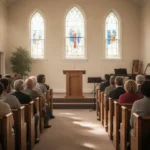
Christian worship commonly includes prayer, singing, scripture reading, preaching, confession, and Communion. Services may take place in cathedrals, small churches, homes, schools, outdoor settings, or buildings used by several congregations. The atmosphere can range from highly formal and ceremonial to conversational and contemporary.
Most Christian churches gather on Sunday, the day associated with Jesus’ resurrection. Some communities also hold services during the week. The church calendar may include seasons such as Advent, Christmas, Lent, Holy Week, Easter, and Pentecost, although the emphasis and customs differ among traditions.
Prayer can be spoken, silent, written, sung, communal, or spontaneous. Christians may pray to praise God, confess wrongdoing, express gratitude, ask for help, seek wisdom, intercede for other people, or sit quietly in God’s presence. Established prayers, including the prayer Jesus taught his disciples, are used alongside personal words.
Baptism marks entry into Christian community in most churches. The ceremony may involve pouring, sprinkling, or immersion in water. Depending on the tradition, baptism may be understood as a sacrament, an act of obedience, a sign of grace, a public profession of faith, or several of these at once.
Communion, also called the Eucharist or the Lord’s Supper, remembers Jesus’ final meal with his disciples. Bread and wine or grape juice are used, and the practice points Christians toward Jesus’ death, the unity of the church, gratitude, and hope. Churches differ on who may participate and how Christ is present in the meal.
Daily Christian practice extends beyond church attendance. It may involve serving neighbors, giving to charity, forgiving others, resisting injustice, caring for creation, studying scripture, and making ethical decisions. Christian groups support food banks, hospitals, schools, disaster relief, refugee assistance, counseling programs, and community outreach, though their methods and social priorities vary.
How Christians understand sin, ethics, and moral responsibility
In Christian theology, sin is more than breaking a list of rules. It can describe attitudes, actions, systems, and patterns that turn people away from God and harm other human beings. Christians commonly connect sin with pride, exploitation, violence, dishonesty, injustice, and the misuse of freedom.
Christian ethics usually begin with love for God and love for neighbor. The practical meaning of those commands is debated, especially in areas such as sexuality, marriage, war, economics, politics, medical decisions, and environmental responsibility. Christians who share a basic commitment to Jesus may reach different conclusions because they weigh biblical passages, tradition, reason, conscience, and social circumstances differently.
Many Christian ethical teachings emphasize human dignity. People are viewed as bearing God’s image, which supports concern for the poor, the unborn, the elderly, people with disabilities, immigrants, prisoners, and those facing discrimination. The way these principles are applied differs considerably among churches and individual believers.
Christianity also contains traditions of confession and repentance. Repentance means more than feeling regret; it involves turning away from wrongdoing and seeking a changed relationship with God and other people. Forgiveness does not remove the need for accountability, restitution, protection of victims, or wise boundaries.
Common mistakes when learning about Christian and Christianity
Christianity is too diverse to be represented accurately by one congregation, one country, or one news story. These practical guidelines can help you study the subject with greater care:
Do not treat all Christians as identical: Ask which denomination, tradition, country, or theological viewpoint a person represents.
Do not confuse cultural identity with personal belief: Someone may identify as Christian because of family or culture while rarely practicing, while another person may practice deeply without using a formal label.
Do not reduce Christianity to politics: Christians participate across the political spectrum, and religious convictions do not translate into one universal political program.
Do not quote isolated Bible passages as complete explanations: Read surrounding paragraphs and consider genre, audience, and interpretation.
Do not assume worship style reveals theological depth: A traditional service and a contemporary service may express serious faith in different forms.
Do not use “Christian” as a synonym for “Protestant” or “evangelical”: Those terms describe particular parts of the wider Christian family.
Do not overlook global Christianity: Christian communities in Africa, Latin America, Asia, Europe, and the Middle East have different histories and priorities.
Do not judge the entire religion only by its failures: Criticism of hypocrisy, abuse, colonialism, or injustice can be necessary, but it should be distinguished from the beliefs and practices Christians claim to follow.
For a balanced first step: Read one Gospel, visit a local congregation if you feel comfortable, and ask how that community understands Jesus, the Bible, baptism, Communion, and service.
How Christianity is practiced around the world today
Christianity is not culturally uniform. Worship, music, clothing, preaching, prayer, and community life reflect local languages and histories. A church in Nigeria, Brazil, South Korea, Lebanon, Mexico, the United States, or the Philippines may share foundational beliefs with churches elsewhere while expressing them through very different customs.
Christian communities in the United States include long-established Catholic, Orthodox, Protestant, evangelical, Black church, immigrant, and independent traditions. Some congregations are highly involved in social services and public advocacy. Others focus more narrowly on worship, discipleship, family life, or local fellowship.
Many Christians experience their faith through a congregation, but not every Christian participates regularly in organized worship. Some practice privately because of illness, work, distance, family circumstances, persecution, or disagreement with church institutions. The label “Christian” therefore includes a wide range of relationships to belief and community.
Christianity also includes serious internal debate about how churches should respond to modern science, religious pluralism, poverty, racism, nationalism, gender, sexuality, technology, and climate change. These debates are not signs that Christianity has one simple position waiting to be identified; they reflect the tradition’s many communities and competing methods of interpretation.
Ways to explore Christian faith respectfully
If you are learning about Christianity for personal, academic, or cultural reasons, begin with its central figure rather than with stereotypes about particular Christians. Read a Gospel such as Mark, Luke, or John and pay attention to how it portrays Jesus’ identity, relationships, teaching, suffering, and resurrection.
It can also help to compare several Christian voices. A Catholic parish, an Orthodox congregation, a Baptist church, an Episcopal church, a Pentecostal congregation, and a nondenominational church may answer important questions differently. Listening to each community explain its own beliefs is more reliable than assuming that one group speaks for all Christians.
Start with primary texts: Read a Gospel and selected early Christian letters in a reputable translation.
Learn basic vocabulary: Terms such as Trinity, incarnation, grace, sacrament, gospel, disciple, liturgy, and denomination have specific meanings.
Ask clear questions: Find out what a church teaches about Jesus, salvation, scripture, baptism, Communion, and Christian service.
Compare historical perspectives: Study how Catholic, Orthodox, Protestant, and other communities developed.
Notice lived practice: Observe how people pray, worship, serve, make moral decisions, and relate to neighbors.
Allow for disagreement: A fair understanding can acknowledge both shared convictions and genuine divisions.
At its center, Christianity asks people to understand God through Jesus Christ and to respond through faith, worship, love, repentance, and service. Its history includes profound charity and serious failures, intellectual achievement and painful conflict, global growth and continual change. Understanding Christian and Christianity requires holding that full picture together rather than reducing a worldwide faith to a single expression.
Frequently asked questions
What is the difference between a Christian and Christianity?
A Christian is an individual who follows Jesus Christ or identifies with the Christian faith. Christianity is the broader religion, including its beliefs, scriptures, churches, traditions, rituals, history, and communities. A person may be culturally Christian, actively practicing, or committed to a particular denomination, so the label can describe different levels of belief and participation.
Do all Christians believe the same things?
No. Most Christians share core beliefs about God, Jesus, the Bible, sin, grace, the church, and resurrection, but they differ over baptism, Communion, church authority, worship, salvation, biblical interpretation, and ethical questions. Catholic, Orthodox, Protestant, Anglican, evangelical, Pentecostal, and independent churches each have distinctive teachings and practices.
Why do Christians read the Old Testament?
Christians read the Old Testament because it forms the scriptural foundation of the Christian Bible and contains creation accounts, Israel’s history, wisdom, poetry, law, and prophetic writings. Christians interpret it through different approaches, often connecting its themes to Jesus and the New Testament while recognizing that these writings originated within ancient Israelite and Jewish religious contexts.
What does it mean to become a Christian?
In many churches, becoming a Christian involves trusting in Jesus Christ, turning toward God, receiving forgiveness, and joining a Christian community. The outward process may include baptism, a public profession of faith, instruction, or confirmation. Churches differ in how they describe conversion and membership, but most connect Christian identity with both belief in Jesus and a changed pattern of life.











Leave a Reply