The Levites traced their ancestry to Levi, one of Jacob’s twelve sons and a son of Leah. Because Jacob’s descendants became the twelve tribes of Israel, the Levites formed one of those tribes. Their role, however, was unusual: unlike the other tribes, they did not receive a large, continuous territorial inheritance in the land of Canaan.
Instead, Levites were distributed among the other tribes and received designated towns and surrounding pasturelands. This arrangement allowed them to serve the wider community rather than operate as a single territorial nation. The biblical account connects their livelihood with offerings and tithes given by the Israelites, particularly the tenth portion that supported their religious service.
Levi’s descendants included several important families. The three main branches were the families of Gershon, Kohath, and Merari. Each branch received different responsibilities connected with the tabernacle, the portable sanctuary used by Israel during its wilderness journey.
The tribe of Levi also produced Israel’s priests. Moses and Aaron were Levites, but only Aaron’s descendants held the specific office of priest. This distinction matters: every priest was a Levite, but not every Levite was a priest.
The central distinction: “Levite” describes membership in the tribe of Levi, while “priest” describes the special descendants of Aaron who performed the altar sacrifices and other priestly duties.
How Levites differed from priests
In everyday speech, people sometimes use “Levites” and “priests” as if they meant the same group. The Bible uses the terms more carefully. The priesthood belonged to Aaron and his male descendants within the tribe of Levi. Other Levites served in supporting roles but were not authorized to perform every priestly function.
Priests offered sacrifices, maintained the altar, handled certain sacred rituals, and taught aspects of Israel’s religious law. They also supervised responsibilities associated with ritual purity and blessing the people. These duties required a level of access to the sanctuary that ordinary Levites did not have.
Non-priestly Levites assisted with the practical and musical work of worship. Their tasks included transporting the tabernacle and its equipment, guarding sacred areas, singing, playing instruments, serving as gatekeepers, and helping administer offerings. Their service was essential, but it had defined boundaries.
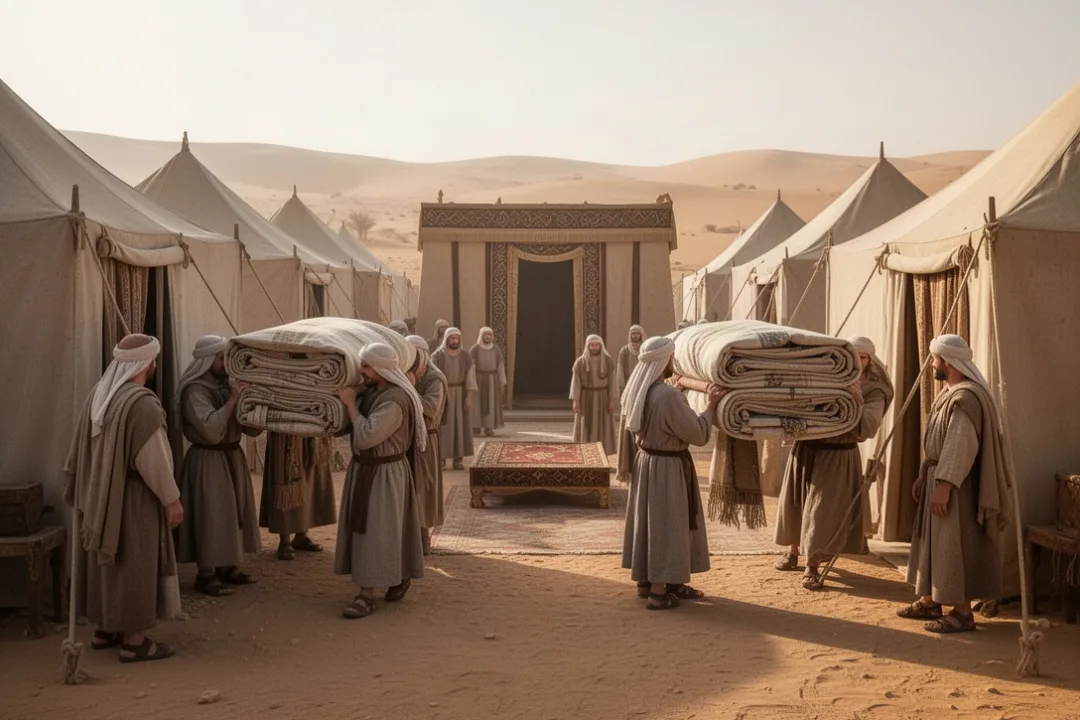
The boundaries were especially serious during the wilderness period. The tabernacle contained sacred objects, including the ark of the covenant, and the biblical laws assigned particular duties for moving and covering these objects. The Kohathite families carried certain holy furnishings, but they were not permitted to touch the objects directly or look at them while they were being prepared for transport.
How the Levite clans served the tabernacle
The book of Numbers presents an organized division of labor among the three major Levite families. This system helped Israel move the tabernacle safely and established a pattern of service based on family responsibilities.
The Gershonites cared for fabric elements, including curtains, coverings, screens, and related materials.
The Kohathites transported the most sacred furnishings after the priests had covered them, including the ark, table, lampstand, and altars.
The Merarites handled the structural parts of the tabernacle, such as frames, bars, pillars, bases, and cords.
The priests prepared the sacred furnishings before the Kohathites transported them. This arrangement preserved the distinction between the Levites’ work and the priests’ direct responsibility for the sanctuary’s holiest objects.
Levite service was also connected with age and physical ability. In the wilderness census, men within a specified adult age range were counted for tabernacle duties. Later biblical passages describe changes to the age requirements as the nature of Levite work changed, particularly once the temple became a permanent structure rather than a tent that had to be carried.
Why the Levites received no single tribal territory
The other tribes received defined territories after Israel entered Canaan. Levi’s inheritance worked differently. The Levites received forty-eight towns distributed throughout the land, along with pasturelands around those towns. The allocation appears in Joshua 21, where the towns are assigned from the territories of the other tribes.
This distribution served a practical and religious purpose. Levites could live among the people and provide instruction and worship-related service across Israel. Their presence was not concentrated in one region, even though the central sanctuary later became especially important in Jerusalem.
The biblical texts describe God as the Levites’ inheritance in a distinctive sense. That language does not mean Levites had no material support or no place to live. It means their primary vocation and source of status were tied to sacred service rather than to a large agricultural territory of their own.
Because Levites depended partly on the generosity and faithfulness of the other tribes, biblical law repeatedly addressed their care. Israelites were instructed to include Levites in the distribution of tithes and in communal celebrations. Prophetic criticism sometimes targeted the neglect of Levites as evidence that the people were failing to honor their religious obligations.
How Levites were supported by tithes and offerings
Levites received a tenth of Israel’s agricultural and livestock produce as support for their service. The Levites, in turn, were instructed to present a “tenth of the tenth” to the priests. This system connected every level of the community to the maintenance of worship.
The arrangement was not simply a payment for ordinary employment. It expressed Israel’s understanding that worship, teaching, and sanctuary service belonged to the whole covenant community. Those who worked directly in religious service were supported by the contributions of those who farmed, raised animals, traded, and managed households.
Several passages also emphasize that Levites were to share in festivals and meals with other vulnerable members of society, including foreigners, widows, and orphans. This shows that Levites were not only religious functionaries. They were also part of the social and economic life of Israel, and their well-being could be affected by the nation’s obedience or disobedience.
Practical meaning of the tithe system: Levites served the entire nation, so the nation was expected to provide for them. Their support was part of Israel’s worship and community responsibility.
What happened to Levi’s reputation after the incident at Shechem
The Bible presents Levi’s early history with both criticism and honor. In Genesis 34, Levi and his brother Simeon respond violently after their sister Dinah is violated by Shechem. Their father Jacob condemns their anger and violence when he later blesses his sons in Genesis 49.
That difficult beginning forms an important background for the tribe’s later identity. In Exodus 32, when Israel worships the golden calf, the Levites rally to Moses and carry out a severe judgment against those involved. The passage presents their loyalty to the covenant as a reason they were set apart for service.
These accounts do not erase the earlier violence, nor do they imply that every Levite was morally superior. They show how biblical narratives can connect a group’s changing role with particular moments of faithfulness, failure, judgment, and restoration.
Deuteronomy 33 also gives Levi a favorable blessing associated with teaching, worship, and the administration of sacred responsibilities. The result is a layered picture: Levi’s descendants are connected with both dangerous zeal and disciplined service. Their later religious role is presented as a calling that required obedience rather than as an automatic reward for ancestry.
What Levites did during the period of the judges and monarchy
After the conquest of Canaan, Levites lived in their assigned towns and traveled when their service was required. The book of Judges suggests that Levites could function as religious specialists, though its stories also portray serious failures and disorder in Israelite worship.
Under David, the organization of Levite service became more systematic. The books of Chronicles describe divisions for music, gatekeeping, administration, and assistance to the priests. David’s arrangements anticipated the temple that Solomon would build, even though the temple itself was completed during Solomon’s reign.
Levite musicians played a major role in organized worship. Families associated with Asaph, Heman, and Jeduthun are linked with songs and instrumental service. These groups helped create a regular liturgical structure rather than leaving music to informal or occasional participation.
Gatekeepers also had an important responsibility. They guarded entrances, storehouses, courts, and other areas connected with the temple. Their work was not merely ceremonial. It protected the order of worship and helped manage access to sacred spaces and supplies.
Other Levites acted as officials, scribes, judges, and teachers. Their work extended beyond the temple itself and supported the administration of the kingdom. This broader role helps explain why biblical writers sometimes connect Levites with legal instruction and public religious education.
How Levites supported reforms under Israelite kings
Several biblical reform movements relied on Levites to restore proper worship. During the reign of Hezekiah, Levites helped cleanse and reorganize the temple after a period of neglect. They assisted the priests, arranged offerings, and helped prepare the people for renewed observance.
During Josiah’s reforms, Levites were involved in restoring the temple and supporting the celebration of Passover. The reforms responded to practices that the biblical writers considered incompatible with worship of the God of Israel. Levites appear as organizers, teachers, musicians, and custodians of the sanctuary.
These accounts show that Levites were not passive assistants waiting for priestly instructions. They could lead important practical efforts, organize personnel, teach religious law, and support national observances. Their authority remained distinct from that of the priests, but their contribution was substantial.
At the same time, the biblical books do not portray every reform as simple or permanent. Later generations often returned to neglect or idolatry. The recurring need to restore Levite service reflects the unstable religious and political history of the kingdoms of Israel and Judah.
What Levites did after the Babylonian exile
When the Babylonian exile ended and groups of Judeans returned, Levites again helped rebuild religious life. The books of Ezra and Nehemiah describe priests and Levites participating in the rebuilding of the temple, the public reading of the law, musical worship, and the renewal of community commitments.
Nehemiah 8 describes Levites helping the people understand the law as it was read publicly. This passage is especially significant because it associates Levites with interpretation and instruction, not only with music or physical service. Their task was to make the meaning of the reading clear to the gathered community.
Postexilic texts also address the problem of Levites leaving their assigned service because they were not receiving adequate support. Nehemiah criticizes this failure and restores provisions for those serving at the temple. The issue shows that the traditional structure of worship depended on real economic arrangements, not merely on ceremonial titles.
After the exile, the temple in Jerusalem became the central place of Jewish worship. Levites continued to serve there, although the details of their duties changed over time as institutions developed. Their identity remained tied to ancestry, temple service, music, teaching, and the administration of worship.
How the Levites are mentioned in the New Testament
The New Testament refers to Levites in a few notable settings. In the parable commonly called the Good Samaritan, Jesus describes both a priest and a Levite passing an injured man before a Samaritan provides help. The point is not that every priest or Levite was uncaring. The story challenges assumptions about religious status and shows that neighborly mercy must be demonstrated through action.
Acts 4 identifies Barnabas as a Levite from Cyprus. He becomes an important early Christian leader and is described as selling land and giving the proceeds to support the community. His example illustrates that the word “Levite” still functioned as a meaningful ancestral identity in the first-century Jewish world.
The letter to the Hebrews discusses the Levitical priesthood in comparison with the priestly work associated with Jesus. Its argument depends on the distinction between the traditional priesthood descended from Aaron and the different priestly category linked with Melchizedek. The text is making a theological argument about access to God, sacrifice, and the limitations of the older system.
These references should not be used to assume that all Levites in the New Testament period had exactly the same duties as Levites in the wilderness. By then, worship centered on the Jerusalem temple, and Jewish religious institutions had developed over many centuries.
What “Levitical” means in the Bible
The adjective Levitical can refer to matters associated with the tribe of Levi, the priesthood, or the worship system described in Israel’s law. It does not always mean that every Levite performed the same task.
The book of Leviticus receives its name because much of its material concerns priests, sacrifices, ritual purity, festivals, and the holiness of the community. Yet the book addresses all Israel, not only Levites. Its central themes include how the people as a whole should live in relation to God and one another.
“Levitical priesthood” is a more specific expression. It refers to the priestly system descended from Aaron and operating within the tribe of Levi. In biblical discussion, this phrase should not be confused with the entire tribe or with every person who assisted in temple worship.
Modern religious and academic writers may use “Levitical” in different ways. The safest approach is to examine the surrounding context: it may describe ancestry, priestly descent, worship regulations, or the broader temple system.
What the main Levite duties included
The Levites’ responsibilities changed depending on the period and setting, but the biblical material identifies several recurring areas of service.
Transporting the tabernacle: During the wilderness years, Levite families moved the tent, coverings, structural parts, and sacred furnishings according to assigned duties.
Guarding sacred areas: Levites served as gatekeepers and watched entrances and storage areas connected with the sanctuary and temple.
Supporting the priests: They assisted with practical tasks and helped maintain the order of worship, while leaving specific altar duties to the priests.
Leading music: Levite families provided singers and instrumentalists for organized temple worship.
Teaching religious law: Levites helped explain the law and instructed the people in matters of worship and covenant life.
Managing supplies: They helped collect, store, distribute, and supervise offerings and other resources dedicated to worship.
Serving in administration: Some Levites acted as officials, scribes, judges, or record keepers in religious and governmental settings.
The range of these responsibilities shows why Levites should not be reduced to a single image, such as temple musicians or assistants carrying the tabernacle. Their service combined ritual support, education, music, security, logistics, and administration.
How the Levite genealogies should be understood
Biblical genealogies often organize Levites by family lines and service groups. The most frequently named branches are Gershon, Kohath, and Merari, while priests are traced through Aaron, a Kohathite. These genealogies helped establish who was authorized to perform particular duties.
Genealogical records became especially important after the exile. Communities needed to determine who belonged to the priestly and Levite families and therefore who could serve in the restored temple. Ezra and Nehemiah describe cases in which people could not prove their priestly ancestry and were excluded from certain priestly privileges until their status could be clarified.
These records were not simply family histories. They served as institutional credentials. Ancestry determined eligibility for temple roles, access to specific responsibilities, and claims to support from the community.
Different biblical books may present genealogies with different emphases, arrangements, or levels of detail. Readers should avoid treating every genealogy as if it were designed for the same purpose. Some trace direct descent, while others organize families by service divisions or prominent ancestors.
What modern readers can learn from the Levites
The biblical picture of the Levites highlights the value of work that supports a larger community. Their service was often behind the scenes: transporting equipment, guarding entrances, explaining texts, preparing worship, maintaining supplies, and helping others fulfill their responsibilities.
It also shows that religious institutions require clear roles and accountability. The Levites had real responsibilities, but they operated within boundaries established for priests, sacred objects, and the wider community. Their status did not eliminate the need for obedience or good administration.
Their dependence on communal support raises another enduring question: how should a community provide for people whose work serves the common good? Biblical laws concerning Levites connect worship with generosity, fair distribution, and attention to those who might otherwise be overlooked.
Finally, the Levites demonstrate how an identity can develop across generations. Their ancestors were associated with violence in Genesis, covenant loyalty in Exodus, teaching in Deuteronomy, organized worship under David, reform under later kings, and restoration after exile. Their story is not a single job description but a long record of changing responsibilities within Israel’s religious life.
Frequently confused facts about Levites
Not every Levite was a priest: Priests came from Aaron’s descendants, while the wider tribe of Levi had many other duties.
Levites did have places to live: They received towns and pasturelands, even though they did not receive one large tribal territory.
Levites were not only musicians: Music was important, but Levites also taught, guarded, transported, administered, and supported worship.
Their duties changed over time: Moving the tabernacle in the wilderness required different work from serving in Solomon’s permanent temple.
Their identity was genealogical: Levite status was connected to descent from Levi, and records helped establish eligibility for temple service.
Understanding these distinctions makes the biblical references much clearer. When a passage mentions a Levite, it may be focusing on ancestry, temple service, teaching, music, social support, or the contrast between religious position and compassionate action.
Frequently asked questions
Were all Levites priests?
No. All priests belonged to the tribe of Levi, but only descendants of Aaron held the priestly office. Other Levites served in supporting roles such as music, gatekeeping, transportation, teaching, administration, and care of temple supplies. The distinction is especially clear in the laws governing the tabernacle and later temple worship.
Where did the Levites live if they had no tribal land?
Levites received towns and surrounding pasturelands distributed among the territories of the other Israelite tribes. They did not receive one large, continuous region like Judah or Ephraim. Their scattered towns allowed them to live among the wider population while serving religious and educational needs throughout Israel.
Did Levites perform animal sacrifices?
The regular altar sacrifices were performed by priests descended from Aaron. Other Levites assisted with many related tasks, including transport, music, guarding, cleaning, administration, and support for the priests. Their responsibilities were important but did not give them the same authority to carry out specifically priestly rituals.
Are there Levites today?
Jewish tradition continues to recognize the ancestral categories of Levite and priest, often called Levi and Kohen. In many communities, these identities still affect certain religious honors and customs. Modern claims of descent generally depend on family tradition, since complete ancient genealogical records do not survive for every family.











Leave a Reply