High priest in the Bible: Role, rituals, and meaning
High priest in the Bible: Role, rituals, and meaning
The high priest was Israel’s chief priest, responsible for representing the people before God and overseeing the nation’s most sacred worship. His role combined religious leadership, ritual responsibility, and national representation in a way no ordinary priest could.
The high priest served as the highest-ranking priest in ancient Israel’s worship system. He worked at the tabernacle during Israel’s wilderness years and later at the temple in Jerusalem, where priests offered sacrifices and maintained the rituals connected with God’s covenant with Israel.
His duties were not limited to performing ceremonies. The high priest stood for the whole nation in worship, carried responsibility for the priesthood, and guarded the proper use of the sanctuary. Because his actions could affect the community, his office carried both honor and serious spiritual risk.
The high priest’s main responsibilities included:
Leading major acts of worship, especially those connected with the Day of Atonement.
Entering the Most Holy Place on the appointed day, according to the instructions in Leviticus 16.
Offering sacrifices for his own sins and for the sins of the people.
Supervising other priests and helping preserve the order of temple service.
Seeking God’s guidance through the sacred objects associated with his office.
Representing Israel before God through his clothing, rituals, and public ministry.
The office was therefore both personal and representative. The high priest needed to approach God with reverence, but he also brought the needs and guilt of the people into the sanctuary. That combination explains why the Bible gives unusual attention to his clothing, consecration, sacrifices, and access to the divine presence.
Central idea: The high priest did not act as a private religious figure. He served as a representative of the covenant community, so his holiness and faithfulness mattered to all Israel.
How Aaron became the first high priest
Aaron, the brother of Moses, is the first person identified as Israel’s high priest. God appointed him in the instructions for the tabernacle, and Exodus 28–29 describes his garments and consecration. Aaron’s sons were appointed as priests, but Aaron occupied the highest position among them.
Aaron’s appointment followed Israel’s escape from Egypt and the establishment of the covenant at Sinai. The priesthood gave structure to Israel’s worship, while the tabernacle provided a central place where God’s presence was represented among the people. Aaron’s ministry was therefore tied to the larger story of covenant, sacrifice, holiness, and divine presence.
The high priest did not become holy simply because of his personal abilities. He was set apart through an official ceremony involving washing, special clothing, anointing oil, and sacrifices. These rituals showed that service in the sanctuary required consecration, not merely status or family connection.
Leviticus records a painful failure during the early priesthood. Aaron’s sons Nadab and Abihu brought unauthorized fire before the Lord and died as a result, according to Leviticus 10. The account emphasizes that worship in the sanctuary was not casual or self-designed. The priests were expected to follow God’s instructions carefully.
Aaron himself also experienced both privilege and failure. He served as Israel’s representative, yet he participated in the making of the golden calf while Moses was on Mount Sinai, as described in Exodus 32. His life illustrates a central tension in the priesthood: the person who represents the people also needs mercy and atonement.
What the high priest wore and what the garments represented
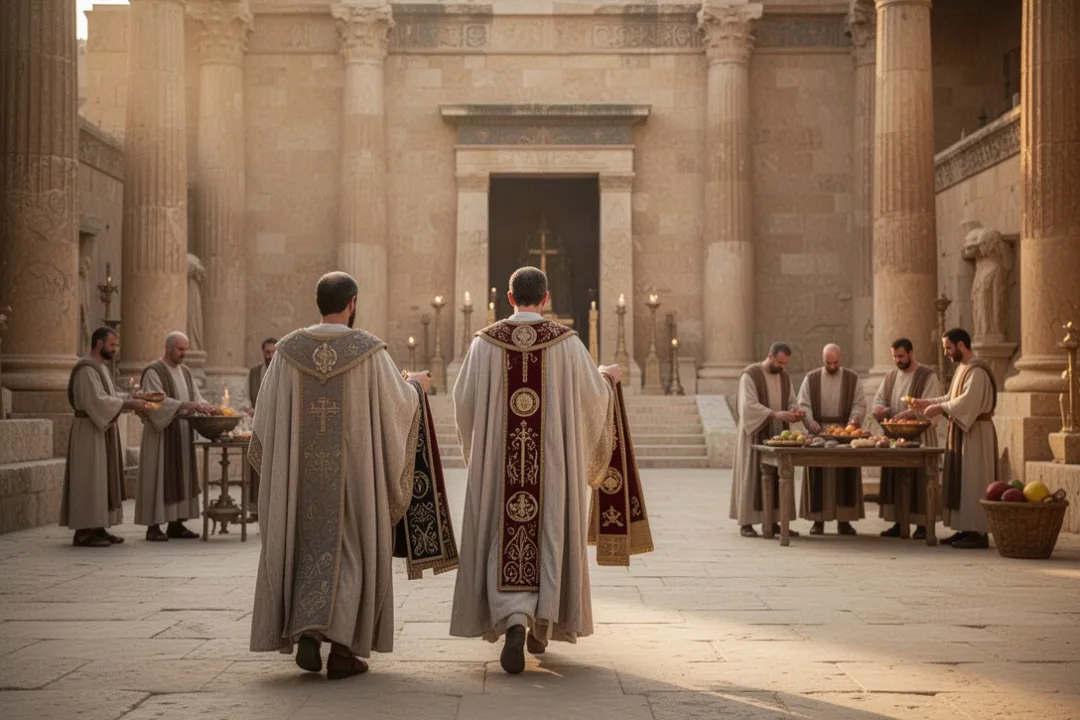
The high priest’s clothing was designed for “glory and beauty,” according to the description in Exodus 28, but its purpose went beyond appearance. Each major garment communicated something about his office, his relationship to God, and his responsibility for Israel.
The ephod and breastpiece carried Israel before God
The ephod was a special priestly garment made from fine materials and woven with colored threads. Two onyx stones were attached to it, and the names of the twelve tribes of Israel were engraved on those stones. Exodus 28 presents the high priest as carrying the tribes before God whenever he served.
The breastpiece of judgment was attached to the ephod. It contained twelve precious stones, each associated with one of Israel’s tribes. The image is clear: the high priest did not enter the sanctuary as an isolated individual. He bore the entire covenant community symbolically in God’s presence.
The breastpiece also held the Urim and Thummim, sacred objects connected with seeking divine decisions. The Bible does not explain their precise shape or operation, and it does not provide enough information to reconstruct how they were used. Their presence nevertheless shows that the high priest’s office included a role in seeking God’s judgment for Israel.
The robe, turban, and engraved plate marked his holiness
The high priest wore a blue robe beneath the ephod. Its distinctive features included pomegranates and bells along the lower edge. The bells were associated with his movement as he entered the sanctuary, while the pomegranates contributed to the garment’s symbolic richness.
On his head, the high priest wore a turban with a gold plate fastened to it. The plate bore words identifying him as holy to the Lord. This visible sign represented his dedication to sacred service and reminded the people that the priesthood belonged to God rather than to the priest’s personal ambition.
The high priest also wore a linen tunic, sash, and undergarments. The detailed instructions in Exodus stress that these garments were to be made carefully and worn in the prescribed way. Clothing, in this setting, was part of the ritual itself: it showed that the priest was approaching the sanctuary in an appointed office.
Why the Day of Atonement was the high priest’s most important service
The high priest’s most solemn duty took place on the Day of Atonement, called Yom Kippur in Hebrew. Leviticus 16 describes this annual ritual, which addressed the impurity and sins associated with the sanctuary, the priesthood, and the people of Israel.
On that day, the high priest entered the Most Holy Place, the innermost area of the sanctuary. Ordinary priests did not enter this space whenever they wished, and the high priest himself did not enter it freely throughout the year. His access was restricted to the appointed ritual and conducted with great care.
The ceremony began with preparation and sacrifice. The high priest offered a bull for his own sin offering and brought additional offerings connected with the people. He also wore simple linen garments for part of the service, rather than relying only on the more elaborate garments associated with his public office.
Two male goats were selected for the people. One was sacrificed, while the other was sent away into the wilderness after the high priest symbolically confessed Israel’s sins over it. This second goat is commonly called the scapegoat. The ritual expressed the removal of guilt from the community, although the Bible’s description does not use the modern word in exactly the same way people often do today.
The high priest also carried blood into the Most Holy Place and applied it according to the instructions in Leviticus 16. The ritual concerned the cleansing of the sanctuary from the effects of Israel’s sin as well as the restoration of the people’s relationship with God.
The Day of Atonement showed that sin was not treated as a minor personal mistake. It damaged the relationship between God and the covenant community and affected the sacred place where God’s presence was represented. Atonement involved confession, sacrifice, cleansing, and restored access.
Do not confuse the rituals: The high priest entered the Most Holy Place on the Day of Atonement, but the Bible does not describe this as an unrestricted or everyday privilege. The entrance was limited, scheduled, and governed by detailed instructions.
How the high priest represented the people
The high priest’s representative role appears in several parts of his ministry. His garments carried the names of Israel’s tribes, his sacrifices addressed the sins of the people, and his prayers and rituals took place on behalf of the nation.
That representation did not mean the people were free from personal responsibility. Israel’s laws repeatedly called individuals and families to obey God, make restitution where required, and bring appropriate offerings. The high priest acted for the community in particular sacred ceremonies, but he did not replace the people’s obligation to live faithfully.
The high priest also represented the people in weakness. Before making atonement for Israel, he had to make atonement for himself and his household. Hebrews 5:1–3 highlights this feature of the priesthood: the high priest could deal patiently with others because he too was subject to human weakness and needed offerings for sin.
This point gives the priesthood a deeply human character. The high priest was set apart, but he was not morally or physically beyond the condition of the people he served. His office pointed toward God’s holiness while also exposing the limitations of human representatives.
How the office developed after Aaron
After Aaron’s death, his son Eleazar became high priest, as recorded in Numbers 20. The office continued through the family line of Aaron, with succession generally passing among his descendants. The high priestly role remained connected with the tribe of Levi and, more specifically, with the priestly family descended from Aaron.
The high priest served in different historical settings as Israel’s worship center changed. The office existed during the period of the tabernacle, the first temple, the Babylonian exile, the second temple, and the Roman period. Its practical authority and political influence varied depending on the nation’s circumstances.
During the monarchy, the high priest worked within a larger system that included the king, prophets, Levites, and other priests. The king governed the nation, while the high priest led the priesthood and sanctuary service. These roles were distinct, even though the boundaries between religious and political influence sometimes became complicated.
After the exile, the high priest became especially significant because the restored Jewish community did not have an independent Davidic king ruling in the same way as before. In later periods, the high priest could hold substantial public influence, and foreign rulers sometimes became involved in appointing or removing high priests.
By the time of the New Testament, the high priesthood operated within the political system imposed by Rome. Several powerful priestly families competed for influence, and the office had both religious and public importance. The Gospels refer to figures such as Annas and Caiaphas in connection with the leadership surrounding Jesus’ arrest and trial, although the wording sometimes reflects a distinction between a current high priest and a former officeholder who retained influence.
What the high priest did in the New Testament period
In the New Testament period, the high priest was associated with the temple in Jerusalem and with the governing council commonly called the Sanhedrin. The high priest could preside over or participate in important religious and legal proceedings, though the exact structure and authority of the council varied over time.
The high priest and leading priests appear in the Gospel accounts as opponents of Jesus. The issue was not simply that Jesus challenged individual personalities. His actions and claims raised questions about temple worship, authority, messianic identity, and the future of Israel’s religious institutions.
At Jesus’ trial, the high priest questioned him about his identity, according to the Gospel narratives. The accounts differ in their details and emphasis, but they present the high priestly leadership as involved in the process that led to Jesus’ condemnation and delivery to the Roman governor.
The book of Acts also presents high priestly authorities as active in attempts to restrict the apostles’ preaching. These scenes show that the high priest was more than a ritual specialist. In the first century, the office could connect temple leadership, religious authority, public influence, and legal action.
Why Hebrews calls Jesus the great high priest
The New Testament book of Hebrews develops the most extensive interpretation of Jesus as a high priest. Hebrews does not present Jesus as a priest descended from Aaron. Instead, it connects him with the priestly figure Melchizedek, introduced in Genesis 14 and discussed in Psalm 110 and Hebrews 5–7.
According to Hebrews, Jesus’ priesthood is different from the Aaronic priesthood in several ways. Aaronic priests were mortal and served in succession, while Jesus is presented as a permanent priest. The argument is not that the earlier priests were meaningless; rather, their ministry served as a pattern that pointed beyond itself.
Hebrews emphasizes that Jesus can sympathize with human weakness because he experienced temptation, yet it describes him as without sin. This creates a contrast with Israel’s high priests, who had to offer sacrifices for their own sins before serving on behalf of others.
The book also presents Jesus’ death as a unique priestly offering. In Hebrews 9–10, the author contrasts repeated animal sacrifices with Jesus’ once-for-all self-offering. Because Bible translations differ, the central idea can be stated simply: Jesus offers himself rather than bringing an animal sacrifice, and his sacrifice is presented as fully effective rather than needing annual repetition.
Hebrews also changes the direction of the imagery. The high priest traditionally entered the earthly sanctuary, but Jesus is portrayed as entering the true heavenly presence of God. Hebrews 4:14–16 uses this belief to encourage Christians to approach God with confidence and to rely on Jesus as a compassionate representative.
For Christian readers, the title “great high priest” therefore expresses several convictions at once: Jesus represents humanity before God, provides atonement, understands human weakness, and gives believers access to God. The title builds on Israel’s priesthood while also claiming that Jesus fulfills what the earlier system could only symbolize.
How the high priest differs from ordinary priests
All priests belonged to the priestly family and served in the sanctuary, but the high priest held responsibilities that ordinary priests did not. The differences involved authority, clothing, access, and representative duties.
Access: The high priest entered the Most Holy Place for the Day of Atonement; ordinary priests served in other areas of the sanctuary.
Clothing: The high priest wore special garments, including the ephod, breastpiece, turban, and engraved gold plate.
Representation: The high priest symbolically carried the twelve tribes before God.
Leadership: He held the highest position within the priesthood and had oversight connected with national worship.
Responsibility: His failures could carry consequences for the wider community because of his representative office.
These distinctions did not make ordinary priests unimportant. Priests carried out daily sacrifices, maintained the sanctuary, taught aspects of the law, and performed many duties necessary for worship. The high priest depended on this broader priestly system even while standing at its head.
Practical tips for reading high priest passages accurately
References to the high priest can be confusing because the Bible discusses the office across many centuries and uses related terms in different contexts. These habits can help you read the passages more carefully.
Check the historical setting. Aaron’s role in Leviticus, the high priest after the exile, and the high priest in the Gospels belong to different periods.
Separate the high priest from the priesthood as a whole. Many passages about priests do not describe the unique duties of the high priest.
Read Leviticus 16 with the sanctuary structure in mind. The Day of Atonement depends on the distinction between the courtyard, the Holy Place, and the Most Holy Place.
Do not treat the scapegoat as a casual metaphor. It belonged to a specific ritual involving confession and the symbolic removal of Israel’s sins.
Compare Hebrews with its Old Testament background. The book’s argument about Jesus depends heavily on Leviticus, Psalms, and the priestly patterns in the Torah.
Keep political power and priestly ritual distinct. A first-century high priest could have public influence, but that does not mean every action was itself a temple ceremony.
Notice the priest’s need for atonement. The high priest represented the people but also needed cleansing and forgiveness.
A common mistake is to imagine the high priest as an all-powerful religious ruler similar to a modern head of a worldwide denomination. Ancient Israel’s system had no exact modern equivalent. The high priest’s authority was substantial, but it existed within the covenant law, the temple system, the priestly family, and the political conditions of each period.
Another mistake is to assume that the high priest could enter God’s presence whenever he wished. The biblical descriptions emphasize restricted access, prescribed clothing, sacrifices, and ritual preparation. The limited entrance of the Day of Atonement was meant to communicate both God’s nearness and God’s holiness.
Where high priest passages appear in the Bible
Several groups of passages are especially useful when studying the office. Each contributes a different part of the picture.
Exodus 28–29: Describes the high priest’s garments, consecration, and priestly appointment.
Leviticus 8–10: Describes the ordination of Aaron and his sons and records an early priestly failure.
Leviticus 16: Gives the central account of the Day of Atonement.
Numbers 20: Records the succession from Aaron to Eleazar.
Zechariah 3: Presents Joshua the high priest in a prophetic vision connected with accusation, cleansing, and restoration.
Matthew, Mark, Luke, and John: Mention high priestly leaders in the events surrounding Jesus’ arrest and trial.
Acts: Shows high priestly authorities interacting with the early Christian movement.
Hebrews 4–10: Explains Jesus’ priesthood, sacrifice, heavenly ministry, and access to God.
Reading these passages together prevents a one-sided understanding. Exodus and Leviticus show how the office was established; historical books and the prophets show how it functioned in Israel’s life; the Gospels and Acts place it in the first-century temple setting; Hebrews gives the major Christian theological interpretation.
What the high priest means for biblical theology
The high priest brings several major biblical themes together. He represents the need for a mediator between a holy God and a sinful people. He also shows that access to God is not treated casually and that forgiveness involves God’s provision rather than human self-confidence.
The office points to the seriousness of sin, but it also points to God’s willingness to provide a way for cleansing and restored fellowship. The priest’s work takes place within a system of sacrifice, but the system itself directs attention beyond ritual performance toward faithful relationship with God.
For Jewish readers, the high priest belongs to the history and worship of ancient Israel, especially the temple tradition and the Day of Atonement. For Christians, the office becomes a foundation for understanding Jesus’ atoning death and continuing intercession. In both settings, the central idea is representation: someone appointed to stand before God on behalf of others.
The high priest was therefore neither merely a ceremonial official nor an independent spiritual celebrity. He was a covenant servant whose office combined sacred access, national responsibility, personal weakness, and the need for atonement. Those features explain why the role remains central to biblical study long after the ancient temple system ended.
Frequently asked questions
Was Aaron the only high priest in the Bible?
No. Aaron was the first high priest, but the office continued through his descendants, beginning with his son Eleazar. Later passages refer to other high priests in Israel’s history and in the Second Temple period. The Bible also mentions high priests in the New Testament setting, including Annas and Caiaphas, whose roles were connected with temple leadership in the first century.
How often did the high priest enter the Most Holy Place?
The high priest entered the Most Holy Place as part of the annual Day of Atonement ritual described in Leviticus 16. This was not an ordinary daily activity. His entrance required prescribed sacrifices, special preparation, and specific garments. The limited access emphasized the holiness of the space and the seriousness of approaching God on behalf of the people.
Did the high priest have political power?
Sometimes, especially in periods when Israel lacked an independent king or lived under foreign rule. The high priest’s primary responsibility was religious, but the office could also carry public and political influence. In the first century, high priests were involved in temple administration and major proceedings, while their authority operated within the limits imposed by Roman rule.
Why does Hebrews call Jesus a high priest if he was not descended from Aaron?
Hebrews connects Jesus with the priestly order of Melchizedek rather than with Aaron’s family line. Its argument is that Jesus’ priesthood is permanent and distinct from the succession of Aaronic priests. Jesus is presented as both the representative who understands human weakness and the one whose self-offering provides lasting atonement.







Leave a Reply