Holy of Holies: Meaning, History, and Biblical Significance
Holy of Holies: Meaning, History, and Biblical Significance
The Holy of Holies was the innermost and most sacred room of ancient Israel’s tabernacle and temples, representing the unique presence of God among his people.
The name Holy of Holies comes from a Hebrew expression that can also be translated as the Most Holy Place. It describes a room set apart from every other part of Israel’s worship space. The sanctuary was not simply a private prayer room; it was the symbolic center of the covenant relationship between God and Israel.
In the tabernacle, the Holy of Holies stood behind a heavy inner veil. In Solomon’s Temple, it occupied the innermost section of the building. The area was associated with God’s throne and presence, yet it was separated from ordinary priests and worshipers because approaching the divine presence was considered profoundly holy and dangerous.
The room was also called the Most Holy Place in many English Bibles. These two names refer to the same sanctuary. “Holy of Holies” uses a Hebrew grammatical pattern that intensifies the word holy, much as “Song of Songs” refers to the greatest or most excellent song.
Central idea: The Holy of Holies showed both God’s nearness and God’s holiness. God dwelled among Israel, but access to his presence was carefully limited and governed by sacrifice, priesthood, and ritual preparation.
Where the Holy of Holies appeared in the Bible
The first Holy of Holies belonged to the wilderness tabernacle, the portable sanctuary described in Exodus. The tabernacle accompanied Israel during its wilderness years and provided a structured place for worship, sacrifice, and the priestly ministry established through Moses and Aaron.
Later, the same basic pattern appeared in Israel’s permanent temples. Solomon built the first temple in Jerusalem, including an inner sanctuary separated from the larger temple room. After that temple was destroyed, a second temple was built, and it was later expanded and renovated under Herod’s rule. The New Testament refers to the temple in Jerusalem during the time of Jesus.
The biblical descriptions emphasize the design and purpose of the sanctuary rather than giving a complete architectural record for every period. The arrangement remained significant because it communicated a theological order: the farther inward a person went, the more restricted and sacred the space became.
How the Holy of Holies functioned step by step
The worship system surrounding the Holy of Holies followed a clear sequence. Each part reinforced the seriousness of approaching God and the need for purification and mediation.
Israel gathered around the sanctuary. The tabernacle stood at the center of Israel’s camp, with the tribes arranged around it. This placement presented God’s presence as central to the nation’s identity and life.
Priests served in the outer sanctuary. Ordinary priests entered the Holy Place, the room outside the inner veil, to perform duties connected with lamps, incense, and the bread of the presence. They did not enter the Holy of Holies as part of their normal service.
The inner veil marked the boundary. A richly made curtain separated the Holy Place from the Most Holy Place. It communicated that access to God’s immediate presence was not casual or open to everyone.
The high priest prepared for the Day of Atonement. Before entering, the high priest followed the purification and sacrifice instructions given in Leviticus 16. His preparation included washing, special linen clothing, and offerings for himself and the people.
Sacrificial blood was brought inside. The high priest entered the inner sanctuary with blood from the prescribed sacrifices. The ritual addressed the uncleanness and sins associated with Israel and its sanctuary.
The high priest left the sanctuary. After completing the ritual, he returned to the people. The ceremony did not make ordinary, unrestricted access possible; it renewed the covenant community within the system God had given Israel.
This annual ritual was not a private spiritual exercise performed according to personal preference. It represented the entire covenant people before God. The high priest acted as a representative, and the sacrifices symbolized the seriousness of sin and the need for cleansing.
What was inside the Holy of Holies
The central object associated with the Holy of Holies was the Ark of the Covenant. The ark was a sacred chest made according to the instructions in Exodus. It represented God’s covenant with Israel and was closely connected with the divine presence above it.
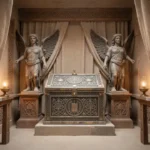
The ark had a cover often called the mercy seat or atonement cover. Two cherubim were positioned above the cover, facing toward it with their wings extended. The biblical imagery presents the space above the cover as a place where God would meet with Moses and speak concerning Israel.
The ark was not a physical container for God. Biblical theology does not treat God as limited to a room or object. Instead, the ark served as a visible sign of God’s covenant rule and presence. The cherubim also echoed the imagery of heavenly guardians and a divine throne, giving the sanctuary a royal and heavenly character.
Hebrews 9 refers to items associated with the ark, including the jar of manna, Aaron’s budding staff, and the covenant tablets. The precise placement of these objects varies among biblical passages and later traditions, so it is best to describe them as items connected with the ark and the tabernacle tradition rather than assume every object was permanently inside the inner room.
In Solomon’s Temple, the inner sanctuary contained large carved cherubim whose wings extended across the room. The room’s decoration used gold and carefully designed plant and heavenly imagery. These features reinforced the idea that the sanctuary represented a meeting point between the earthly worship of Israel and the heavenly throne of God.
Why the inner veil mattered
The veil was more than a decorative curtain. It was a physical boundary with a theological meaning: human beings cannot approach God’s holiness on their own terms. The curtain separated the priestly service of the Holy Place from the special access granted to the high priest on the Day of Atonement.
The veil also protected the sanctuary from improper access. In the biblical system, holiness was not merely moral goodness or emotional intensity. It described being set apart for God, and contact with what was holy required obedience to the rules governing the sanctuary.
Leviticus 16 warns that Aaron was not to enter the inner sanctuary whenever he wished. The high priest needed to follow the appointed ritual because unregulated access could bring judgment. The warning made the boundary unmistakable: the privilege of approaching God’s presence came with strict responsibility.
The veil therefore communicated two truths at the same time. God was genuinely present with Israel, and the relationship between a holy God and a sinful people required mediation and purification. The sanctuary did not suggest that God was distant in the ordinary sense; it showed why access had to be ordered and safeguarded.
Who could enter the Holy of Holies
Under the tabernacle and temple system described in the Torah, the high priest was the only person authorized to enter the Holy of Holies, and his access was associated especially with the annual Day of Atonement. Ordinary priests served in the Holy Place but did not pass through the inner veil into the Most Holy Place.
The high priest did not enter as a private individual. He represented Israel and first dealt with his own need for purification. The ritual in Leviticus 16 includes sacrifices for the high priest and his household, followed by offerings connected with the people and the sanctuary.
His clothing also changed for this service. Instead of wearing the full set of ornate garments used in some priestly duties, he wore sacred linen garments for the Day of Atonement ritual. The change emphasized humility and the solemn character of the ceremony rather than personal display.
Traditional Jewish practice connected the Day of Atonement with an annual entrance into the inner sanctuary. After the destruction of the temple, the sacrificial service of the Holy of Holies could no longer be performed. Jewish observance of Yom Kippur developed around prayer, repentance, fasting, and other practices rather than temple sacrifice.
The Day of Atonement and the Holy of Holies
Leviticus 16 provides the most detailed biblical explanation of the Holy of Holies ritual. The Day of Atonement, known in Hebrew as Yom Kippur, addressed the sins and ritual uncleanness of the people as well as the sanctuary itself.
The ceremony involved several important elements:
Purification of the high priest: He prepared himself through washing, special clothing, and sacrifice before acting for the nation.
Offerings for sin: The prescribed animals represented the seriousness of sin and the need for atonement.
Blood applied in the sanctuary: The ritual used blood in a way that symbolized purification and the removal of the defilement associated with sin.
The two goats: One goat was sacrificed, while the other was sent away into the wilderness after the priest confessed Israel’s sins over it. This imagery portrayed sin being carried away from the community.
Renewal of the covenant community: The ritual restored the people’s standing within the worship system and marked the sanctuary as cleansed.
The ceremony did not imply that an animal had independent magical power. Its meaning came from God’s covenant instructions and the priestly act of presenting the sacrifice. The ritual taught Israel that forgiveness, cleansing, and restored fellowship were gifts of divine mercy, but they were not to be treated lightly.
The Hebrew Bible presents atonement through several related ideas, including covering, cleansing, purging, and reconciliation. These terms should not be reduced to one simple mechanical explanation. The Day of Atonement addressed both the people’s guilt and the contamination that sin brought into the sacred community.
How the temples represented the Holy of Holies
In the tabernacle, the Most Holy Place was a defined section of a portable tent. It was separated by a veil and contained the ark. Its design allowed Israel to carry the sanctuary while traveling through the wilderness and later during periods of settlement.
In Solomon’s Temple, the inner sanctuary was built as a distinct room at the back of the main temple structure. The biblical description presents it as a cube, with equal length, width, and height. Large cherubim, gold surfaces, and carved imagery gave the room the appearance of a royal throne room.
The later temple in Jerusalem retained the division between the outer temple areas and the Most Holy Place. However, the history of the ark after the destruction of Solomon’s Temple is uncertain. Biblical and later Jewish sources do not provide a single, universally accepted account of what happened to it, so claims about its location should be treated cautiously.
By the time of the New Testament, the temple remained the center of Jewish worship in Jerusalem. The Gospel accounts mention the temple curtain in connection with Jesus’ death. The precise historical details of that curtain and its ritual use are interpreted differently across Christian traditions, but the event clearly draws on the symbolism of restricted access to the Holy of Holies.
Historical caution: The biblical text gives the clearest information about the tabernacle and the first temple. Details about later temple furnishings, the ark’s fate, and the exact appearance of the veil are not all known with certainty.
What the Holy of Holies meant for Israel’s faith
The Holy of Holies expressed the holiness of God more powerfully than any ordinary meeting place could. God was not represented as one local deity among many. The sanctuary’s symbolism presented him as the covenant Lord whose presence governed Israel’s worship and national life.
At the same time, the inner sanctuary communicated God’s willingness to dwell among his people. The ark, the mercy seat, and the tabernacle arrangement all pointed to a God who chose to be present in the midst of Israel. Holiness was therefore not only a barrier; it was also an invitation to live in covenant relationship under God’s care.
The Holy of Holies also taught that worship required mediation. Priests, sacrifices, washings, and appointed times created a structured way for the community to approach God. These practices separated Israel’s worship from casual religious activity and reminded the people that reconciliation involved both divine mercy and faithful obedience.
The sanctuary carried a warning about human pride. No king, soldier, wealthy worshiper, or ordinary priest could simply enter because of social status or personal confidence. The rules applied to everyone, including the high priest, whose access depended on obedience to God’s instructions.
The Holy of Holies in the book of Hebrews
The New Testament book of Hebrews gives the Holy of Holies a central role in its explanation of Jesus’ priesthood. Hebrews compares the earthly sanctuary and its repeated sacrifices with the greater work it attributes to Jesus as high priest.
Hebrews 9 describes the structure of the tabernacle and the restricted entrance into the inner sanctuary. It then presents Jesus’ sacrifice as superior to the repeated animal offerings of the older covenant system. The writer’s point is theological: Jesus offers a lasting means of cleansing and access to God rather than a ritual that must be repeated every year.
Hebrews 10 uses the sanctuary imagery to encourage believers to approach God with confidence. That confidence is not based on ignoring holiness or pretending that sin does not matter. It rests on the belief that Jesus’ priestly work provides the cleansing and mediation that the former system represented.
Christian traditions differ in how they explain the relationship between Jesus’ death, resurrection, ascension, and the heavenly sanctuary. They generally agree that the Holy of Holies points beyond the physical room to questions of atonement, access, mediation, and God’s presence.
What the torn temple curtain means in Christianity
Matthew 27, Mark 15, and Luke 23 report that the temple curtain was torn when Jesus died. The accounts do not all describe the event in exactly the same way, but Christian interpretation has often connected it with the opening of access to God.
The torn curtain does not mean that the Holy of Holies was an unimportant symbol. It means that the barrier represented by the curtain has been reinterpreted through Jesus’ death. In the Christian reading, the separation caused by sin is addressed through Christ’s mediating work rather than through the continuing annual entrance of the high priest.
Some Christian traditions connect the torn curtain specifically with the inner veil, while others focus more broadly on the temple’s sacred boundary. Either way, the image marks a dramatic transition. The symbolism moves from limited access through one priest on one appointed day toward direct approach to God through Christ.
This interpretation should not be projected backward onto every Jewish practice. The Holy of Holies had a meaning within Israel’s covenant worship before Christian claims about Jesus. Christian theology builds on that earlier meaning and reads it as a pattern fulfilled in the new covenant.
How the Holy of Holies differs from the Holy Place
The Holy Place and the Holy of Holies were not two names for the same room. They were separate sections of the tabernacle and temple, divided by a veil and assigned different levels of access.
The Holy Place: Priests entered this room for regular service. It contained the lampstand, the table for the bread of the presence, and the altar of incense according to the tabernacle arrangement.
The Holy of Holies: The high priest entered this inner room under special conditions, especially for the Day of Atonement. It was associated with the ark, the mercy seat, and God’s covenant presence.
The courtyard: Worshipers could come into the outer areas of the sanctuary according to the rules governing Israel’s sacrifices and religious life. The courtyard was less restricted than either inner room.
These divisions created a visual and practical hierarchy of holiness. The courtyard, Holy Place, and Holy of Holies belonged to one sanctuary, but they did not offer identical access. The arrangement helped worshipers understand that nearness to God was possible while also recognizing boundaries established by divine command.
Common misunderstandings about the Holy of Holies
One misunderstanding is that the Holy of Holies was simply the place where God was physically trapped. The biblical writers use sanctuary language to describe God’s presence, but they also affirm that God cannot be contained by a human building. Solomon’s prayer in 1 Kings 8 makes this tension clear by celebrating the temple while acknowledging that the heavens cannot contain God.
Another misunderstanding is that only the high priest was allowed anywhere near the temple. Priests served in the Holy Place, and the people participated in worship in the outer areas under the laws governing the sanctuary. The strictest restriction concerned the inner room.
Some readers also assume that the high priest entered the room whenever a major religious need arose. The biblical rules describe a particular annual ritual for the Day of Atonement, not casual or frequent access. The timing and preparation were part of the meaning.
Finally, the Holy of Holies should not be treated as a complete blueprint for every modern church building. Some Christian communities use sanctuary architecture inspired by biblical imagery, but the ancient Israelite tabernacle and temple served a specific covenant, priestly, and sacrificial system.
Why the Holy of Holies still matters
The Holy of Holies remains important because it gathers several major biblical themes into one image: God’s presence, human sin, priestly mediation, sacrifice, judgment, mercy, and restored fellowship. Understanding the room helps readers make sense of the laws in Exodus and Leviticus as well as the arguments in Hebrews.
It also provides essential context for the language of access in Christian worship. Phrases about drawing near to God, entering God’s presence, or having confidence before God often echo the restrictions and rituals associated with the inner sanctuary.
For Jewish readers, the Holy of Holies belongs to the history and theology of the Jerusalem temple and the Day of Atonement. For Christians, it also becomes a symbol of Jesus’ priestly ministry and the new covenant. Those interpretations should be distinguished while still recognizing the shared biblical foundation.
The room’s deepest message is not simply that God is hidden. It is that divine holiness is real, human beings need reconciliation, and access to God depends on a way God himself provides. In the biblical story, the Holy of Holies stands at the center of that tension between sacred distance and gracious presence.
How to read Holy of Holies passages in context
When you encounter the phrase in Scripture, identify which sanctuary period the passage describes. Exodus and Leviticus primarily concern the tabernacle, 1 Kings and 2 Chronicles describe Solomon’s Temple, and Hebrews reflects on the sanctuary through the lens of Christian theology.
Then ask what the passage is emphasizing. A text may focus on the ark, the veil, the high priest, the Day of Atonement, the temple’s destruction, or access to God. Each detail contributes to the larger meaning, but not every passage is making the same point.
Read the surrounding chapter: A single mention of the inner sanctuary can be misunderstood without its ritual or historical context.
Distinguish physical description from symbolism: Biblical sanctuary language can describe an actual room while also expressing theological ideas.
Check the covenant setting: Levitical instructions and New Testament reflections do not use the sanctuary in identical ways.
Handle uncertain details carefully: The fate of the ark and the precise appearance of later temple furnishings are not fully documented.
Compare related passages: Exodus, Leviticus, Kings, Chronicles, the Gospels, and Hebrews each add different information.
The Holy of Holies is best understood as both a real sanctuary in Israel’s worship and a concentrated symbol of the Bible’s teaching about God’s presence. Its veil, ark, priest, and annual ritual all point to the same central question: how can a holy God dwell with a sinful people and allow them to draw near?
Frequently asked questions
Is the Holy of Holies the same as the sanctuary?
Not exactly. The sanctuary can refer to the whole sacred complex, including the courtyard, Holy Place, and Most Holy Place. The Holy of Holies was the innermost room within that larger sanctuary. It was separated from the Holy Place by a veil and had the most restricted access.
Did the high priest enter the Holy of Holies every day?
No. The biblical instructions especially associate his entrance with the annual Day of Atonement described in Leviticus 16. He had to complete specific purification rituals and bring the appointed sacrifices. Ordinary priests served in the Holy Place but did not enter the inner room as part of their regular duties.
What happened to the Holy of Holies after the temple was destroyed?
After the Jerusalem temple was destroyed, its sacrificial and priestly service could no longer continue in the same way. The location and fate of the original ark are uncertain. Jewish observance of Yom Kippur continued through prayer, repentance, fasting, and other practices rather than through the temple’s former rituals.
Why do Christians connect the Holy of Holies with Jesus?
The book of Hebrews presents Jesus as the ultimate high priest whose sacrifice provides lasting cleansing and access to God. The Gospel accounts of the temple curtain tearing at Jesus’ death are also commonly interpreted as a sign that the separation symbolized by the veil had been overcome through his mediating work.





Leave a Reply