Eleazar was the son of Aaron and Elisheba, the nephew of Moses, and the third high priest of Israel. He became high priest after Aaron’s death and served during Israel’s transition from the wilderness years into the settlement of the promised land. His story appears mainly in Exodus, Leviticus, Numbers, and Joshua.
Eleazar is also the name of several other men in the Bible, so the reference can be confusing. The most prominent Eleazar is Aaron’s son, but Scripture also mentions an Eleazar who fought a Philistine, an Eleazar connected with the ark, and men named Eleazar in later genealogical records.
The name Eleazar comes from Hebrew and is commonly understood to mean “God has helped” or “God is my help.” Biblical names often express faith, family memory, or a hope connected with God’s action. The meaning fits the biblical portrait of Aaron’s son, whose position depended on God’s calling rather than personal ambition.
Eleazar’s importance comes from more than his family connection. He served during a period when Israel’s leadership was changing: Moses was still leading the nation, Aaron’s priestly ministry came to an end, Joshua would eventually succeed Moses, and the wilderness generation was giving way to a new generation. Eleazar stood at the center of those transitions.
His work involved worship, ritual responsibility, national leadership, and the preservation of priestly succession. He was not usually presented as a dramatic speaker or battlefield hero. Instead, his faithfulness appears through careful service, obedience to God’s instructions, and the steady transfer of responsibility.
Quick answer: When the Bible refers simply to “Eleazar,” it most often means Aaron’s son. He became Israel’s high priest after Aaron and later worked with Moses and Joshua to guide the people and distribute their inheritance.
Eleazar’s family and position among Israel’s priests
Eleazar was born into the family chosen for Israel’s priesthood. His father, Aaron, was Moses’ brother and Israel’s first high priest. His mother was Elisheba, daughter of Amminadab and sister of Nahshon, a leader from the tribe of Judah, according to Exodus 6:23.
Eleazar had three brothers who are named in the priestly records: Nadab, Abihu, and Ithamar. Nadab and Abihu were also priests, but they died after offering unauthorized fire before the Lord, as described in Leviticus 10. After their deaths, Eleazar and Ithamar continued the priestly service.
The distinction between Eleazar and Ithamar matters because both survived into the later wilderness period, but Eleazar eventually received the office of high priest. The biblical record presents this succession as part of God’s established order for the priesthood, not as a political contest between brothers.
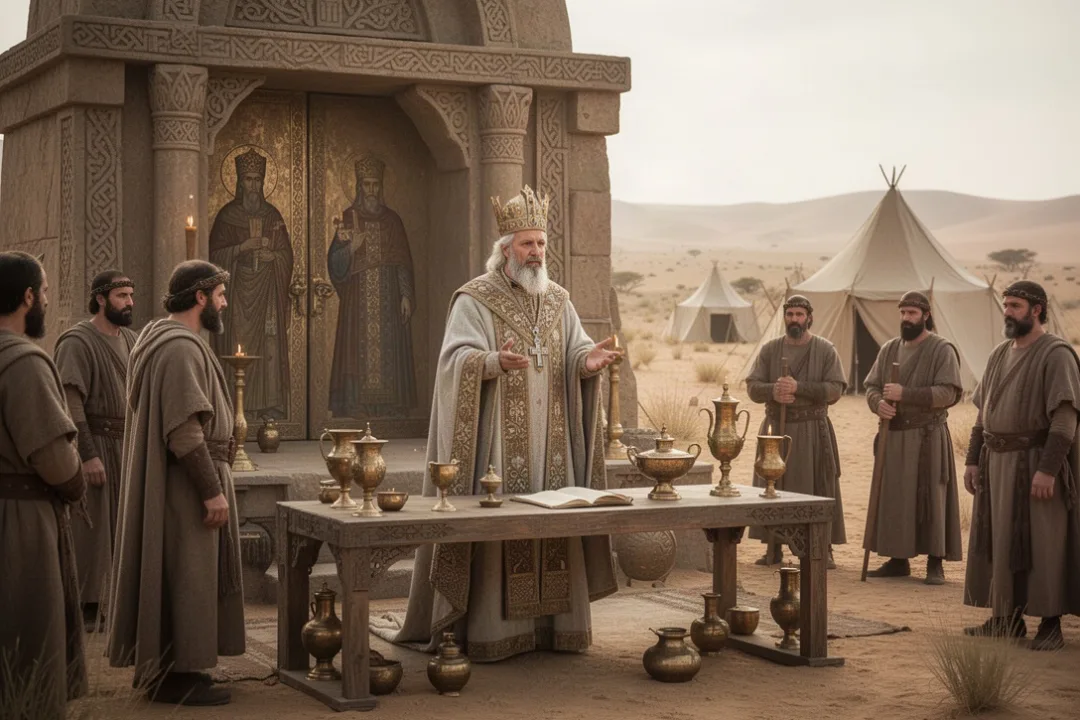
Eleazar’s responsibilities were connected to the tabernacle, the portable sanctuary where Israel worshiped during the wilderness years. Numbers 4 describes the duties assigned to Aaron’s sons, including oversight of sacred objects and the work of the priests and Levites. Eleazar had particular authority over the oil for the lamps, fragrant incense, the regular grain offering, and the anointing oil.
These duties show that his role involved both ritual supervision and practical administration. He was responsible for sacred materials and for ensuring that worship continued according to God’s commands. His ministry was not limited to ceremonial moments; it required ongoing care and accountability.
How Eleazar became high priest after Aaron
Eleazar became high priest after Aaron died on Mount Hor. Numbers 20 records that God instructed Moses to take Aaron and Eleazar up the mountain. There Moses removed Aaron’s priestly garments and put them on Eleazar, marking the transfer of office before Aaron’s death.
The scene communicates several things at once. Aaron’s ministry had ended, but the priesthood continued. The sacred office did not depend on one man living forever, and Eleazar did not seize the position. He received it through a public act that confirmed continuity between generations.
After Aaron died, the people mourned him for thirty days. Eleazar then served as high priest while Moses remained the nation’s leader. This arrangement illustrates the different responsibilities held by Israel’s leaders: Moses was the great prophet and covenant mediator, while Eleazar represented the priestly ministry.
The transfer also carried a serious emotional and spiritual weight. Eleazar had lost his father and inherited his public responsibilities at the same time. The biblical account does not describe his private feelings, but the circumstances make clear that succession involved both grief and duty.
Eleazar’s responsibilities as high priest
Eleazar’s high-priestly role can be understood through several connected responsibilities. Together, they explain why he remained a significant figure during Israel’s journey and settlement.
Guarding the priestly system: He helped preserve the worship practices and responsibilities assigned to Aaron’s descendants.
Supervising sacred materials: He oversaw items used in the tabernacle and the regular offerings connected with worship.
Supporting national decisions: He joined Moses in communicating God’s direction to the people and in making decisions that affected all Israel.
Maintaining continuity: He carried the priesthood from Aaron’s generation into the generation that entered Canaan.
Overseeing succession: He later participated in the transfer of leadership from Moses to Joshua.
Some of these responsibilities were explicitly ritual, while others were connected to national administration. In Israel’s system, worship and public leadership were closely related. Decisions about war, purification, inheritance, and leadership could affect the spiritual life of the whole community.
Eleazar therefore represented more than a religious official performing ceremonies. He was a guardian of a system designed to keep Israel’s worship ordered and to remind the people of their covenant relationship with God.
Eleazar’s role in the judgment after Korah’s rebellion
Eleazar appears in a serious episode after the rebellion led by Korah, Dathan, and Abiram in Numbers 16. The rebellion challenged the authority of Moses and Aaron and questioned the special priestly role assigned to Aaron’s family.
After judgment fell on the rebels, God instructed Eleazar to take the censers used by the men who had offered unauthorized incense. The censers were hammered into a covering for the altar. This object served as a visible reminder that unauthorized claims to priestly authority had brought judgment.
Eleazar’s participation was significant because it connected him directly with the preservation of legitimate worship. The censers were not treated as ordinary objects, and they were not simply discarded. Their conversion into a covering for the altar made them a warning for future generations.
This account also shows the danger of treating spiritual authority as a matter of personal status. The rebellion was not merely a disagreement over administrative policy. It challenged the order God had established for Israel’s worship and leadership. Eleazar’s work helped turn the event into a lasting lesson for the community.
Reading tip: Eleazar’s story is best understood through the passages that describe his duties, not through one isolated event. Numbers 3–4, Numbers 16–20, Numbers 25–27, Numbers 31, and Joshua 14–19 together show the range of his ministry.
Eleazar and the bronze serpent’s purification rules
Numbers 19 assigns Eleazar a role in preparing the ashes of the red heifer. This ritual was connected with purification from contact with death, one of the most serious forms of ritual impurity in Israel’s worship system.
Eleazar was to supervise the preparation outside the camp. The animal was burned according to the prescribed instructions, and its ashes were kept for use in water associated with purification. The process was not a private ceremony; it was part of a broader system that allowed people to return to the worshiping community after ritual defilement.
The passage emphasizes the care required when dealing with holiness and impurity. Eleazar had to follow the instructions precisely, because the ritual involved both the person being purified and the people handling the materials. The biblical system distinguished between physical death, ritual status, and moral guilt, even though these categories could overlap in the community’s religious life.
Readers sometimes connect this passage with the bronze serpent because both appear in the wilderness narratives and involve objects used in Israel’s religious memory. They are not the same ritual. The red-heifer ashes were used for purification, while the bronze serpent in Numbers 21 was associated with healing from venomous snakebites.
Eleazar’s leadership after the plague at Peor
In Numbers 25, Israel became involved in idolatrous and immoral worship at Peor. A plague struck the community, and the crisis ended when Phinehas, Eleazar’s son, acted decisively against the wrongdoing. Phinehas’ action brought an end to the immediate judgment, and God established a special covenant of peace with him.
This event makes Eleazar the father of a priest whose actions had major consequences for Israel’s future. The account also highlights the seriousness of covenant disloyalty. Israel’s worship was not treated as a private preference; it affected the community’s identity and relationship with God.
Eleazar’s presence in this part of the story is less about a recorded speech or action and more about the priestly family line. He was the father of Phinehas, who later became a prominent priest. Through Eleazar and Phinehas, the priesthood continued into another generation.
Eleazar and the selection of Joshua
When Moses learned that he would not lead Israel into the promised land, he asked God to appoint a successor who would guide the people. Numbers 27 records that Joshua was chosen, and Moses was instructed to present him before Eleazar and the congregation.
Eleazar had a specific role in seeking God’s direction for the nation. Joshua was to stand before Eleazar, who would inquire before the Lord on his behalf using the priestly means provided for that purpose. This arrangement placed Joshua’s military and administrative leadership alongside Eleazar’s priestly responsibility.
Moses then laid his hands on Joshua and commissioned him publicly. Eleazar and the community witnessed the transfer. The scene shows that Israel’s leadership was not replaced by one person taking every responsibility. Instead, Joshua led the people, while Eleazar continued to serve as high priest and spiritual authority.
This division of responsibility is one of the clearest features of Eleazar’s career. He did not replace Moses as national leader, and Joshua did not replace him as priest. Their roles were distinct but connected, allowing Israel to move forward under coordinated leadership.
Numbers 31 describes Israel’s war against Midian and Eleazar’s instructions to the soldiers afterward. The priest explained the purification requirements for people, clothing, metal objects, and other items that had been exposed to the battle.
He also helped determine how the captured goods were to be handled. The passage connects military victory with worship, purification, and the distribution of possessions. Israel could not simply return from battle and resume ordinary life without addressing the ritual consequences of war.
This episode reveals Eleazar as a practical leader in a complicated national crisis. He dealt with questions that involved soldiers, property, communal purity, and offerings. His ministry reached beyond the tabernacle courtyard and into the public life of the nation.
For modern readers, the ritual details can seem distant, but they show how the biblical community understood responsibility. Victory did not remove the need for obedience. Material gain did not erase the need for purification or gratitude. Eleazar’s instructions brought those concerns together.
Eleazar and the division of Israel’s inheritance
After Israel entered Canaan, Eleazar worked with Joshua and the tribal leaders to divide the land. Numbers 34 names him alongside Joshua as one of the officials responsible for distributing the inheritance west of the Jordan River.
Joshua 14–19 repeatedly places Eleazar in the setting where the tribes received their territories. He was present when the land was assigned by lot and when the boundaries of tribal possessions were established. His involvement gave the process priestly oversight as well as civil administration.
The land division was more than a property survey. The promised land was understood as a gift from God, and each tribe’s inheritance carried historical, economic, and religious importance. Decisions about boundaries could affect generations, so the process required public accountability.
Eleazar’s role shows that the priesthood remained involved after Israel left the wilderness. The high priest was not only responsible for sacrifices. He participated in the orderly establishment of the nation in its new home.
Several details make this responsibility especially important:
The distribution involved all the tribes, not only the priestly family.
The inheritance was treated as a covenant gift, not merely land captured in war.
Eleazar worked with Joshua, showing cooperation between priestly and civil leadership.
The process created a stable national structure for families and future generations.
How Eleazar’s ministry ended and continued through Phinehas
The Bible does not provide a detailed account of Eleazar’s death, but Joshua 24:33 records that he died and was buried at Gibeah, in the hill country of Ephraim, in a place associated with his son Phinehas. The verse marks the end of his service and the continuation of the priestly line through his family.
Eleazar’s career therefore spans several major stages of Israel’s history: the wilderness tabernacle, the priestly succession after Aaron, the crises of the desert years, the commissioning of Joshua, the military campaign against Midian, and the division of Canaan.
His influence continued through Phinehas. Later biblical records refer to the descendants of Eleazar, and the priestly line associated with him became important in Israel’s religious history. The story is one of institutional continuity: a responsibility entrusted to Aaron was carried by Eleazar and then passed to another generation.
Eleazar’s life also demonstrates that a person can have a major biblical role without many personal speeches or dramatic scenes. His importance is shown through the responsibilities he carried and the stability he provided during national change.
Other men named Eleazar in the Bible
Not every biblical reference to Eleazar concerns Aaron’s son. The name appears in several family and historical settings. Checking the surrounding passage is essential before drawing conclusions about which Eleazar is meant.
Eleazar the son of Dodo
Second Samuel 23 and First Chronicles 11 mention Eleazar son of Dodo, one of David’s notable warriors. He fought the Philistines when Israel’s troops withdrew, and the account presents him as a courageous soldier who stood firm in battle.
This Eleazar was not a priest. His story belongs to the military traditions surrounding David’s mighty men. The similarity of names can cause confusion, but the family connection and setting clearly distinguish him from Aaron’s son.
First Samuel 7 refers to Eleazar, son of Abinadab, who was set apart to guard the ark after it was brought to the house of Abinadab. This account takes place before David brought the ark to Jerusalem.
Because this Eleazar is connected with the ark, readers may mistake him for a priest. The passage does not identify him as Aaron’s son or as the high priest. His role was associated with guarding the sacred object in his family’s care.
Eleazar in the genealogies and later records
The name also appears in genealogical lists and later Jewish history. In Matthew 1, Eleazar is included in the genealogy that traces the line from Aaron through later generations to Joseph, the husband of Mary. In Ezra 8, a priest named Eleazar is among those involved in the return from exile.
These references belong to different periods and individuals. Biblical genealogies often use names that recur across generations, so the name alone does not establish that two people are the same. The surrounding family information and historical setting provide the necessary identification.
What Eleazar teaches about faithful service
Eleazar’s story offers several useful themes for reading the Bible. First, leadership can be faithful without being conspicuous. His service was often administrative, ritual, or supervisory, but those duties mattered because they protected the community’s worship and order.
Second, succession requires preparation and humility. Eleazar received Aaron’s garments and office after his father’s death. Later, he helped support Joshua’s appointment. In both situations, the focus was not on preserving personal status but on ensuring that God’s work continued through the next generation.
Third, spiritual responsibility includes ordinary details. Eleazar dealt with sacred objects, purification rules, military spoils, national boundaries, and public ceremonies. The biblical presentation joins worship with careful practical action rather than separating faith from daily administration.
Fourth, his story places authority under accountability. Eleazar did not invent the priesthood’s rules or make himself the center of national leadership. He served within a structure that connected God’s instructions, Moses’ leadership, the congregation’s witness, and Joshua’s future role.
When you study Eleazar, these steps can help keep the passages clear:
Identify the family connection. Aaron’s son is the high priest; other Eleazars belong to different families.
Check the historical setting. Wilderness passages differ from the stories of David, the ark, or the postexilic community.
Read the surrounding chapter. Eleazar’s responsibilities are often explained by the event around his name.
Separate priestly and military roles. Eleazar son of Dodo was a warrior, while Aaron’s son served as a priest and national leader.
Track succession. Aaron, Eleazar, and Phinehas show how priestly responsibility continued across generations.
Where to read about Eleazar
The most useful starting passages are Numbers 3 and 4 for his priestly duties, Numbers 16 for the censers after Korah’s rebellion, Numbers 19 for purification, and Numbers 20 for his succession to Aaron. Numbers 25–27 develops his connection with Phinehas and Joshua.
Numbers 31 shows his instructions after the war against Midian. Numbers 34 and Joshua 14–19 describe his participation in dividing the land. Joshua 24 records his death, while Second Samuel 23, First Samuel 7, Matthew 1, and Ezra 8 refer to other men named Eleazar.
Reading these passages together gives a fuller picture than focusing on the name in isolation. The central Eleazar was a priest, successor, administrator, and guardian of continuity during one of the most important transitions in Israel’s history.
Frequently asked questions
Was Eleazar the same person as Lazarus?
No. Eleazar and Lazarus are related forms of a Hebrew name, but the biblical characters are different. Eleazar was Aaron’s son and Israel’s high priest in the Old Testament. Lazarus was a man from Bethany whom Jesus raised from the dead in the Gospel of John. Similar naming traditions do not make them the same individual.
Who became high priest after Eleazar?
Eleazar’s son Phinehas succeeded him in the priestly line. The biblical record emphasizes family continuity within Aaron’s descendants, although it does not provide a complete, uninterrupted list of every high priest between the wilderness period and later Israelite history.
Did Eleazar enter the promised land?
Yes. Eleazar was alive after Israel entered Canaan and worked with Joshua and the tribal leaders to distribute the land. This distinguishes him from Aaron, who died before Israel crossed the Jordan. Eleazar continued serving as high priest during the settlement period.
Why is Eleazar important to Christian Bible study?
Eleazar helps readers understand the Old Testament priesthood, the importance of succession, and the relationship between worship and national leadership. His service also provides historical background for the priestly family line that appears in later biblical genealogies and religious traditions.





Leave a Reply