Ammonites in the Bible: History, conflicts, and meaning
Ammonites in the Bible: History, conflicts, and meaning
The Ammonites in the Bible were an ancient people descended from Lot, Abraham’s nephew, and they lived east of the Jordan River. Their capital was Rabbah, later known as Rabbath-ammon and associated with modern Amman. The Bible presents them as relatives of Israel with a complicated history: God protected their territory at one point, yet their rulers repeatedly fought Israel and were later condemned for violence, pride, and hostility.
The Ammonites were not the same people as the Amalekites, Moabites, or Canaanites, although all appear in the broader story of Israel’s neighbors. Their story includes family origins, territorial boundaries, wars with Israel, political alliances, prophetic warnings, and examples of how Scripture evaluates both individuals and nations.
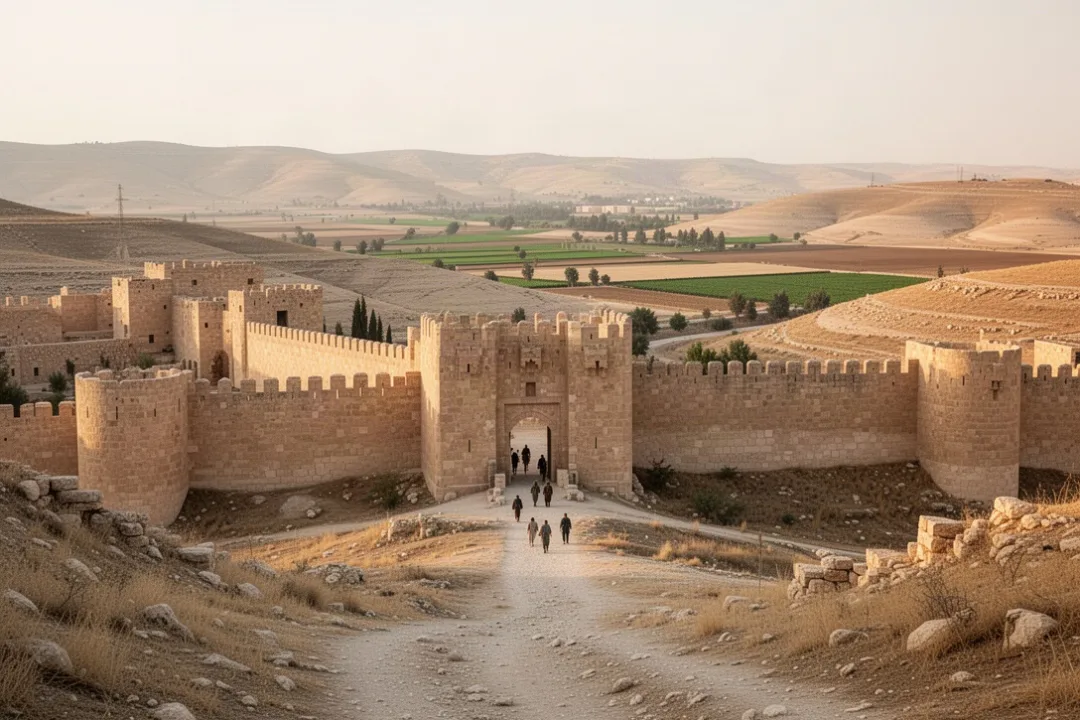
The Ammonites occupied a region east of the Jordan River, generally north of Moab and east of the territory associated with Gad. Their land included the area around the Jabbok River and the stronghold of Rabbah. Because they lived beyond the Jordan, they were close enough to Israel for regular contact, trade, migration, and conflict.
In the Hebrew Bible, the people are often called the sons of Ammon. This name connects them with Ben-ammi, the son born to Lot through his younger daughter in Genesis 19:30–38. The passage explains the traditional Israelite understanding of the Ammonites’ origin, while the Ammonites’ relationship with Israel is also shaped by geography, politics, and military rivalry.
Ammonite society had its own rulers, religious practices, military forces, and fortified cities. Their main god was Milcom, also called Molech in some biblical contexts. The biblical writers distinguish the Ammonites from Israel, but their shared ancestry through Lot means that the relationship is never presented as a simple foreign-enemy story.
Important distinction: In the Bible, “Ammonites” refers to an ancient people, not to ammonite fossils. The word can look similar in English, but the biblical term concerns the nation descended from Ammon.
How the Ammonites fit into Israel’s family history
The first major reference to the Ammonites appears in Genesis 19:30–38. After the destruction of Sodom and Gomorrah, Lot and his two daughters lived in a cave. The account describes the daughters’ actions and identifies their sons, Moab and Ben-ammi, as the ancestors of the Moabites and Ammonites.
This origin story places the Ammonites within the extended family of Abraham. Lot was Abraham’s nephew, so the Ammonites were related to the Israelites through Abraham’s family line, even though they were not descendants of Jacob. That relationship helps explain why Israel received specific instructions about Ammonite territory rather than being told to conquer it as it entered the land.
Deuteronomy 2:19 records God’s instruction that Israel should not seize the land of the Ammonites. The passage presents the territory as a possession given to the descendants of Lot. Deuteronomy 2:37 also says that Israel avoided the land of the Ammonites while fighting the Amorite king Sihon.
That boundary did not prevent later conflict. It meant that Israel’s treatment of Ammon was not simply a matter of taking every neighboring territory. The biblical narrative recognizes both a family connection and a divinely established territorial limit, while later generations are judged for their own actions.
Ammonite identity explained through four biblical themes
The biblical references become easier to follow when the Ammonites are considered through four connected themes. Their story is not contained in one chapter; it develops across Israel’s settlement, monarchy, exile, and restoration periods.
Family relationship: The Ammonites were connected to Israel through Lot, Abraham’s nephew.
Territorial separation: God instructed Israel not to take the Ammonite land during the wilderness period.
Repeated conflict: Ammonite kings and armies fought Israel at several important moments.
Prophetic judgment: Later prophets condemned Ammon for cruelty, contempt, pride, and attacks against God’s people.
These themes should be held together. The Bible does not say that every Ammonite was personally guilty of every national crime. It does, however, describe the conduct of Ammonite rulers and communities and announces judgment against the nation for its public actions.
What happened between the Ammonites and Israel during the judges
The Ammonites became a major threat during the period of the judges. Judges 10:6–9 describes Israel turning away from God and being oppressed by surrounding enemies, including the Ammonites and Philistines. The Ammonites crossed the Jordan to fight against the tribes of Judah, Benjamin, and Ephraim.
Israel cried out for help, and the account emphasizes that deliverance required more than a temporary request for rescue. The people were confronted with their idolatry and were urged to remove foreign gods. They then gathered for military action at Mizpah, where the leadership of the campaign became a central question.
Jephthah eventually led Israel against Ammon in Judges 11. Before the battle, he sent messengers to the Ammonite king, asking why Ammon was attacking Israel. The king claimed that Israel had taken his land when it came from Egypt, but Jephthah’s response reviewed the historical route of Israel’s journey and argued that Israel had not taken Ammonite territory.
Jephthah’s account refers to Israel’s wars with Sihon, king of the Amorites. It argues that Israel took land from the Amorites after Sihon attacked them, rather than taking the land of Ammon. The dispute therefore involved both military action and competing historical claims about who had the right to the territory.
Judges 11 says that the Spirit of the Lord came upon Jephthah before the campaign. It also records his rash vow involving his daughter, a troubling episode that has received extensive interpretation. The narrative should not be reduced to a simple endorsement of every action Jephthah took; it presents a flawed leader in a violent and spiritually disordered period.
Jephthah defeated the Ammonites, and the immediate threat ended. Yet the victory did not create lasting peace. The relationship between the two peoples continued to deteriorate as regional kingdoms competed for land, influence, and security.
Why Nahash and the Ammonites matter in the books of Samuel
One of the most memorable Ammonite rulers was Nahash, whose name appears in 1 Samuel 11 and 2 Samuel 10. In 1 Samuel 11, Nahash besieged Jabesh-gilead, an Israelite town east of the Jordan. He offered terms that involved a humiliating mutilation, showing that his demand was intended not only to control the city but also to disgrace Israel.
The people of Jabesh-gilead asked for time to seek help. Saul heard about the crisis, summoned Israel, and led an army that defeated the Ammonite force. This victory helped establish Saul’s authority as king and showed how a conflict with Ammon could shape Israel’s national leadership.
The account also demonstrates the strategic vulnerability of the Transjordan. Towns east of the Jordan could be attacked before the western tribes organized a response. The Ammonites were therefore more than a symbolic enemy; they were a real regional power able to threaten Israel’s settlements and challenge its kings.
Later, 2 Samuel 10 describes another conflict involving the Ammonites. After Nahash died, David sent representatives to comfort Hanun, Nahash’s son. Hanun’s advisers suspected that David’s delegation was spying, so they humiliated the messengers by shaving them and cutting their clothing.
That insult led to war. The Ammonites hired Aramean forces, creating a larger coalition against David. Joab and the Israelite army faced enemies on two sides, while David’s forces eventually defeated both the Arameans and the Ammonites. The episode shows how a diplomatic misunderstanding, aggravated by bad advice and public humiliation, turned into a major military confrontation.
How David captured Rabbah, the Ammonite capital
The conflict with Ammon continued after the field armies were defeated. According to 2 Samuel 11–12, Joab fought against Rabbah, the Ammonite capital, while David remained in Jerusalem. The campaign forms the setting for the account of David, Bathsheba, and the death of Uriah, a soldier serving in the war.
Joab eventually captured the water supply or strategic waterworks of the city and sent word to David. He urged the king to come and claim the victory so that the city would not be named after Joab. David then gathered the troops, took Rabbah, and carried away the city’s crown and substantial spoil.
The details of the conquest are difficult to interpret in every translation, particularly the description of what David did to the Ammonite population. The central point is clear: Rabbah fell to David, and Ammon became subject to Israelite power during David’s reign.
This victory did not erase the moral failures connected with the campaign. The same narrative places David’s abuse of royal power and Uriah’s death within the period of the Ammonite war. Scripture therefore allows military success and serious personal wrongdoing to appear in the same story.
Read the war narratives carefully: A biblical account of Israel’s victory does not automatically approve every decision made by its leaders. The surrounding narrative may expose deception, pride, violence, or misuse of authority.
What the Bible says about Ammonite religion and influence
The Ammonites worshiped their own deity, commonly identified as Milcom. Their religious practices became especially significant during the reign of Solomon. First Kings 11:1–8 says Solomon married foreign women, including Ammonite women, and that his heart was turned toward other gods.
One of Solomon’s wives was Naamah the Ammonite, who became the mother of Rehoboam, Solomon’s successor. This detail appears in 1 Kings 14:21 and 2 Chronicles 12:13. It shows that Ammonite influence was present within the royal household and that the relationship between Israel and Ammon was not limited to battles.
The concern in these passages is not ancestry alone. The biblical criticism centers on idolatry, divided loyalty, and the king’s failure to remain faithful to the worship of Israel’s God. The story warns that political marriages and international alliances could carry religious consequences.
Nehemiah 13:1–3 refers to the exclusion of Ammonites and Moabites from the assembly in connection with the wilderness-era opposition described in Deuteronomy. Nehemiah later confronts the presence of Tobiah, an Ammonite official or associate, in a chamber of the temple complex. The issue is presented as a violation of religious and administrative boundaries during the restoration period.
These passages should be read in their historical setting. They address covenant membership, worship, leadership, and opposition to the restored community. They should not be used to justify contempt for modern people based on ancestry or national origin.
Which prophets spoke against Ammon
Several prophets announced judgment against Ammon. Their messages identify specific wrongdoing rather than merely repeating that Ammon was an enemy of Israel. The charges include violence, territorial aggression, mockery, arrogance, and participation in the suffering of God’s people.
Amos condemned violence against Gilead
Amos 1:13–15 condemns Ammon for attacking Gilead and committing extreme violence against pregnant women. The prophecy presents this brutality as an attempt to enlarge Ammon’s territory. The judgment is directed at a nation that treated human life as expendable for political and military gain.
The passage also shows how the prophets evaluated international powers. Ammon was not judged only because it opposed Israel. It was judged because its expansion was carried out through cruelty. The prophetic concern is therefore both national and moral.
Jeremiah addressed Ammon’s false confidence
Jeremiah 49:1–6 asks what happened to Ammon’s inheritance and why its king, Milcom, is associated with possession of the territory of Gad. The prophecy recalls the loss of Israelite land and announces disaster for Rabbah. It also condemns Ammon’s confidence in its valleys, treasures, and security.
At the same time, Jeremiah 49 ends with a note of restoration: the descendants of Ammon will be brought back from captivity. That detail matters because prophetic judgment is not always presented as total or permanent annihilation. The oracle condemns national wrongdoing while leaving room for a future return.
Ezekiel described Ammon’s malicious joy
Ezekiel 25:1–7 says that Ammon rejoiced when the sanctuary was profaned, the land of Israel became desolate, and the people went into exile. The prophecy portrays Ammon as celebrating Israel’s catastrophe and treating the suffering of another people as an opportunity for its own advantage.
Ezekiel’s message announces punishment because Ammon acted with contempt and hostility. The emphasis is on the attitude behind the political behavior: malicious satisfaction in another nation’s downfall is itself presented as morally accountable.
Zephaniah connected Ammon with pride and insult
Zephaniah 2:8–11 condemns the reproach and taunting of Moab and Ammon against God’s people. The prophecy describes their pride and announces that their land will become like Moab’s fate. It then turns toward a broader vision in which the nations will recognize the authority of the Lord.
This passage places Ammon’s judgment within a wider concern about arrogant nations. Their downfall is not merely a change in regional power; it demonstrates that human pride cannot permanently withstand divine justice.
How the Ammonites appear after the exile
Ammonites continued to appear in the postexilic period. Nehemiah 4:7–8 names Sanballat, Tobiah, the Arabs, and the people of Ashdod as groups angered by the rebuilding of Jerusalem’s walls. Tobiah is associated with Ammon and opposed Nehemiah’s work.
The opposition was political as well as religious. Rebuilding Jerusalem’s defenses threatened the balance of influence in the region, while the restored Jewish community was attempting to reestablish its identity and administration. Nehemiah describes the opponents as planning to attack and create confusion among the builders.
Tobiah’s later access to a room in the temple complex caused another confrontation in Nehemiah 13. Nehemiah removed his belongings and restored the space for its intended use. The episode reflects the continuing tension between Jerusalem’s restored community and neighboring leaders with interests in its affairs.
The Ammonites also appear in lists of peoples connected with intermarriage and communal reform. These texts focus on covenant identity and loyalty to Israel’s worship. They do not provide a complete social history of every person of Ammonite background, but they show that Ammon remained a recognizable neighboring identity in the biblical period.
What the Ammonite story teaches about related nations
The Bible’s treatment of Ammon includes several principles that are easy to miss if the people are viewed only as enemies. First, shared ancestry did not guarantee peaceful behavior. Ammon and Israel were related through Lot and Abraham’s family, yet family connection did not prevent territorial disputes or cruelty.
Second, Israel was not given unlimited permission to seize neighboring land. Deuteronomy 2 establishes a boundary around Ammonite territory. This means the later conflicts must be understood in light of particular events and offenses, not as a blanket command to attack every neighboring people.
Third, the prophets judged Israel’s neighbors by ethical standards. Ammon was condemned for violence against civilians, contempt for the vulnerable, territorial greed, and delight in another nation’s disaster. These charges show that biblical judgment is concerned with how power is used.
Fourth, the story distinguishes between national guilt and individual identity. The Bible speaks about Ammon as a nation, its rulers, armies, and public actions. That language should not be turned into a modern judgment against people because of ethnicity, nationality, or family background.
Do not confuse Ammon with Moab, even though both nations were linked to Lot.
Do not treat every conflict with Ammon as the same event; the battles occurred under different leaders and circumstances.
Read military victories alongside the moral failures of Israel’s rulers.
Pay attention to the prophets’ reasons for judgment, especially cruelty and pride.
Remember that Jeremiah includes a restoration hope for the people of Ammon.
Where to read about the Ammonites in the Bible
If you want to study the Ammonites in sequence, begin with the passages that establish their origin and territory. Then move through the judges and monarchy narratives before reading the prophetic oracles. The following references provide a useful path:
Genesis 19:30–38: the account connecting Ben-ammi with the Ammonites.
Deuteronomy 2:19, 2:37: Israel’s instructions concerning Ammonite territory.
Judges 10–11: Ammonite oppression, Jephthah’s negotiations, and the ensuing war.
1 Samuel 11: Nahash’s attack on Jabesh-gilead and Saul’s response.
2 Samuel 10–12: the diplomatic insult, the war with Ammon, and the capture of Rabbah.
1 Kings 11:1–8 and 14:21: Ammonite influence in Solomon’s family and royal worship.
Jeremiah 49:1–6: judgment and a promise concerning Ammon’s future.
Ezekiel 25:1–7 and Amos 1:13–15: prophetic accusations against Ammon.
Zephaniah 2:8–11 and Nehemiah 4; 13: later judgment and postexilic opposition.
Reading these references together prevents an incomplete picture. A person who reads only the battle stories may miss the territorial protections and prophetic ethics. A person who reads only the genealogical account may miss how Ammon became a powerful regional kingdom that repeatedly interacted with Israel.
Are the Ammonites mentioned in the New Testament?
The New Testament does not give the Ammonites the same narrative role they have in the Old Testament. By the time of the New Testament, the ancient political identity of Ammon had largely faded from the biblical storyline. The New Testament’s focus is on Jesus, the early church, and the expansion of the gospel rather than on the old territorial conflicts east of the Jordan.
That absence does not erase the earlier history. The Ammonite material remains part of the biblical witness about family relationships, national power, idolatry, warfare, judgment, and mercy. It also provides historical background for understanding the complicated world surrounding ancient Israel.
How to interpret the Ammonites responsibly today
The most responsible reading treats the Ammonites as a historical people described within an ancient covenant narrative. Their story should not be used to label modern Jordanians, Arabs, or any other present-day population as equivalent to the biblical Ammonites. Ancient national identities do not map neatly onto modern ethnic or political groups.
The central lessons concern the use of power, the danger of pride, the consequences of exploiting vulnerable people, and the limits placed on political ambition. The narratives also warn readers not to confuse military success with moral approval. David conquered Rabbah, but the same period exposed grave failures in his own leadership.
The Ammonite story also encourages careful attention to context. Scripture can describe a nation as an enemy in one passage, recognize a territorial boundary protecting that nation in another, and announce possible restoration later. Those details resist simplistic readings and show that biblical accounts of judgment include history, ethics, sovereignty, and hope.
In biblical terms, the Ammonites were Israel’s relatives and neighbors, but they became persistent rivals. Their history begins with Lot’s family, develops through struggles over land and security, reaches a major point during the reigns of Saul and David, and ends in the prophetic record with warnings against violence and pride. Their story remains useful because it asks how nations treat neighbors, how leaders respond to conflict, and how justice applies even to powerful societies.
Frequently asked questions
Were the Ammonites related to the Israelites?
Yes. Genesis presents the Ammonites as descendants of Ben-ammi, the son of Lot. Since Lot was Abraham’s nephew, the Ammonites were part of Israel’s extended family rather than an unrelated population. Even so, they formed a separate nation with their own territory, rulers, religious practices, and political interests.
Did God command Israel to destroy the Ammonites?
Deuteronomy says Israel was not to take the Ammonites’ land during the wilderness journey because it had been given to the descendants of Lot. Later conflicts arose from specific attacks and disputes. The Bible’s accounts should not be turned into a general command to harm people identified with Ammonite ancestry today.
Who was the most important Ammonite king in the Bible?
Nahash is one of the best-known Ammonite kings. He attacked Jabesh-gilead in 1 Samuel 11 and was later connected with the conflict that followed David’s diplomatic mission in 2 Samuel 10. His son Hanun also played a major role by humiliating David’s representatives, which helped trigger a larger war.
What was the main reason prophets condemned Ammon?
The prophets focused on conduct such as extreme violence, territorial greed, contempt for Israel’s suffering, mockery, and national pride. Amos emphasizes brutality in Gilead, while Jeremiah, Ezekiel, and Zephaniah address Ammon’s confidence, hostility, and joy over Jerusalem’s disaster. Jeremiah also leaves room for a future restoration.









Leave a Reply