Nahum’s central message is that Nineveh’s brutal power will not escape God’s judgment. The short Old Testament book speaks to a people threatened by the Assyrian Empire, assuring Judah that oppression has an end and that divine justice is not indifferent to suffering.
The book contains only three chapters, but its language is forceful and its subject is historically significant. Nahum describes the coming collapse of Nineveh, the capital of Assyria, a city associated with military conquest, forced deportation, and imperial cruelty. His prophecy is both a warning to an enemy and a message of relief to those living under its shadow.
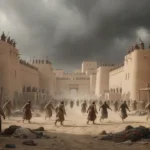
Nahum announces the destruction of Nineveh through vivid images of an advancing army, broken defenses, fleeing soldiers, plundered wealth, and public humiliation. The prophecy does not present the city’s fall as an accident of politics. It interprets the event as God’s response to violence, arrogance, and exploitation.
Assyria had become the dominant power in the ancient Near East. Its armies conquered territories, demanded tribute, displaced populations, and enforced obedience through fear. Biblical books such as 2 Kings and Isaiah describe Assyria’s pressure on Judah, including the threat against Jerusalem during the reign of Hezekiah. Nahum addresses the same imperial reality from the perspective of a nation that has suffered under it.
The prophet’s language moves between divine speech, battle imagery, and descriptions of Nineveh as a corrupt city. Nineveh is portrayed as a place that has lured nations into destructive relationships and accumulated wealth through domination. Its downfall is therefore more than a change in government. It represents the exposure of a system built on deception, coercion, and bloodshed.
Nahum does not give a detailed military strategy or a neutral political report. His concern is moral and theological. The empire that seemed permanent will be judged, and the people who assumed that no one could challenge them will discover that power does not make injustice invulnerable.
Central idea: Nahum’s prophecy is not mainly about admiring the collapse of a city. It is about God seeing oppression clearly and setting a limit on an empire that appeared impossible to resist.
The prophecy uses repeated contrasts to make this point. Nineveh is strong, fortified, wealthy, and feared; yet it is also exposed, vulnerable, and destined to fall. Its weapons cannot secure it forever. Its walls cannot protect it from judgment. Its reputation cannot prevent the truth about its actions from being revealed.
When Nahum lived and why Nineveh mattered
The exact date of Nahum’s ministry is not stated, but the book provides two historical boundaries. It refers to the fall of Thebes, also called No-amon, an Egyptian city that Assyria conquered in 663 BCE. It also predicts Nineveh’s destruction, which occurred in 612 BCE. Nahum therefore belongs broadly to the period between those events, probably during the final decades of Assyrian dominance.
This setting helps explain the prophecy’s urgency. Assyria had ruled or influenced much of the region for generations. To Judah, its power was not an abstract threat. Assyrian campaigns had affected the kingdoms, cities, families, and religious life of the surrounding lands. A message declaring the end of Nineveh would have sounded extraordinary to people accustomed to seeing Assyria win.
Nineveh stood on the eastern bank of the Tigris River in what is now northern Iraq. It became one of the most important centers of the Assyrian Empire. The city represented more than a location on a map: it symbolized the empire’s military authority, administrative reach, cultural prestige, and imperial pride.
Nahum’s audience in Judah may have heard the prophecy as a promise that the political landscape could change. Judah’s survival did not depend entirely on Assyria’s current strength. The empire that had shaped the region through intimidation could itself be removed.
The book should not be treated as a simple prediction detached from history. It reflects the concerns of a real community living amid international conflict. Its message combines historical awareness with faith in God’s authority over nations. Assyria’s rise and fall are placed within a larger moral order.
Several details about Nahum himself remain uncertain. He is identified as an Elkoshite, but the location of Elkosh is not known with confidence. Different proposals have connected it with places in Judah, Galilee, or areas outside Israel, but the text does not settle the question. The uncertainty about his hometown does not weaken the book’s main message.
The name Nahum is related to the idea of comfort or consolation. That association fits the book’s effect on Judah, although the prophecy itself is severe toward Nineveh. For a community facing an aggressive empire, the announcement of judgment against that empire could function as genuine comfort through the promise of release.
How the three chapters develop Nahum’s message
Chapter 1 presents God’s character and authority
The opening chapter begins with a description of God as both just and powerful. It emphasizes patience, but not moral indifference. God is slow to anger, yet wrongdoing is not treated as harmless or permanently overlooked. This balance matters because Nahum’s message is not based on uncontrolled rage. It presents judgment as an expression of holy justice.
Chapter 1 uses images from nature—storms, mountains, rivers, and dry land—to portray God’s supremacy. Creation itself appears responsive to divine power, while human empires are shown to be temporary. The effect is to place Assyria’s military strength in proper perspective. The empire may terrify nations, but it is not ultimate.
The chapter also turns toward Judah. In the midst of judgment against Nineveh, Nahum describes God as a refuge for those who trust him. The contrast is deliberate: the same divine power that brings down an oppressor can protect people who are crushed by oppression. Judgment and comfort belong together in the prophecy.
Chapter 1 then announces that Assyria’s burden over Judah will be broken. The language suggests the removal of a yoke or restraint. Judah is not promised that history will become easy, but it is told that this particular imperial threat will not rule forever.
Chapter 2 depicts Nineveh’s defeat
The second chapter shifts into a dramatic battle scene. Attackers approach, shields and weapons appear, defenses are breached, and the city’s resources are carried away. The pace is quick, creating the impression that the collapse is already underway.
Nahum describes panic among soldiers and officials. The city that once projected disciplined strength becomes disorganized and frightened. The imagery may reflect the chaos of a siege, but it also serves a symbolic purpose: the proud city experiences the fear it had imposed on others.
The chapter recalls Nineveh’s identity as a center of power and wealth. Its treasures are seized, its inhabitants flee, and its defenses fail. The prophet also compares the city to a lion’s lair, an image of predatory strength. The lions once brought prey home safely, but that confidence will not last.
The details should not be forced into a modern-style eyewitness report. Prophetic poetry uses compression, repetition, metaphor, and dramatic address. Its purpose is to communicate the certainty and meaning of Nineveh’s downfall rather than record every stage of the campaign.
Chapter 3 explains why Nineveh must fall
The final chapter gives the clearest moral explanation. Nineveh is condemned as a city of bloodshed, deceit, plunder, and exploitation. Its wealth is not presented as evidence of blessing. Instead, prosperity gained through violence becomes part of the indictment against it.
Nahum compares Nineveh to a prostitute who has seduced nations. The metaphor communicates political manipulation and the spreading influence of corruption. It does not mean that every inhabitant had identical guilt. The target is the city as an imperial power and the system it represents.
The chapter again refers to Thebes. That earlier city had seemed secure because of its location, defenses, and alliances, yet Assyria conquered it. Nahum uses that historical example against Nineveh’s confidence. If Thebes could fall, Nineveh should not assume that its own position makes it untouchable.
The prophecy ends with a picture of wounds that cannot be healed and nations that will not mourn the fallen empire. Those who suffered under Assyria have no reason to grieve its disappearance. The ending is intentionally stark: an empire that caused widespread pain cannot demand sympathy simply because it is powerful.
How Nahum relates to Jonah and other biblical prophets
Nahum’s prophecy is often read alongside the book of Jonah because both books focus on Nineveh. The comparison is useful, but the two books make different points. Jonah centers on God’s mercy toward Nineveh after the city responds to a warning. Nahum announces judgment against Nineveh after Assyria’s violence and arrogance have become central concerns.
These books should not be treated as contradictory accounts of a single moment. They may reflect different periods and theological emphases. Jonah highlights the possibility of repentance and compassion; Nahum emphasizes accountability and the end of oppression. Together they show that divine mercy does not erase justice, and divine judgment does not mean that mercy was never offered.
Nahum also belongs with the biblical prophets who speak about empires and national pride. Isaiah, Jeremiah, Ezekiel, Habakkuk, and Zephaniah each address the rise or fall of powerful nations in different circumstances. Their common concern is that political strength must answer to God’s moral rule.
That perspective challenges the assumption that historical success proves moral approval. Assyria’s victories did not show that its conduct was righteous. Likewise, the temporary weakness of Judah did not mean that Judah had been abandoned or that Assyria had become morally superior.
Readers should also distinguish between the book’s poetic denunciation of Nineveh and hostility toward modern ethnic groups. Nahum addresses an ancient imperial regime in a specific historical setting. It must not be used to justify hatred against Assyrians, Iraqis, or any present-day community. Biblical judgment against an oppressive system is not permission for collective prejudice.
Read the imagery carefully: Nahum’s violent language belongs to prophetic poetry about an ancient empire. It should be interpreted as a declaration of divine justice, not copied as a model for personal revenge or political cruelty.
What Nahum teaches about justice, fear, and hope
Nahum speaks to people who may feel that injustice has become permanent. The Assyrian Empire seemed too large to challenge, and its violence affected ordinary people far beyond the battlefield. The prophecy insists that apparent permanence is not the same as ultimate security.
That does not mean every oppressive power collapses quickly or that victims always see justice during their lifetime. Nahum does not provide a timetable for every injustice. Its claim is theological: God is not blind to cruelty, and human authority remains accountable.
The book also offers a more demanding view of power. A government, institution, business, or leader cannot measure success only by territory, wealth, influence, or fear. Nahum asks what those achievements cost and whom they harm. A structure built through exploitation may appear stable while carrying the seeds of its own judgment.
For people who have suffered, the book gives permission to name wrongdoing honestly. It does not require the oppressed to pretend that abuse is acceptable or that reconciliation can happen without truth. Its promise of judgment means that the suffering of victims matters before God.
At the same time, Nahum does not encourage individuals to take vengeance into their own hands. The prophecy places judgment in God’s authority. That distinction matters for personal ethics. Anger at injustice can be morally serious, but it should not become an excuse for harming others or repeating the violence one condemns.
The book also warns readers who identify with Judah rather than Nineveh. Being threatened by one empire does not make every action of the threatened community righteous. The prophecy’s comfort should produce humility, not national self-congratulation. Anyone who receives relief from oppression must resist becoming an oppressor.
You can apply Nahum’s themes by asking practical questions about the systems around you:
Who benefits from a particular arrangement, and who bears its costs?
Are fear, misinformation, or economic dependence being used to control people?
Do leaders accept accountability, or do they treat authority as permanent protection?
Are victims being heard, or are their experiences being hidden to preserve an institution’s reputation?
Does the desire for justice remain guided by truth, restraint, and concern for human dignity?
Nahum’s hope is not shallow optimism. It is confidence that oppression has a limit because God’s justice is greater than human domination. That hope can strengthen endurance while also requiring moral clarity, honest remembrance, and responsibility toward those who remain vulnerable.
How to read Nahum responsibly today
Begin with the book’s historical setting rather than treating every image as a direct prediction of a modern country or political event. Identify the Assyrian background, notice the references to Nineveh and Thebes, and remember that the original audience lived under the pressure of ancient imperial power.
Next, read the three chapters as a unified work. Chapter 1 establishes God’s authority and Judah’s hope. Chapter 2 dramatizes Nineveh’s fall. Chapter 3 explains the moral reasons for that judgment. Reading only the harshest lines can obscure the book’s movement from fear toward relief.
Several habits can help you interpret Nahum with care:
Separate poetry from literal description. Images of lions, storms, wounds, and exposed bodies communicate theological meaning through vivid language.
Identify the audience. The prophecy addresses Judah and speaks against Nineveh as an imperial center, not against every individual connected with Assyria.
Look for the moral cause of judgment. Violence, deception, exploitation, and pride are repeated themes.
Keep justice and mercy together. Compare Nahum’s message with Jonah and other biblical passages that stress repentance and compassion.
Reject revenge as a personal program. The book entrusts final judgment to God rather than authorizing private retaliation.
It is also helpful to read Nahum alongside historical information about Assyria and the fall of Nineveh, while recognizing the limits of what can be reconstructed. Archaeology and ancient records can illuminate the world behind the text, but Nahum is not merely an archaeological report. It is a theological interpretation of imperial violence and its defeat.
The book remains difficult because it describes destruction with emotional intensity. That difficulty should not be ignored. A responsible reading allows the severity of the language to confront the reality of violence while also refusing to turn the prophecy into a slogan for hatred.
Nahum’s lasting contribution is its insistence that justice belongs at the center of faith. It tells frightened people that the empire is not God, the oppressor is not invincible, and suffering is not forgotten. It also warns every powerful community that strength without righteousness eventually stands exposed.
Frequently asked questions
What is the main message of Nahum’s book?
Nahum’s main message is that God will judge Nineveh for violence, deception, exploitation, and imperial pride. For Judah, the prophecy promises that Assyrian oppression will not last forever. The book combines a severe warning to the oppressor with comfort for people living under its power, emphasizing that political strength cannot shield injustice from accountability.
Is Nahum connected to the book of Jonah?
Yes. Both books focus on Nineveh, but they emphasize different moments and themes. Jonah highlights God’s willingness to show mercy when Nineveh responds to warning, while Nahum announces judgment against the city’s oppressive imperial system. Together, they show that mercy and accountability are not opposites: repentance matters, but persistent violence and arrogance still face judgment.
When was Nahum written?
The exact date is unknown. Nahum refers to the Assyrian conquest of Thebes in 663 BCE and predicts Nineveh’s fall in 612 BCE, so the prophecy comes from the period between those events. It was likely written during the later years of Assyrian dominance, when Judah and other nearby peoples still felt the empire’s political and military pressure.
Does Nahum predict a modern nation’s destruction?
The book directly addresses ancient Nineveh and the Assyrian Empire, not a specific modern nation. Its broader themes—accountability, abuse of power, and hope for the oppressed—can still speak to modern readers. Applying it responsibly means drawing ethical lessons without assigning its ancient judgment to present-day ethnic groups or using the text to justify hatred and revenge.










Leave a Reply