The 7 sacraments are Baptism, Confirmation, the Eucharist, Reconciliation, Anointing of the Sick, Holy Orders, and Matrimony. In the Catholic Church, they are sacred signs instituted by Christ and entrusted to the Church to give grace and strengthen believers at important moments of Christian life.
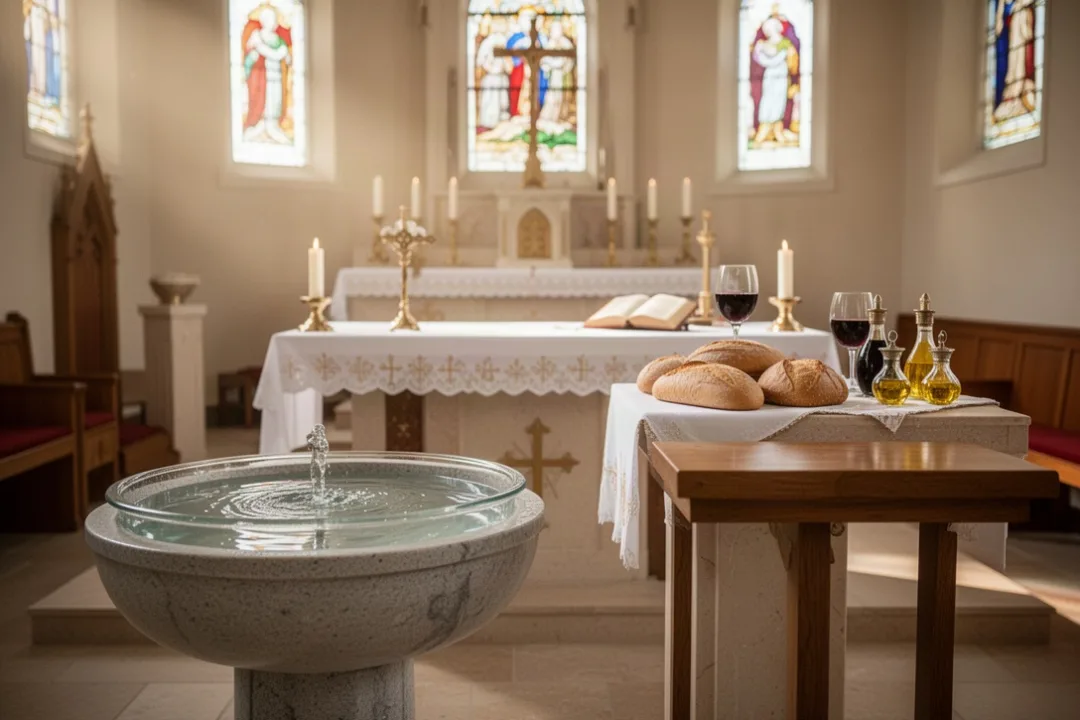
The sacraments are not simply ceremonies or public symbols. Catholics believe that Christ acts through them, using visible signs—such as water, oil, bread, wine, vows, and the laying on of hands—to communicate God’s invisible grace. Each sacrament has its own purpose, minister, signs, and proper circumstances.
The sacraments connect ordinary human experiences with the life, death, and resurrection of Jesus. Some begin and nourish a person’s life as a Christian, some bring healing, and others equip people for service and lifelong commitment.
Catholic teaching groups the sacraments into three categories:
Sacraments of initiation: Baptism, Confirmation, and the Eucharist establish and deepen a person’s membership in the Church.
Sacraments of healing: Reconciliation and Anointing of the Sick bring forgiveness, spiritual healing, strength, and comfort.
Sacraments at the service of communion: Holy Orders and Matrimony help people serve the Church and the wider human community.
The seven sacraments are celebrated in different ways, but they share a central purpose: they draw people into a deeper relationship with God and with the Catholic community. They also point beyond the ceremony itself to a continuing way of life.
Key idea: Catholics believe the sacraments work because of Christ’s action, not because the recipient has perfect emotions, complete understanding, or personal merit. Faith and proper preparation still matter, because the sacraments are meant to be received freely and lived faithfully.
The 7 sacraments at a glance
Each sacrament addresses a distinct stage or need in Christian life. The following list gives the essential answer before examining the sacraments in greater depth.
Baptism: Begins Christian life through water and the Holy Spirit, freeing a person from sin and incorporating the person into the Church.
Confirmation: Strengthens baptismal grace and seals the baptized person with the Holy Spirit for mature Christian witness.
Eucharist: Makes Christ’s saving presence available through Holy Communion and nourishes believers with spiritual food.
Reconciliation: Offers God’s forgiveness for sins through confession, repentance, and absolution.
Anointing of the Sick: Gives grace, peace, courage, and spiritual healing to people facing serious illness, old age, or significant physical weakness.
Holy Orders: Consecrates bishops, priests, and deacons for specific ministries of service and leadership in the Church.
Matrimony: Joins a baptized man and woman in a lifelong covenant ordered toward their good and the raising of children.
1. Baptism begins a person’s Christian life
Baptism is the first sacrament and the foundation of the Christian life. Through the pouring of water or immersion in water, together with the Trinitarian formula, a person is welcomed into the Church. Catholics understand Baptism as a sacrament of new birth, in which a person becomes a child of God and receives a new identity in Christ.
Baptism is associated with the forgiveness of original sin and, for those who are old enough to have committed personal sins, personal sin as well. It does not remove every temptation or difficulty. Instead, it gives a new spiritual beginning and the grace needed to grow in holiness.
What happens during Baptism
The visible sign of Baptism is water. Water suggests both cleansing and new life. The minister pours water over the person’s head or immerses the person while invoking the Father, Son, and Holy Spirit. Other signs may include anointing with sacred oil, receiving a white garment, and being given a baptismal candle.
In the Catholic Church, infants may be baptized because salvation is God’s gift, not a reward earned through intellectual understanding. Parents and godparents accept the responsibility of guiding the child in faith. Adults normally prepare through a process of instruction and conversion before receiving the sacrament.
Baptism leaves a permanent spiritual mark, so it is received only once. A person who has already been validly baptized in another Christian community is not ordinarily baptized again when entering the Catholic Church.
2. Confirmation strengthens baptismal grace
Confirmation completes and strengthens Baptism by giving a fuller outpouring of the Holy Spirit. It is associated with the Spirit’s gifts, including wisdom, understanding, right judgment, courage, knowledge, reverence, and wonder at God’s presence. The sacrament calls Catholics to live publicly and responsibly as disciples of Christ.
Confirmation is not graduation from religious education or a reward for reaching a certain age. Although the age of reception varies according to local Church practice, the sacrament is fundamentally about mission and spiritual strength, not simply a milestone in adolescence.
The bishop, or a priest authorized to confirm, lays hands on the candidates and anoints them on the forehead with sacred chrism. Chrism is perfumed olive oil consecrated by a bishop. The anointing expresses being marked and strengthened by the Holy Spirit.
Confirmation deepens the grace received in Baptism, roots the person more firmly in the Church, and gives courage to defend and share the faith. It also increases the recipient’s responsibility to take part in the Church’s worship, service, and mission.
Like Baptism, Confirmation is received only once because it leaves a lasting spiritual character. Preparation commonly includes prayer, learning about the faith, examining one’s readiness, and choosing a sponsor who can offer ongoing support.
3. The Eucharist nourishes Catholics with Christ’s presence
The Eucharist is the sacrament Catholics celebrate at Mass and receive in Holy Communion. It is the memorial of Christ’s Passion, death, and resurrection. In Catholic belief, the bread and wine become the Body and Blood of Christ while retaining the appearances of bread and wine.
The Eucharist is both a meal and a sacrifice. At the Last Supper, Jesus gave bread and wine to his disciples and connected them with his self-giving. The Mass makes that one sacrifice present sacramentally; it does not repeat Christ’s death. The community receives Communion as spiritual nourishment and as a sign of unity with Christ and one another.
How the Eucharist is celebrated
The Mass has two closely connected main parts: the Liturgy of the Word and the Liturgy of the Eucharist. Scripture is proclaimed and explained, the community offers prayers, and the bread and wine are presented. During the Eucharistic Prayer, the priest invokes the Holy Spirit and repeats Christ’s commands from the Last Supper.
Catholics are normally expected to receive Communion worthily and to observe the Church’s requirements for fasting and freedom from serious unconfessed sin. A person who cannot receive sacramentally may still participate through prayer and spiritual communion.
First Communion is usually preceded by instruction and the reception of Reconciliation. Catholics continue receiving the Eucharist throughout life because they understand it as the central nourishment of Christian discipleship, not a one-time ceremony.
A practical distinction: The Eucharist is celebrated at every Mass, while Holy Communion refers especially to receiving the consecrated Body and Blood of Christ. Catholics may attend Mass without receiving Communion, but they are still invited to join fully in the prayers and worship.
4. Reconciliation restores communion after sin
Reconciliation, also called Confession or Penance, is the sacrament through which Catholics receive God’s forgiveness for sins committed after Baptism. It includes genuine repentance, confession of sins to a priest, a prayer or act of contrition, and absolution spoken by the priest.
The sacrament does more than relieve guilt. It restores or strengthens communion with God and the Church, gives spiritual help for resisting sin, and encourages a person to repair harm when possible. Catholics believe that Christ entrusted this ministry of forgiveness to the apostles and their successors.
The usual steps in Confession
Examination of conscience: The person prayerfully considers actions, choices, attitudes, and omissions in light of God’s commandments and the teaching of Christ.
Contrition: The person is sorry for sin and sincerely desires to turn away from it.
Confession: The person honestly names serious sins to the priest, including their kind and number when known.
Absolution: The priest, acting in the person of Christ, grants forgiveness in the Church’s name.
Penance: The person completes a prayer or action intended to express repentance and begin repairing the effects of sin.
Confession is ordinarily required before receiving Communion when a person is conscious of mortal sin. Catholics are encouraged to receive the sacrament regularly, even when they have not committed serious sin, because it can sharpen self-knowledge and strengthen the desire to live faithfully.
5. Anointing of the Sick brings strength during serious illness
Anointing of the Sick is the sacrament for people whose health is seriously impaired by illness, advanced age, or a major medical procedure. It is not reserved only for someone who is dying, and it should not be postponed until the final moments of life.
Through prayer and anointing with blessed oil, the sacrament gives comfort, peace, courage, and a deeper union with Christ in suffering. It may also bring physical healing if that serves the person’s salvation, but physical recovery is not guaranteed or required for the sacrament to bear spiritual fruit.
A Catholic may receive this sacrament when facing a serious illness, a significant deterioration in health, or the weakness associated with old age. It may be received again if the person recovers and later becomes seriously ill, or if the same illness becomes more severe.
A priest usually lays hands on the person, prays over the person, and anoints the forehead and hands with the Oil of the Sick. If the person is able, Reconciliation may be celebrated first. When someone is near death, the Church may also offer Viaticum—the Eucharist received as spiritual food for the final passage from this life.
The sacrament recognizes that illness affects the whole person. It does not suggest that suffering is good in itself. Instead, it offers grace for facing vulnerability, receiving care, forgiving others, and remaining connected to the Christian community.
6. Holy Orders appoints ministers for service
Holy Orders is the sacrament through which the Church’s ordained ministry is conferred. It has three degrees: the episcopate for bishops, the presbyterate for priests, and the diaconate for deacons. Each degree has a distinct role, although all are ordered toward serving God’s people.
Bishops receive the fullness of Holy Orders and teach, govern, and sanctify their local churches in communion with the pope and the other bishops. Priests cooperate with their bishop, preside at the Eucharist, celebrate Reconciliation and Anointing of the Sick, preach, and serve parish communities. Deacons assist at the liturgy, proclaim the Gospel, preach when permitted, and devote themselves to works of charity and service.
What ordination involves
The essential sign of ordination is the laying on of hands by a bishop, followed by a consecratory prayer. Other parts of the rite express the responsibilities of the ordained ministry, such as presenting the Gospel book to a deacon or presenting bread and wine to a priest.
Ordination configures a person to Christ in a particular form of service. It is not a promotion or personal honor. The ordained minister is called to act for the good of the Church and to help the baptized live their own Christian vocation.
In the Catholic Church, only baptized men are ordained to the priesthood and diaconate. The Church teaches that bishops, priests, and deacons are called to different forms of ministry, while all baptized Catholics share a common dignity and a responsibility to participate in the Church’s mission.
7. Matrimony creates a lifelong covenant of love
Matrimony is the sacrament in which a baptized man and a baptized woman freely establish a lifelong covenant with each other. The marriage covenant is directed toward the good of the spouses and the generation and education of children. In Catholic understanding, it is both a natural human institution and, between two baptized people, a sacrament.
The couple themselves are the ministers of the sacrament. Their free consent—expressed through their vows—creates the marriage bond. The priest or deacon who witnesses the wedding represents the Church and blesses the union, but the spouses give the sacrament to one another through their consent.
The promises and responsibilities of Catholic marriage
Catholic marriage involves unity, fidelity, permanence, and openness to children. It is meant to form a household in which spouses help each other grow in holiness and parents take responsibility for the faith and well-being of their children.
The exchange of rings is a powerful sign of faithful commitment, but the essential element is the consent of the couple. A wedding ceremony cannot create a valid sacramental marriage if consent is absent or seriously impaired by circumstances that prevent a genuine lifelong commitment.
Marriage is not presented as a guarantee of an easy life. Its sacramental grace helps spouses forgive, persevere, communicate honestly, care for one another, and serve others. A Catholic marriage may also become a witness to Christ through hospitality, family life, and concern for the vulnerable.
How the sacraments relate to the stages of Christian life
The sacraments form a connected pattern rather than seven unrelated rituals. Baptism gives the foundation, Confirmation strengthens it, and the Eucharist continually nourishes it. Reconciliation restores the relationship with God when sin has damaged it, while Anointing of the Sick offers grace amid physical weakness and serious illness.
Holy Orders and Matrimony show that Christian life is also a vocation of service. Some people are called to ordained ministry, while others are called to marriage and family life. Both vocations are ordered toward love of God and neighbor rather than personal status.
At the beginning of Christian life: Baptism gives new birth and membership in the Church.
As faith matures: Confirmation gives strength for witness and responsibility.
In regular worship: The Eucharist unites believers with Christ and the Church.
After sin: Reconciliation renews friendship with God and communion with the Church.
During serious illness: Anointing offers comfort, courage, and spiritual healing.
In lifelong service: Holy Orders and Matrimony establish particular vocations.
Who may receive the 7 sacraments?
Reception depends on the sacrament and the person’s circumstances. Baptism is available to any unbaptized person who receives it according to the Church’s requirements. Confirmation and the Eucharist ordinarily follow Baptism and appropriate preparation. Reconciliation is available to baptized Catholics who are capable of confessing their sins and seeking forgiveness.
Anointing of the Sick is for Catholics facing serious illness or the frailty of old age. Holy Orders is received by men who are called, selected, and properly prepared for ordained ministry. Matrimony is celebrated between a baptized man and a baptized woman who are free to marry and who give valid consent.
Reception of a sacrament is not merely a matter of attending a ceremony. The person must meet the relevant conditions and approach the sacrament with an appropriate disposition. Parish priests, Catholic chaplains, and diocesan offices can explain preparation requirements, especially when a person has a complicated family, marital, or medical situation.
Why the sacraments use physical signs
Christian faith concerns the whole person, including the body and the senses. The sacraments therefore use things people can see, hear, touch, taste, and smell. Water can wash, oil can soothe, food can nourish, vows can express commitment, and the laying on of hands can communicate blessing and appointment.
These signs do not replace faith, but they make God’s grace tangible within the life of the Church. They also connect Catholic worship with the biblical story. Baptism recalls Jesus’ command to make disciples and baptize them in the name of the Trinity. The Eucharist reflects the Last Supper. Anointing echoes the Church’s prayer for the sick described in the Letter of James.
The visible rite also makes the sacraments communal. Even when a sacrament is celebrated privately, it belongs to the Church and joins the recipient more closely to the Christian community. Sacramental life is therefore both personal and public: it changes the believer and calls that believer to love and serve others.
How to prepare for a sacrament
Preparation differs from one sacrament to another, but several practices are broadly helpful. Start by speaking with a parish priest or formation leader, especially if you are unsure which sacrament applies to your situation.
Learn what the sacrament means: Understanding the signs and promises can help you participate with greater faith.
Pray honestly: Bring your hopes, fears, questions, and responsibilities before God.
Examine your readiness: Consider whether you are freely accepting the sacrament and prepared to live its commitments.
Complete the required formation: Classes, retreats, sponsor meetings, or counseling may be part of preparation.
Take part in the Church’s worship: Regular Mass and prayer help place the sacrament within a continuing Christian life.
Ask about practical requirements: Documents, godparents, witnesses, previous marriages, or medical circumstances may affect preparation.
The sacrament itself is a significant moment, but its effects are meant to continue. Baptized Catholics are called to live as disciples, confirmed Catholics are sent to witness, married couples are called to faithful love, and ordained ministers are expected to serve. The grace of each sacrament becomes visible over time through choices, relationships, prayer, and works of mercy.
Frequently asked questions
Are the 7 sacraments the same for all Christians?
No. The seven-sacrament system is especially associated with the Catholic Church and is also recognized in several Eastern Christian traditions, including Eastern Catholic churches. Many Protestant communities recognize Baptism and the Lord’s Supper as sacraments or ordinances, while their understanding of the other five differs. A person’s denomination therefore affects how the sacraments are defined and celebrated.
Can a person receive all 7 sacraments?
A Catholic may receive Baptism, Confirmation, the Eucharist, Reconciliation, and Anointing of the Sick under the appropriate circumstances. Holy Orders and Matrimony involve particular vocations, so a person does not normally receive both as personal life commitments. Baptism and Confirmation are received only once, while the Eucharist, Reconciliation, and Anointing may be received repeatedly when properly prepared.
Which sacraments leave a permanent spiritual mark?
Baptism, Confirmation, and Holy Orders are understood to imprint an indelible spiritual character. Because these sacraments permanently configure a person for a particular relationship with Christ and the Church, they are not repeated. If someone’s faith changes or the person later returns to practice, the Church does not administer these sacraments again.
What is the difference between a sacrament and a sacramental?
A sacrament is one of the seven signs instituted by Christ that communicates grace in a unique way through the Church. A sacramental is a sacred sign established by the Church, such as a blessing, rosary, crucifix, or holy water. Sacramentals prepare people to receive grace and help make ordinary life more prayerful, but they are not the seven sacraments.






Leave a Reply