What the word sacrament means in Christian context
The English word sacrament comes through Latin from a term associated with a sacred oath or solemn pledge. Early Christians also used the Greek word mysterion, meaning a sacred mystery or divine reality made known. Over time, “sacrament” became a technical term for certain Christian rites that use physical signs to communicate spiritual truth and God’s grace.
A sacrament is not merely a symbol in the sense of a reminder or illustration. In traditions that use the word formally, the sacramental action is understood to be a means of grace: God acts through the rite, while the visible elements point beyond themselves to an invisible spiritual reality.
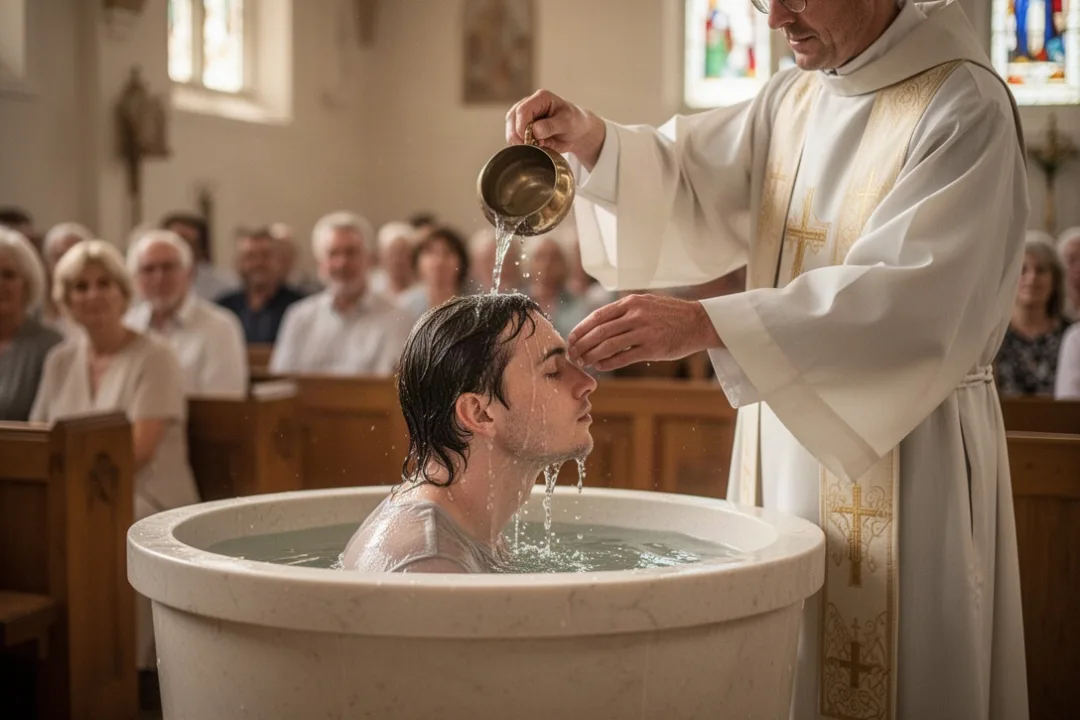
For example, water in baptism is genuinely water, but it also signifies cleansing, new life, belonging to the Christian community, and union with Christ. Bread and wine in the Eucharist are ordinary food and drink, yet the service uses them to proclaim and participate in Christ’s self-giving.
Core definition: A sacrament joins a visible action or element with an invisible gift of grace, making Christian faith tangible through worship and community life.
Why Christians use different definitions of sacrament
Christians do not all agree on how many sacraments exist or what makes a rite sacramental. The main differences come from the way churches interpret Jesus’ commands, the authority of church tradition, and the relationship between outward ritual and inward faith.
The Roman Catholic Church officially recognizes seven sacraments. Eastern Orthodox churches also celebrate the same central mysteries, although they may be less likely to restrict sacramental life to a precisely numbered list. Anglican and Lutheran churches commonly give special status to baptism and Holy Communion while also honoring other rites. Many Reformed, evangelical, and Baptist churches use the term ordinance instead of sacrament, emphasizing that Christ commanded the practice without defining it in the same way as Catholic theology.
These differences do not mean that every Christian tradition rejects ritual or physical signs. Most churches practice baptism and Communion, but they may disagree about what happens through those actions, who may receive them, and how grace is related to faith.
How to identify what a sacrament does
You can understand a sacrament by looking at several connected parts rather than focusing only on the physical ceremony. This step-by-step approach helps explain why Christians regard sacramental worship as more than a public demonstration.
Identify the visible sign. Look for an element or action that can be seen, heard, tasted, or physically experienced, such as water, anointing with oil, laying on of hands, bread, wine, or spoken vows.
Ask what the sign represents. Each sacrament points to a spiritual reality, such as forgiveness, incorporation into the church, healing, reconciliation, or lifelong vocation.
Consider Christ’s role. Churches with a formal sacramental theology connect the rite to Christ’s teaching, example, command, or saving work.
Examine the church’s action. A sacrament is normally celebrated within the gathered Christian community, under an authorized minister or according to the church’s recognized order.
Look for the promised grace. The rite is intended to be a channel through which God strengthens, restores, unites, or sends believers.
Separate the outward act from superstition. Sacramental theology does not generally treat the object as magical. The power belongs to God, not to the material item or the person performing the ceremony.
This framework also shows why a sacrament is both personal and communal. It may meet an individual’s spiritual need, but it also places that person within the worship, teaching, responsibilities, and relationships of the church.
The seven sacraments in Roman Catholic teaching
Roman Catholic teaching recognizes seven sacraments. They are commonly grouped into three categories: initiation, healing, and service or vocation. Together, they describe a Christian life that begins with incorporation into the church, receives ongoing restoration, and is directed toward the good of others.
Baptism begins Christian initiation
Baptism is the first sacrament of Christian initiation. Water is used with a Trinitarian confession, and the baptized person is received into the church. Catholic teaching connects baptism with the forgiveness of sin, new birth, and participation in the death and resurrection of Christ.
Catholic churches baptize infants as well as older children and adults. In infant baptism, parents and sponsors make commitments on the child’s behalf, while the church expects the child to be raised in Christian faith. Adults normally receive instruction and make a personal profession of faith before baptism.
Confirmation strengthens baptismal commitment
Confirmation completes or strengthens baptismal initiation through prayer, the laying on of hands, and anointing with chrism, a consecrated oil. It is associated with the Holy Spirit and with a believer’s fuller participation in the church’s witness and mission.
The details of preparation and age vary by community. The central idea is that Christian life involves more than initial membership: believers are also equipped to live publicly and faithfully as disciples.
The Eucharist, also called Holy Communion or the Lord’s Supper, uses bread and wine in remembrance and proclamation of Jesus’ last supper and saving death. Catholic teaching holds that Christ is truly present in the Eucharist, though the precise theological explanation concerns a change in substance rather than an ordinary physical transformation visible to the senses.
The Eucharist is both sacrifice and meal in Catholic worship. It brings the church into communion with Christ and with one another, while directing worshipers toward thanksgiving, holiness, and service.
Reconciliation restores relationship with God and the church
Reconciliation, also called confession or penance, is the sacrament through which a baptized person confesses serious sin, receives absolution, and undertakes a response of repentance. The priest acts within the ministry entrusted to the church, but forgiveness is understood to come from God.
The practice includes more than listing wrongdoing. It involves conversion of heart, honest acknowledgment, trust in divine mercy, and a willingness to repair harm when possible. The assigned penance may include prayer, restitution, or another fitting act of repentance.
Anointing of the sick offers prayer and spiritual strength
Anointing of the sick is offered to people facing serious illness, advanced age, or significant medical treatment. A priest anoints the person with oil and prays for healing, peace, courage, forgiveness, and strength.
The sacrament does not promise that every illness will disappear. Its purpose is to place suffering within God’s care and to support the sick person spiritually and, when appropriate, physically and emotionally.
Holy orders serves the church through ordained ministry
Holy orders is the sacrament through which bishops, priests, and deacons receive a particular ministry in the church. The rite includes prayer and the laying on of hands, expressing the church’s recognition and authorization of the person’s service.
The three degrees have distinct responsibilities. Bishops have the fullness of ordained ministry, priests assist in pastoral and sacramental leadership, and deacons serve through ministry of the word, worship, and charity. Catholic practice regarding who may receive ordination differs by degree and is governed by church discipline.
Matrimony forms a covenant of married life
Matrimony is the sacrament of marriage in Catholic teaching. A baptized man and woman enter a lifelong covenant ordered toward mutual good and the care and raising of children. Their consent is central, because the spouses confer the sacrament on one another within the church’s recognized form.
Marriage therefore is not treated only as a private contract or social celebration. It is a public vocation that involves fidelity, self-giving, family life, and participation in the church’s mission.
How baptism and Communion function in many Protestant churches
Many Protestant churches recognize two sacraments: baptism and the Lord’s Supper. The reason is usually that these are the rites most clearly commanded by Christ and practiced by the earliest Christian communities. Some Protestants prefer the word ordinance because it highlights Christ’s instruction rather than defining the rite as a channel of grace in the Catholic sense.
Protestant churches differ among themselves. Baptists commonly practice baptism after a person makes a conscious profession of faith, often by immersion. Reformed churches may baptize infants and understand baptism as a sign of God’s covenant and church membership. Lutherans teach that baptism is a means through which God gives forgiveness and creates faith, while also stressing the necessity of trust in God’s promise.
Views of Communion vary as well. Some churches understand Christ’s presence as spiritual and real without a physical change in the elements. Others describe the bread and cup primarily as memorial signs. Many churches share the conviction that Communion should create unity, remembrance, thanksgiving, and faithful discipleship, even when they explain Christ’s presence differently.
How Eastern Orthodox Christians understand the holy mysteries
Eastern Orthodox Christians often call the sacraments the Holy Mysteries. Baptism, chrismation, and the Eucharist are central, and Orthodox worship also includes confession, marriage, ordination, and anointing. Rather than placing the same emphasis on a fixed numerical list, Orthodox theology often presents sacramental life as the church’s participation in God’s transforming work.
In Orthodox practice, baptism and chrismation are commonly celebrated together, followed by the person’s participation in the Eucharist. This reflects a strong connection between entry into the church, receiving the Holy Spirit, and sharing in the church’s worship.
The word “mystery” does not mean that the rite is irrational or unknowable. It indicates that God’s action cannot be reduced to what human beings can measure or fully explain. The church can describe the rite, its signs, and its fruits while still confessing that divine grace exceeds human understanding.
What makes a sacrament different from an ordinary symbol
An ordinary symbol can communicate an idea without being understood as a means by which God acts. A wedding ring, for example, can symbolize marriage, fidelity, and commitment. It may carry deep personal meaning, but it is not necessarily a sacrament. A sacrament includes a recognized ecclesial action and a promise or theological meaning connected to God’s grace.
That distinction does not make ordinary symbols unimportant. Christian worship uses candles, crosses, music, gestures, art, and architecture to teach and shape attention. These signs can support prayer, but churches that use a formal definition of sacrament reserve the term for particular rites with a special place in the church’s life.
Symbol: points to an idea, person, event, or spiritual truth.
Ritual: follows a repeated pattern of meaningful actions.
Ordinance: is a practice commanded by Christ and observed by the church.
Sacrament: is a recognized visible sign through which God communicates grace according to a church’s theology.
Sacramental: often describes objects, blessings, or practices that help people receive grace and grow in holiness without being sacraments themselves.
The boundaries between these terms can vary. A church may call a rite a sacrament while another calls the same practice an ordinance. The safest way to understand the term is to ask which Christian tradition is speaking and what that tradition believes the rite accomplishes.
How sacraments relate to faith, grace, and human action
Grace is central to the meaning of sacrament. In Christian theology, grace is God’s free and undeserved gift, not something a person earns through effort. A sacrament makes that grace tangible through an action that the church can celebrate, remember, and receive.
At the same time, sacramental practice does not remove the need for faith. Christians are not generally taught to perform a ceremony mechanically and assume that an inward life with God is unnecessary. Faith, repentance, participation, and openness to God shape how a person receives the sacrament’s spiritual fruit.
Different traditions explain this relationship in distinct ways. Catholic theology teaches that sacraments are effective because of Christ’s action and promise, not because the minister possesses special personal holiness. It also teaches that the recipient’s disposition matters, especially when the person knowingly rejects the grace being offered.
Protestant theology often places stronger emphasis on the Word of God and faith as the means by which the sacramental promise is received. Even then, baptism and Communion are not treated as empty performances. They are visible acts of obedience that proclaim the gospel and strengthen the community’s faith.
Important distinction: A sacrament is not magic. Christian churches teach that its meaning and power come from God’s promise and Christ’s work, not from treating water, bread, oil, or spoken words as supernatural objects.
What sacraments reveal about the Christian view of the body
Sacraments use the material world to communicate spiritual realities. Water touches the body, bread is eaten, wine is received, oil is applied, hands are laid upon a person, and spoken promises are heard. This physical dimension reflects the Christian belief that God meets people not only through private thoughts but also through embodied actions and shared life.
The use of material signs also affirms the value of ordinary creation. Water can cleanse, food can sustain, touch can comfort, and a public promise can establish a lasting responsibility. The sacrament does not make matter divine in itself; rather, it treats material things as capable of serving God’s purposes.
This helps explain why sacramental worship usually includes more than an abstract sermon. It engages the senses and places belief within a concrete event. A person is baptized at a particular time, receives Communion with a particular community, or is anointed while facing a particular illness.
Why sacraments matter in church and daily life
Sacraments mark important moments, but their purpose extends beyond the ceremony itself. Baptism calls a person to live as a member of Christ’s body. Communion sends worshipers back into ordinary life with renewed responsibility toward God and neighbor. Marriage involves daily fidelity, and ordination requires sustained service.
The sacramental pattern can therefore shape a person’s understanding of work, suffering, family, forgiveness, and community. Grace is not confined to a church building or a special service. The rite becomes a continuing call to live according to what it signifies.
For many Christians, sacramental worship provides three kinds of support:
Assurance: God’s promise is communicated through a concrete, repeatable sign rather than left only to changing emotions.
Belonging: The person is connected with a worshiping community and its shared confession.
Formation: Repeated participation trains habits of repentance, gratitude, courage, service, and hope.
Sacraments also make faith public. Baptism, for example, is not simply a private spiritual experience. It is witnessed by a community that accepts responsibility for teaching, welcoming, and supporting the baptized person.
How to define sacrament in one sentence for different audiences
If you need a brief general definition, say: “A sacrament is a visible Christian rite that communicates or signifies God’s grace.” This wording is broad enough to be understood across several traditions while recognizing that churches explain the rite differently.
For a Roman Catholic audience, you could say: “A sacrament is an effective sign of grace, instituted by Christ and entrusted to the church.” For an Orthodox audience, “Holy Mystery” may be more natural. For many Protestant readers, it may be clearer to explain baptism and Communion as Christ-commanded practices that visibly proclaim the gospel and strengthen faith.
When a precise answer matters, add the tradition’s position. The phrase “there are seven sacraments” describes Roman Catholic teaching, but it should not be presented as the universal definition used by every Christian church.
Questions to ask when comparing churches’ sacramental beliefs
Comparing traditions requires more than counting rites. Two churches may use the same ceremony but attach different meanings to it. These questions can clarify the differences:
Which rites does the church call sacraments? Does it name two, seven, or a broader range of mysteries and sacred actions?
What does the church believe happens during the rite? Is grace given, symbolized, remembered, or received through faith?
Who may receive it? Consider infants, baptized believers, communicant members, married couples, the sick, or ordained candidates.
Who may preside? Some traditions require ordained clergy, while others allow a wider range of leaders in particular circumstances.
Can the rite be repeated? Baptism is commonly regarded as unrepeatable, while Communion, confession, and anointing may be received more than once depending on the tradition.
What lasting responsibility follows? A sacrament usually points toward a way of life, not merely a completed ceremony.
These questions keep the definition accurate without flattening the differences among Christian communities. The shared idea is that God’s grace is made known through visible, communal, and meaningful practices; the details depend on the church’s theology.
How to recognize sacramental language in worship
Listen for words such as grace, covenant, communion, forgiveness, new birth, presence, healing, anointing, vocation, and remembrance. Watch for physical signs that accompany prayer and proclamation. The combination of action, promise, community, and spiritual meaning often signals sacramental language.
Also pay attention to what the church says about the elements. If water is described as the means of baptismal rebirth, or Communion is described as participation in Christ, the church is making a stronger sacramental claim than a community that calls the elements only memorial reminders.
A clear definition respects both the common Christian center and the denominational distinctions. At its heart, a sacrament connects visible worship with invisible grace, bringing faith into the shared, physical, and ongoing life of the church.
Frequently asked questions
Is baptism a sacrament in every Christian church?
No. Roman Catholic, Eastern Orthodox, Anglican, and Lutheran churches generally describe baptism as a sacrament or holy mystery. Many Baptist and evangelical churches call it an ordinance instead. Even where the terminology differs, baptism is widely regarded as a central Christian practice commanded by Jesus and connected with public identification with the Christian faith.
How many sacraments does Christianity have?
There is no single answer accepted by every Christian tradition. Roman Catholic teaching recognizes seven sacraments. Eastern Orthodox churches celebrate the same central sacramental rites but often emphasize holy mysteries rather than a fixed number. Many Protestant churches recognize two ordinances or sacraments: baptism and the Lord’s Supper.
Are sacraments necessary for salvation?
Christian traditions answer this differently. Catholic and Orthodox theology gives the sacraments a central role in receiving grace and living within the church, while recognizing exceptional circumstances. Many Protestant churches stress salvation by God’s grace through faith and view baptism and Communion as commanded signs of that faith rather than human achievements that earn salvation.
Can a sacrament be celebrated outside a church building?
Often, yes. The proper setting depends on the rite and the church’s rules. Baptisms may occur in rivers, homes, hospitals, or other suitable places; anointing may happen in a hospital or residence. What matters is the recognized rite, the appropriate minister or community, and the church’s required prayers and elements.








Leave a Reply