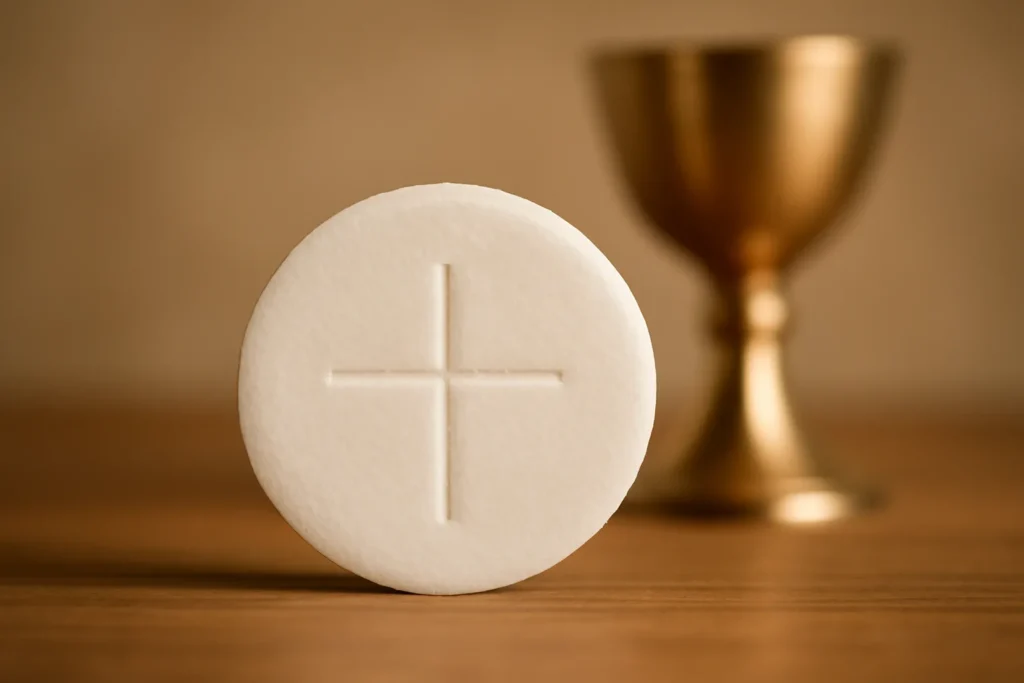
In Catholic worship, the term Communion host refers to the sacred Eucharistic bread that is consecrated during the Mass and becomes, in Catholic belief, the Body of Christ for those who receive it. This wafer is more than ordinary bread: it is a sacramental sign that embodies the mystery of the Real Presence — the belief that Christ is truly present, Body and Blood, under the appearances of bread and wine. The word host itself has deep roots in liturgical language, deriving from Latin terms that convey the idea of an offering, a sacrifice, or something to be offered to God.
In everyday language and in liturgical books, you will encounter several phrases that refer to the same item, or to aspects of it, including the Blessed Sacrament, the consecrated host, and the Eucharistic bread. While there are variations in rite and tradition across the global Catholic Church, the essential concept remains the same: a sacred sign entrusted to the Church for the purpose of making Christ present in the assembly and in the hearts of the faithful.
Theology, History, and the Sacred Mystery of the Host
The doctrine surrounding the Body of Christ and the practice of Holy Communion rests on a long history of theological reflection and liturgical development. Transubstantiation is the technical term used by the Catholic Church to describe the change that occurs at the moment of consecration: while the bodily appearance (the accidents) of the bread remain, its substance is transformed into the Body of Christ. This teaching, declared in ecumenical councils and summarized in the Church's creeds, expresses the core belief that Christ is literally present under the appearances of bread and wine for the faithful who partake.
The historical practice of using bread for the Eucharist goes back to the earliest celebrations of the Church in the Apostolic era. Over centuries, the form and preparation of the bread evolved in different rites. In the Latin Rite, the standard is a small, unleavened wafer, typically round or square, made specifically for liturgical use. In various Eastern Catholic Churches, you may encounter leavened bread that is baked or prepared according to their own ancient customs. Both families of rites uphold the same sacramental intention: to give the faithful a tangible sign of Christ’s presence and to unite the community in a shared meal of faith.
For Catholics, the host is not only a symbol but a living encounter with Christ. The ritual surrounding the host—its creation, blessing, and distribution—exists to invite the assembly into the mystery of the Eucharist, to nurture unity in the Church, and to deepen the discipleship of each communicant. This is why reverence, preparation, and proper care for the sacramental bread are emphasized in liturgical norms and in catechesis.
Types, Shapes, and Variations of the Host
Understanding the types of hosts used in Catholic worship helps illuminate how a universal rite can be celebrated across cultures and languages while preserving its essential meaning. The Roman Rite (the largest liturgical tradition within the Catholic Church) uses unleavened bread for the Eucharist, while some Eastern Catholic churches retain the use of leavened bread in their liturgies. The bread itself is designed to be pure, durable, and suitable for use in the sacred rite.
Unleavened wafer (the standard for the Roman Rite) — The customary form is a flat, disk-shaped wafer, typically made from wheat flour and water only. It is baked to a crisp texture that allows it to be distributed at the altar and easily consumed by communicants. The unleavened character is tied to ancient Jewish and Christian liturgical practices, and it serves to emphasize the sacramental rather than fermentable nature of the bread used in the Eucharist.
Leavened bread in Eastern rites — In some Eastern Catholic Churches, the Eucharist is prepared with leavened bread that is baked or baked and prepared according to their own liturgical norms. Although the form differs from the Roman unleavened wafer, the theology remains the same: the bread is consecrated and becomes the Body of Christ. The use of leavened bread in these communities reflects traditions that have deep roots in early Christian practice and in the distinctive spirituality of the Eastern Church.
Size and shape variations — Even within a single rite, hosts may vary in size or edge design, depending on the local liturgical custom, the baker’s design, or the specific ritual needs of a given celebration. The important point is that these variations do not affect the doctrinal understanding of the bread as the Body of Christ after the consecration.
Special variants for accessibility — In some places, accommodations are made to serve individuals who have difficulty with standard forms, such as gluten-free or low-gluten options. The presence of such options reflects pastoral care for the faithful while maintaining the integrity of the sacrament; however, the use of alternatives is typically guided by local bishops’ conferences and the liturgical norms of the diocese.
Terminology — In common usage, you will hear terms like host, the Body of Christ spoken after the consecration, and Blessed Sacrament used when referring to the Eucharist stored for adoration or reserved in the tabernacle. Throughout Catholic teaching, the terms are complementary and point toward the same sacred reality.
Production, Preparation, and Handling of the Host
The creation of the sacred bread for the Eucharist is a solemn and carefully regulated process. While lay volunteers may assist in the preparation of bread for various uses in the church, the specific form used for Communion is ordinarily prepared under the supervision of ordained ministers or religious communities that oversee liturgical obligations.
Ingredients used in the standard Eucharistic host are intentionally minimal: wheat flour and water are the essential components. No sugar, salt, oil, or other additives are included in the conventional Roman Rite host, because these elements are considered to alter the sacramental character of the bread. This strict standard helps ensure the bread remains consistent with long-standing liturgical norms and the theological understanding of the sacrament.
Stamping and shaping — The bread is typically rolled into a thin sheet, cut into the desired shape, and embossed with a seal or imprint, often featuring a cross or other religious symbols. The stamping symbolizes the dedication of the bread to the service of God and the church community. The process is designed to produce a uniform, durable wafer that can be distributed during the distribution rite with reverence.
Blessing and consecration — The transformation of the host into the Body of Christ happens during the consecration at the Mass, when the priest pronounces the words of Jesus at the Last Supper and the Holy Spirit works the sacramental change. After consecration, the blessed host is reserved in the tabernacle as the Blessed Sacrament, and it may be exposed for adoration or processed to the faithful for Holy Communion.
Storage and reverence — Leftover consecrated hosts are treated with the utmost reverence. In most churches, they are either consumed by the priests or placed in the tabernacle for reparation and prayer. The responsible handling of the host reflects the belief that it remains the Body of Christ even after the Mass, when it is kept for the sick, for processions, or for adoration.
Significance of the Host in the Catholic Mass
The central role of the Communion host in the Mass is both sacramental and communal. It is the instrument by which Catholics participate in the Eucharist, a focal point of worship that expresses both personal devotion and corporate unity.
The Eucharist is a privileged moment of grace, where believers are nourished for the journey of faith. The host represents Christ’s Body given for love, and when the faithful receive it, they unite themselves more fully to Christ and to one another as members of the one Body of the Church.
Unity in the Church — Sharing in the same sacred bread underlines the unity of the Church as the Body of Christ. The reception of the Host by all present signifies Christian solidarity and the communal nature of salvation.
Memory of the Last Supper — The Eucharistic moment recalls Jesus’ actions at the Last Supper, when He took bread, said the blessing, broke it, and gave it to the disciples. The host thus becomes a living memorial and a source of grace rooted in the institution of the Eucharist.
Spiritual nourishment — The faithful are invited to partake of the Host as a means of grace that sustains the Christian life. The reception strengthens the believer’s union with Christ, which in turn fosters virtue, charity, and service to others.
Real Presence in practice — The Hosts’ transformation at consecration is the Church’s concrete expression of the Real Presence, inviting the faithful to encounter Christ in a unique and abiding way during the Mass.
Practical Aspects: Distribution, Adoration, and Devotions
The way the host is distributed, honored, and contemplated reflects a balance between liturgical order and pastoral sensitivity. The practice may vary somewhat by diocese and culture, but the core reverence for the sacrament remains constant.
Distribution of the Host During the Liturgy
During Communion, the celebrant or an ordained minister pronounces a brief invitation and then says the traditional formula, typically The Body of Christ, to which the communicant responds Amen. The host is then placed on the communicant’s hand, or the communicant receives it on the tongue, depending on local discipline and personal conscience.
In the hand — The communicant receives the host on the palm and then consumes it reverently after a short moment of prayer. The hands are kept clean and reverent, and the host is treated with care to prevent loss or profanation.
On the tongue — Some communicants prefer to receive on the tongue. In this practice, the minister places the host directly on the tongue, and the communicant remains still for a moment of prayer before consuming it.
Intinction — In certain contexts and with specific guidelines, some communities have used a method where the host is dipped into the chalice (intinction). This practice varies by diocese and is generally not the standard method in the Latin Rite; it may occur in some Eastern or particular liturgical settings. Always follow the local norms for authenticity and safety.
Adoration and Devotional Practices
Outside Mass, the Blessed Sacrament is often reserved in a tabernacle. The faithful may participate in personal or communal adoration, processions, or public devotions that honor Christ present in the host. In churches where the host is exposed in a monstrance, public worship may include readings, prayers, and hymns that deepen devotion and reverence for the sacrifice and gift of the Eucharist.
Devotional practices connected with the Eucharist emphasize gratitude, repentance, and a renewed commitment to follow Christ. The host, whether in silent prayer or in communal liturgy, invites the faithful to reflect on mercy, service, and the call to love one another as Christ has loved us.
Handling Leftovers and the Repose of the Sacred Bread
The question of what to do with leftover consecrated hosts is an important one in Catholic practice. Reverence dictates that host fragments not be discarded casually. In most parishes, any remaining breads are respectfully consumed by the clergy or placed in the tabernacle for prayer and for distribution to those who were unable to attend Mass. Some communities reserve certain portions for the sick or for special liturgical uses as permitted by liturgical norms.
The care of the Sacred Host underscores a broader approach to the Eucharist: it is not merely a symbolic act but a living encounter with the Risen Lord. Therefore, proper handling, storage, and disposal—when necessary—are integral to the church’s sacramental life.
Common Questions and Clarifications
Is a host the same thing as ordinary bread? In the sense that both are made from flour and water, yes, but a communion host is specially prepared and consecrated for the Eucharist. After consecration, the host becomes the Body of Christ, which is a defining characteristic that ordinary bread lacks.
Why unleavened bread? The Roman Rite uses unleavened bread to reflect the Judeo-Christian heritage of the Eucharist and to emphasize the sacramental fidelity of the offering. Leavened bread is used in some Eastern rites, but in the Latin tradition, unleavened wafers are standard.
Can gluten-free hosts be used? Some jurisdictions offer gluten-free or low-gluten hosts to accommodate individuals with celiac disease or gluten sensitivity. The use of such hosts is subject to local episcopal permission and liturgical norms, and it may vary by diocese. The goal is to preserve the integrity of the sacrament while ensuring accessibility for the faithful.
What happens to leftover hosts? Leftover hosts are treated with reverence. They are typically consumed by clergy or placed in the tabernacle for reverent reposed prayer. They are not discarded as ordinary waste.
What is the relationship between the host and the Blessed Sacrament? The host becomes the Blessed Sacrament once it is consecrated during the Mass. The term Blessed Sacrament often refers to the consecrated Eucharist kept or exposed for prayer outside the Mass, whereas the host that is consumed in communion is the same Eucharistic bread that has become the Body of Christ.
Conclusion: The Sacred Significance of the Host in Catholic Worship
The Communion host stands at the heart of Catholic worship as a tangible sign of the divine mystery of the Eucharist. From its humble ingredients to its transformation at the altar, the host embodies a core invitation: to be fed by Christ and to be formed as his disciples in a world that longs for mercy, truth, and love. Across rites and cultures, the practice of celebrating the Eucharist with sacred bread unites believers in a shared sacral moment — a moment that links the faithful to the Last Supper, to the crucified and risen Christ, and to the universal Church gathered in worship.
By exploring the varied realities of the Eucharistic host — its meaning, its types, and its significance — we gain a richer understanding of how Catholic liturgy communicates grace. The bread that looks like ordinary food becomes, through God's action, a living source of grace for the assembly. In every celebration, the host invites us to worship, to receive with faith, and to live out the Gospel with renewed charity toward our neighbors.





Leave a Reply