Roman Catholicism: beliefs, practices, and history
Roman Catholicism: beliefs, practices, and history
Roman Catholicism is a Christian tradition centered on Jesus Christ, the sacraments, Scripture, and communion with the pope.
It is the largest church within the worldwide Catholic Church and has shaped religious, cultural, artistic, educational, and charitable life across many centuries. Roman Catholics worship through the Mass, receive the sacraments, follow the teachings of the Church, and seek to live the Gospel through prayer, service, and moral action.
The word Roman refers primarily to the Latin or Western Catholic tradition, whose central administrative and spiritual see is Rome. The word Catholic means universal. In ordinary American usage, “Roman Catholic” and “Catholic” often mean the same thing, although the Catholic Church also includes Eastern Catholic churches that are fully united with the pope while preserving their own liturgies, spiritual traditions, and church laws.
Roman Catholicism understands itself as part of the one Church founded by Jesus Christ and continued through the apostles. Its bishops are regarded as successors of the apostles, and the bishop of Rome, the pope, is considered the successor of Saint Peter. This belief gives Catholicism a visible structure of teaching, worship, and pastoral leadership that reaches across national borders.
The tradition developed through the early Christian communities of the Mediterranean world, the writings of the Church Fathers, the decisions of ecumenical councils, and centuries of prayer and practice. Its history includes periods of spiritual renewal, political influence, intellectual achievement, conflict, reform, and serious institutional failures. Understanding Roman Catholicism requires acknowledging both its enduring religious claims and its complicated human history.
How Roman Catholicism is organized and practiced
You can understand the tradition by looking at several connected elements. None stands alone: Catholic teaching informs worship, worship shapes daily life, and the Church’s structure supports both.
Faith in Jesus Christ: Catholics believe Jesus is the Son of God, truly divine and truly human, whose life, death, and resurrection bring salvation.
Scripture and tradition: The Bible and the living Tradition of the Church are received together as sources for Christian faith, interpreted through the Church’s teaching office.
The sacraments: Catholics recognize seven sacraments as visible signs through which God gives grace in the life of the Church.
The Mass: Sunday worship centers on readings from Scripture, preaching, communal prayer, and the Eucharist.
Church leadership: The pope, bishops, priests, deacons, religious communities, and lay members serve different roles within one worldwide communion.
Moral and spiritual life: Catholics are called to prayer, repentance, compassion, justice, family responsibility, and care for people who are vulnerable.
Communion across cultures: Roman Catholic worship follows the Latin tradition but appears in many languages and local cultures around the world.
A useful distinction: Roman Catholicism is not simply a set of private beliefs. It is a sacramental way of life practiced within a visible, worldwide community with shared worship, teachings, leadership, and traditions.
What Roman Catholics believe about God and salvation
Roman Catholic belief is Trinitarian. Catholics worship one God in three persons: the Father, the Son, and the Holy Spirit. This is not understood as belief in three gods, but as a mystery about God’s unity and relational life. The Nicene Creed, recited in many Catholic communities, expresses central Christian beliefs about creation, Jesus Christ, the Holy Spirit, the Church, baptism, resurrection, and eternal life.
Jesus Christ is at the center of Catholic faith. Catholics believe that Jesus revealed God’s love through his teaching, healing, death, and resurrection. His death is understood as a saving act, and his resurrection is regarded as the foundation of Christian hope. Catholics also believe that Christ remains present to the Church in a special way through the Eucharist.
Salvation is understood as God’s gift of grace, not something a person can earn through good behavior alone. At the same time, Catholic teaching says that grace transforms human freedom and calls people to respond through faith, love, repentance, and good works. Faith and action are therefore connected rather than treated as competing paths.
Catholic theology also teaches that human beings are created in the image of God and possess inherent dignity. Sin damages a person’s relationship with God, other people, and creation, but God offers forgiveness and restoration. The Church encourages people to seek reconciliation, practice mercy, and grow in holiness throughout their lives.
Why Scripture and Church tradition both matter
Roman Catholics read the Bible as the inspired word of God and use it in Mass, personal prayer, theological study, and moral reflection. Catholic editions of the Bible include books that are not found in the Protestant Old Testament, often called the deuterocanonical books. These include Tobit, Judith, Wisdom, Sirach, Baruch, and First and Second Maccabees, along with additions to Esther and Daniel.
Catholics do not generally treat the Bible as a text meant to be interpreted entirely apart from the historic Christian community. They read it within the Sacred Tradition, meaning the Church’s received life of worship, teaching, prayer, and interpretation. The Church’s teaching office, called the Magisterium, has responsibility for giving authoritative guidance on matters of faith and morals.
This does not mean that Catholics ignore individual Bible reading. Parish study groups, devotional reading, Catholic schools, homilies, and personal prayer all encourage engagement with Scripture. The Catholic approach places individual reading inside a broader framework that includes the Church’s liturgy, historic creeds, councils, and theological reflection.
The seven sacraments and what they signify
A sacrament is a visible sign through which God’s grace is made present in the Church. Roman Catholicism recognizes seven sacraments. Some are received once, while others are repeated throughout a person’s life.
Baptism: Baptism welcomes a person into the Church, unites the person with Christ’s death and resurrection, and marks the beginning of Christian life. Catholic families often baptize infants, while adults receive preparation before baptism.
Confirmation: Confirmation strengthens baptismal grace and is associated with a deeper outpouring of the Holy Spirit. It calls Christians to bear public witness to their faith.
Eucharist: The Eucharist is the sacrament Catholics receive during Mass. Catholics believe that the bread and wine become the Body and Blood of Christ while retaining their outward appearances.
Reconciliation: Also called confession or penance, this sacrament involves acknowledging sin, expressing repentance, receiving absolution, and accepting a suitable act of penance.
Anointing of the Sick: This sacrament offers prayer, spiritual strength, and comfort to people facing serious illness, advanced age, or significant physical weakness. It is not limited to the moment of death.
Holy Orders: This sacrament establishes the ministries of bishops, priests, and deacons. Ordained ministers serve the Church through preaching, worship, pastoral care, and leadership.
Matrimony: Marriage is understood as a covenant between a man and a woman, ordered toward the good of the spouses and the upbringing of children. Catholic marriage involves a lifelong commitment and a public ecclesial celebration.
The sacraments connect major stages and needs of human life with the life of Christ and the Church. They are not merely symbolic ceremonies in the casual sense. Catholic teaching treats them as concrete means by which God acts in and through the community of believers.
What happens during the Catholic Mass
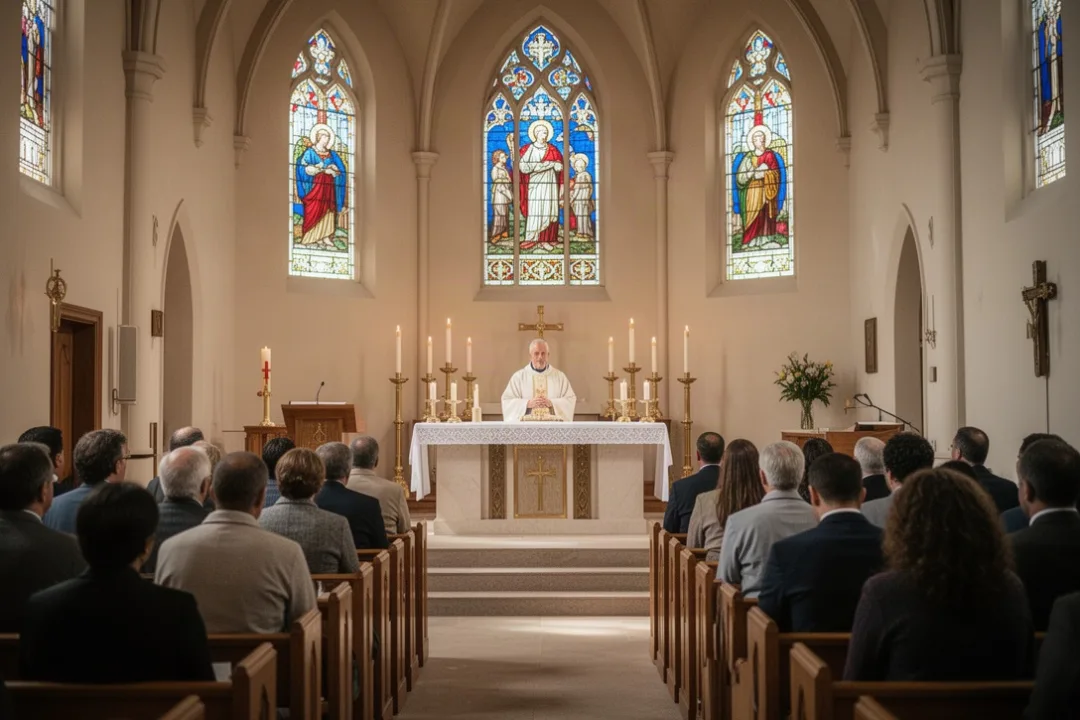
The Mass is the central act of Roman Catholic worship, especially on Sundays and holy days of obligation. Its structure normally has two major parts: the Liturgy of the Word and the Liturgy of the Eucharist. The congregation gathers, listens, responds, prays, and participates through singing, gestures, silence, and receiving Communion when properly prepared.
The Liturgy of the Word includes readings from the Old Testament, a psalm, a New Testament reading, and a Gospel reading. A priest or deacon usually gives a homily that connects the readings with Christian life. The congregation may also recite the Creed and offer prayers for the Church, society, the sick, the dead, and people in need.
During the Liturgy of the Eucharist, bread and wine are brought forward with prayers of thanksgiving. The priest leads the Eucharistic Prayer, which recalls Christ’s saving work and asks the Holy Spirit to sanctify the gifts. Catholics believe that Christ is truly present in the Eucharist, which is why Communion is treated with reverence.
People who are not Catholic may attend Mass, stand, sit, and pray respectfully. The usual Catholic practice is that only Catholics who meet the Church’s requirements receive Communion. A visitor can remain seated or come forward for a blessing where that local parish permits it.
How prayer shapes Roman Catholic life
Catholic prayer includes personal, family, communal, and liturgical forms. The goal is not simply to recite words but to develop a relationship with God and become more attentive to God’s presence. Prayer may involve silence, Scripture, gratitude, petition, repentance, or intercession for others.
Common Catholic practices include the Our Father, the Hail Mary, the Glory Be, daily examination of conscience, Eucharistic adoration, and lectio divina, a prayerful reading of Scripture. Catholics also pray with the Rosary, which uses repeated prayers while reflecting on events in the lives of Jesus and Mary. The Rosary is intended to lead the person toward contemplation of Christ, not to replace the Bible or the Mass.
Many Catholics ask Mary and the saints to pray for them. This practice is called intercession. Catholics distinguish it from worship, which belongs to God alone. In this understanding, asking a saint for prayer is comparable to asking another Christian to pray, while also recognizing the saints as members of the heavenly Church.
Mary, the saints, and religious images
Mary holds a distinctive place in Roman Catholicism because she is regarded as the mother of Jesus and an example of faithful cooperation with God’s grace. Catholic teaching gives her titles such as Mother of God, a title intended to affirm the full identity of Jesus as both human and divine. Catholics honor Mary, but they do not worship her as a goddess.
Two teachings about Mary are often misunderstood. The Immaculate Conception refers to the belief that Mary was preserved from original sin from the beginning of her own conception. It does not refer to Jesus’ conception. The Assumption refers to the belief that Mary was taken into heavenly glory at the end of her earthly life.
Saints are Christians whom the Church recognizes as notable examples of holiness and, in some cases, as intercessors. Statues, paintings, icons, medals, and other images help Catholics remember Christ, Mary, and the saints. The image itself is not considered a god. Respect shown to a sacred image is directed toward the person or mystery represented.
What Catholic teaching says about moral life
Roman Catholic moral teaching begins with the dignity of every human person and the call to love God and neighbor. It addresses personal conduct, family life, work, sexuality, economic justice, political responsibility, war, the death penalty, medical ethics, and care for creation. Specific conclusions can be complex, and Catholics may disagree about how principles apply in difficult circumstances.
The Ten Commandments, the teachings of Jesus, the Beatitudes, and the moral tradition of the Church all guide Catholic conscience. Catholics are encouraged to form conscience through prayer, Scripture, sound reasoning, Church teaching, and honest attention to the effects of their choices. Conscience does not mean doing whatever feels right; it means making a serious, informed judgment about what is morally good.
Catholic social teaching emphasizes that a just society must protect human dignity and promote the common good. Frequently discussed principles include the rights and responsibilities of individuals, solidarity with the poor, care for families, the dignity of work, concern for migrants, religious freedom, and responsible stewardship of the environment.
Practice and teaching are not always identical: Catholics may fail to live up to Church teaching, as members of any community can fail to live up to their ideals. The tradition evaluates conduct against the Gospel and calls for repentance, repair, and renewed responsibility.
How the pope, bishops, priests, and deacons serve the Church
The pope is the bishop of Rome and the visible point of unity for Catholics worldwide. He teaches, oversees the governance of the universal Church, appoints or confirms bishops in many circumstances, and represents the Catholic community in international religious and civic settings. Catholic teaching gives the pope a particular authority in defined matters of faith and morals, but papal infallibility is narrowly understood and does not mean that every papal statement is error-free.
Bishops lead dioceses, which are regional churches made up of parishes. They teach, ordain ministers, oversee worship and pastoral programs, and work with priests, deacons, religious communities, and lay leaders. A bishop is normally assisted by priests, who serve individual parishes and celebrate the Eucharist and other sacraments.
Deacons are ordained ministers who may proclaim the Gospel, preach, baptize, witness marriages, conduct funerals, and serve the poor. Permanent deacons can be married before ordination, while priests in the Latin Church ordinarily make a commitment to celibacy. Catholic religious orders include women and men who dedicate themselves to prayer, education, health care, missionary work, contemplation, or service.
How the Catholic calendar organizes worship
The liturgical year guides Catholic worship through seasons that recall the life, death, and resurrection of Jesus. Advent prepares for Christmas and also directs attention toward Christ’s future coming. Christmas celebrates the Incarnation, the belief that the Son of God entered human life.
Lent is a penitential season of prayer, fasting, and almsgiving leading to Holy Week. Holy Week includes Palm Sunday, the Mass of the Lord’s Supper, the commemoration of Christ’s Passion, and the Easter Vigil. Easter celebrates the resurrection of Jesus and begins the central season of the Christian year.
Ordinary Time includes weeks devoted to the public ministry and teachings of Jesus. Other observances honor Mary, the apostles, martyrs, and other saints. Catholics also observe days of fasting and abstinence according to Church discipline, with exact requirements shaped by universal and local regulations.
How Roman Catholicism differs from other Christian traditions
Roman Catholicism shares core beliefs with Eastern Orthodox, Anglican, and many Protestant churches, including faith in Jesus, the Trinity, the Bible, baptism, and the resurrection. The differences concern authority, sacraments, ministry, worship, and particular doctrines.
Authority: Catholics recognize the pope and the bishops united with him as part of the Church’s teaching and governing structure. Many Protestant traditions give greater formal authority to Scripture alone, while Eastern Orthodox churches do not accept universal papal jurisdiction.
Sacraments: Catholics recognize seven sacraments. Many Protestant communities recognize baptism and Communion as the two ordinances or sacraments directly instituted by Christ, though beliefs about them vary.
Worship: Catholic worship follows a structured liturgy centered on the Eucharist. Protestant worship ranges from highly liturgical services to informal gatherings.
Mary and the saints: Catholics honor Mary and ask saints for intercession. Protestant traditions differ widely in their use of these practices.
Church unity: Catholicism is a worldwide communion with a common catechism, sacramental system, and relationship with the pope, while many Protestant churches are organized through denominations, networks, or independent congregations.
These comparisons describe broad patterns rather than every individual church. Eastern Catholic communities, for example, share Catholic doctrine and communion with Rome while using Eastern liturgies and maintaining traditions that differ from those of most Roman Catholic parishes.
A person who wants to learn about Roman Catholicism can attend Mass, speak with a priest, read one of the Gospels, or contact a parish office. Visitors are not expected to know every response or gesture. Sitting near the back and following the congregation’s posture is usually enough for a first visit.
Adults who are considering becoming Catholic generally take part in the Order of Christian Initiation of Adults, commonly known as OCIA. The process provides instruction, prayer, discussion, and discernment. It may lead to baptism, confirmation, and first Communion for someone who has not been baptized, or to reception into full communion for a baptized Christian from another tradition.
Visit a parish: Attend Mass or arrange a conversation with a priest or parish staff member.
Ask questions: Discuss beliefs, worship, family circumstances, moral concerns, and any previous Christian baptism.
Join formation: Participate in OCIA or another parish program that explains Catholic faith and practice.
Discern freely: Take time to pray, learn, and decide without treating the process as a test to pass quickly.
Receive the sacraments: If appropriate, enter the Church through baptism, confirmation, and Eucharist, or be received into full communion after preparation.
People who have experienced abuse or serious harm connected with a Catholic institution may need support that goes beyond theological information. Dioceses generally have reporting procedures and victim-assistance resources, and local civil authorities may also be appropriate points of contact. Seeking help should be treated as a serious pastoral and safeguarding matter.
What daily Catholic practice can look like
There is no single daily routine shared by every Roman Catholic. Some attend daily Mass, pray the Rosary, read Scripture, or observe a regular period of silence. Others participate mainly in Sunday worship and important family or community celebrations. Practice can also vary according to culture, age, health, work schedule, and personal devotion.
A Catholic household might pray before meals, celebrate saints’ feast days, volunteer through a parish, support a food pantry, visit someone who is sick, or set aside time for confession. These actions express the belief that faith should shape ordinary relationships and responsibilities, not remain limited to church buildings.
The central pattern is a repeated movement toward worship, conversion, and service. Catholics gather for the Eucharist, examine their lives, ask for forgiveness, receive grace, and return to family, work, and society with a responsibility to practice love and justice.
Common questions about Roman Catholic identity
Roman Catholicism includes people with different levels of religious practice and different cultural backgrounds. Someone may identify as Catholic because of baptism, family, parish belonging, personal conviction, regular worship, or several of these together. The tradition’s official teachings provide a common framework, while lived Catholic experience is expressed through many languages, customs, spiritualities, and forms of service.
Frequently asked questions
Are Roman Catholicism and Catholicism the same thing?
In everyday American speech, the terms usually refer to the same faith. More precisely, Roman Catholicism refers to the Latin or Western Catholic tradition, while the worldwide Catholic Church also includes Eastern Catholic churches. Those Eastern churches are united with the pope and share core Catholic doctrine, but they retain distinct liturgies, spiritual customs, and some disciplinary traditions.
Do Catholics worship Mary and the saints?
Catholics worship God alone. They honor Mary and the saints and may ask them to intercede, or pray, on their behalf. Catholic theology distinguishes this request from worship because saints are understood as fellow members of the Christian community who point people toward God. Religious images are used as reminders of Christ, Mary, or the saints rather than as gods.
Can a non-Catholic attend Mass?
Yes. Visitors are welcome to attend Mass, listen to the readings, join communal responses if comfortable, and observe the congregation’s posture. The usual practice is that only Catholics who meet the Church’s requirements receive Communion. A visitor may remain seated during Communion or ask the parish about its local custom for coming forward for a blessing.
What is the difference between a Catholic priest and a deacon?
Both are ordained ministers, but their responsibilities differ. Priests preside at Mass and ordinarily celebrate reconciliation and anointing of the sick. Deacons may proclaim the Gospel, preach, baptize, witness marriages, lead certain services, and serve charitable ministries. Permanent deacons in the Latin Church may be married before ordination, while priests ordinarily make a commitment to celibacy.






Leave a Reply