Rebekah in the Bible: Her story, choices, and legacy
Rebekah in the Bible: Her story, choices, and legacy
When people ask who Rebekah was, they usually want more than a family tree. She is the woman who became Isaac’s wife, the mother of Jacob and Esau, and a central figure in the book of Genesis. Her story includes remarkable hospitality, personal courage, family conflict, prayer, and a morally complicated attempt to secure the blessing God had promised.
Rebekah appears mainly in Genesis 24–27. She enters the story as a young woman from the family of Abraham’s relatives in Mesopotamia and becomes part of the next generation through which God’s covenant promises continue. Her decisions influence the future of Israel, but the biblical account also shows the cost of favoritism, secrecy, and manipulation within her household.
Rebekah was the daughter of Bethuel, the sister of Laban, and a relative of Abraham’s household. Genesis identifies her as part of the extended family Abraham had left behind when he traveled to Canaan. She lived in the region associated with Haran, where Abraham’s servant later found her.
Rebekah became the wife of Isaac, Abraham and Sarah’s son. Isaac was the child through whom God had promised to continue Abraham’s covenant line. Their marriage therefore carried significance beyond the household itself: it connected Rebekah to the story of the people who would descend from Abraham.
She later gave birth to twins, Esau and Jacob. The brothers became the ancestors associated with two distinct peoples, and their rivalry shaped much of the remainder of Genesis. Rebekah’s role as their mother placed her at the center of a family struggle over identity, inheritance, and blessing.
The Bible presents Rebekah as capable and decisive rather than passive. She makes a quick choice to leave her home, shows generosity to a stranger and his animals, seeks God when her pregnancy becomes difficult, and acts boldly when she believes Isaac is about to bless the wrong son. These qualities can be admirable and troubling at the same time.
How Rebekah met Abraham’s servant at the well
After Sarah died, Abraham wanted to find a wife for Isaac from among his own relatives rather than from the surrounding Canaanite communities. He sent his senior servant to Mesopotamia with instructions to locate a suitable woman and bring her back to Canaan.
The servant stopped near a well outside the city and prayed for guidance. He asked that the woman chosen for Isaac would offer him water and also volunteer to water his camels. The request was demanding because watering several thirsty camels required considerable effort, not a brief act of courtesy.
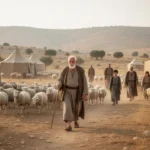
Before he finished praying, Rebekah arrived with a jar. She gave the servant water and then drew enough water for his camels. Genesis emphasizes the speed and energy of her response: she repeatedly went to the well until the animals had enough to drink.
This meeting reveals several features of Rebekah’s character:
Hospitality: She responded generously to a tired traveler rather than offering only the minimum assistance.
Initiative: She acted without waiting for someone else to tell her what to do.
Strength: Drawing and carrying water was physically demanding work.
Confidence: She spoke directly with the stranger and answered his questions clearly.
Family connection: Her identification as Bethuel’s daughter confirmed that she belonged to Abraham’s wider family.
The servant gave Rebekah jewelry and asked about her family. When he learned who she was, he bowed in worship and understood the meeting as an answer to prayer. Rebekah then ran home and told her household what had happened.
A useful distinction: Rebekah’s hospitality was not merely a polite gesture. In the story, her willingness to serve becomes the visible sign that she is the person the servant had been seeking.
Why Rebekah agreed to leave her family
Rebekah’s family welcomed Abraham’s servant and heard his account of the journey. Her brother Laban and her father Bethuel recognized that the circumstances appeared to be directed by God. They agreed that Rebekah could go with the servant and marry Isaac.
The next morning, the servant wanted to leave immediately. Rebekah’s family initially asked that she remain for additional time, but they allowed her to decide. When asked whether she would go, she answered that she would. That brief response is one of the clearest moments of personal agency in her story.
Rebekah left her home, relatives, and familiar surroundings to travel to a man she had never met. The journey linked her permanently to Isaac’s household and to the covenant family descended from Abraham. Her decision required trust, courage, and willingness to accept an uncertain future.
When Rebekah saw Isaac in the distance, she covered herself with a veil. Isaac brought her into his mother Sarah’s tent, married her, and loved her. Genesis says that Rebekah brought comfort to Isaac after Sarah’s death, showing that their marriage provided emotional healing as well as family continuity.
The story does not describe a long courtship or explain Rebekah’s private thoughts in detail. Instead, it highlights her actions: she served generously, listened to the proposal, made her own decision, traveled far from home, and entered a marriage that became central to the next generation of the biblical story.
What happened when Rebekah could not have children
Isaac and Rebekah did not have children for many years. In the world described by Genesis, infertility brought deep emotional pain and threatened the continuation of a family line. Their difficulty was especially significant because God’s promises to Abraham involved future descendants.
Isaac prayed to God on behalf of Rebekah, and she eventually became pregnant. The pregnancy, however, was unusually difficult. The children struggled within her, and Rebekah asked why this was happening. She went to inquire of the Lord, a detail that presents her as someone who actively seeks understanding rather than silently accepting confusion.
The response she received explained that two nations were in her womb and that the older would serve the younger. This reversed the normal expectation that the firstborn would hold the primary position in the family. The message became a major interpretive key for the conflict between Esau and Jacob.
Rebekah gave birth to twins. The first child was red and covered with hair, so he was named Esau. The second came out holding Esau’s heel, so he was named Jacob, a name connected with the image of grasping the heel and later associated with supplanting or overtaking.
The birth account establishes a tension between human expectations and the divine announcement Rebekah had received. Esau was born first, but the oracle indicated that Jacob would hold the greater position. That tension helps explain Rebekah’s later actions, although it does not automatically excuse every method she used.
How Rebekah and Isaac treated Esau and Jacob differently
As the boys grew, their personalities and interests diverged. Esau became a skilled hunter and spent time in the open country. Jacob was described as a quieter man who remained among the tents. Their differences were not necessarily a problem by themselves, but the parents responded to them in ways that deepened the rivalry.
Isaac loved Esau, apparently because he enjoyed the food Esau brought from hunting. Rebekah loved Jacob. Genesis gives this direct statement without presenting it as a healthy family pattern. The parents’ divided affection created an atmosphere in which the brothers competed for approval and status.
Family favoritism can be especially destructive when it becomes connected to inheritance or spiritual identity. Esau and Jacob were not simply competing for affection; they were part of a household carrying Abraham’s covenant promise. Each parent’s preference therefore had consequences beyond ordinary sibling tension.
Rebekah’s preference for Jacob may also have been shaped by the message she received during pregnancy. She knew that the younger son would become greater than the older one. Yet the narrative does not say that God instructed her to deceive Isaac. This leaves readers with an important distinction between trusting a promise and trying to control its fulfillment.
Why Esau sold his birthright to Jacob
Before the deception involving Isaac’s blessing, the brothers had already experienced a major conflict over the birthright. Esau returned from the field exhausted and asked Jacob for some of the stew he was preparing. Jacob demanded Esau’s birthright in exchange for the meal.
Esau agreed, and the account portrays him as treating the birthright with little regard. The birthright represented the privileges associated with the firstborn son, including family leadership and an important share in inheritance. The passage does not present the exchange as a model of fair negotiation; it exposes the brothers’ different priorities and their willingness to exploit one another.
Jacob’s later actions cannot be separated from this earlier incident. Esau had despised or undervalued his birthright, while Jacob intensely desired the position connected with it. Rebekah’s role in the birthright episode is not described, but she becomes central when Isaac prepares to give his formal blessing.
How Rebekah helped Jacob receive Isaac’s blessing
When Isaac grew old and his eyesight failed, he believed death might be near. He called Esau and asked him to hunt game and prepare a meal. After eating, Isaac intended to bless Esau. In the family’s context, this blessing was not a casual compliment. It conveyed authority, prosperity, and a place in the family’s future.
Rebekah overheard the conversation and immediately formed a plan. She told Jacob to bring two young goats so she could prepare the meal Isaac liked. Jacob would then present the food as though he were Esau and receive the blessing intended for his older brother.
Jacob recognized the danger. Isaac might discover the deception because Esau was hairy while Jacob’s skin was smooth, and a failed attempt could bring a curse instead of a blessing. Rebekah responded by taking responsibility for the consequences and telling Jacob to follow her instructions.
She prepared the meal, dressed Jacob in Esau’s clothing, and covered his hands and neck with the goatskins so that he would feel like Esau. Jacob went to Isaac and claimed to be his older brother. Isaac questioned him several times, but the disguise and meal eventually persuaded him.
Isaac blessed Jacob with prosperity, agricultural abundance, authority over other peoples, and superiority over his brothers. The blessing included the expectation that those who blessed Jacob would be blessed and those who cursed him would be cursed, language connected to the promises given to Abraham.
Rebekah’s plan succeeded in obtaining the blessing for Jacob, but success did not make the process harmless. The deception fractured the family. Esau hated Jacob and planned to kill him after Isaac’s death. Rebekah learned of the threat and arranged for Jacob to leave home and stay with her brother Laban.
The central tension: Rebekah believed Jacob was the son associated with God’s promise, but she pursued the desired outcome through deception. Genesis presents both the promise and the damage caused by the method.
Was Rebekah wrong to deceive Isaac?
The Bible does not give a simple sentence declaring Rebekah wholly righteous or wholly condemned. Readers have interpreted her actions in different ways. Some emphasize her knowledge of the prophecy about the older serving the younger and view her as acting to protect the promised future. Others emphasize that she manipulated Isaac, involved Jacob in a lie, and helped create years of family separation.
The narrative itself allows the moral difficulty to remain visible. Rebekah’s goal aligns with the earlier oracle, but her method violates trust within the household. Isaac is deceived, Esau is enraged, Jacob must flee, and Rebekah loses the immediate presence of the son she favored.
Her actions can be understood through several questions:
Did she believe God’s promise? Her actions suggest that she took the message about Jacob’s future seriously.
Did she trust the promise to unfold without manipulation? The story gives no indication that she waited for a peaceful or transparent solution.
Did the deception have consequences? Yes. It led to anger, threatened violence, separation, and long-term family tension.
Does a correct outcome justify a dishonest method? The text does not provide that conclusion. It shows that the outcome and the method must be considered separately.
Rebekah’s story therefore resists a shallow label. She is neither simply a villain nor an uncomplicated model of faith. She is a determined woman who understands the stakes, acts courageously, and makes a choice that produces real harm. That complexity is part of why her story continues to invite careful reading.
How Rebekah protected Jacob from Esau
After Jacob received the blessing, Rebekah heard that Esau intended to kill him. She warned Jacob and told him to flee to Laban in Haran. Her stated reason when speaking with Isaac was that Jacob should not marry a local woman, since Esau’s marriages had caused distress to the family.
Rebekah’s plan had two purposes. It protected Jacob from immediate danger and directed him toward relatives who shared the family’s ancestral background. She and Isaac sent Jacob away with a blessing and instructions not to marry among the local Canaanite families.
Genesis does not record Rebekah seeing Jacob again after his departure. That silence gives the end of her story a painful quality. She acted to secure his future, but the deception that helped him obtain the blessing also separated him from her. Her protective decision carried an emotional cost that the narrative leaves largely unstated.
Jacob’s journey to Laban’s household began a new stage in the family story. He married Leah and Rachel, became the father of the tribes of Israel, and eventually returned to Canaan. Rebekah’s influence therefore extended into the formation of the nation associated with Jacob’s new name, Israel.
What Rebekah’s story says about faith and family life
Rebekah’s story presents faith as more than passive agreement. She responds to circumstances, asks questions, makes decisions, and accepts major changes. Her life shows how biblical women can function as significant agents in family and covenant history even when the surrounding social structure is patriarchal.
At the same time, the story warns against confusing strong desire with faithful action. Rebekah wanted Jacob to receive what she believed belonged to him, but she did not create a transparent path toward that end. Her fear of losing the blessing may have encouraged her to rely on control rather than patience.
The family conflict also shows how favoritism spreads. Isaac’s preference for Esau and Rebekah’s preference for Jacob made the sons symbols of their parents’ competing loyalties. Once affection became divided and strategic, ordinary disagreements became threats to the family’s future.
Good intentions do not erase consequences: Rebekah’s concern for Jacob did not prevent pain caused by the deception.
Common mistakes when reading Rebekah’s story
Rebekah is often reduced to one scene: the mother who helped Jacob deceive Isaac. That approach overlooks her introduction, her courage in leaving home, her suffering during pregnancy, and the way she sought divine guidance. A fuller reading follows her development across the entire narrative.
Keep these points in mind when studying her life:
Do not confuse Rebekah with Rachel. Rebekah was Isaac’s wife and Jacob’s mother; Rachel was Jacob’s wife and the mother of Joseph and Benjamin.
Do not treat Esau and Jacob as ordinary twins. Their conflict involves birthright, blessing, inheritance, and the future of Abraham’s family.
Do not assume Rebekah received an instruction to deceive Isaac. She received a prophecy about the sons’ future, but Genesis does not state that God commanded her scheme.
Do not ignore Isaac’s role. The family conflict was not caused by Rebekah alone. Isaac favored Esau, and Jacob willingly participated in the deception.
Do not overlook the consequences. Jacob gained the blessing but had to leave home, while Rebekah apparently never saw him return.
Do not read the well scene as a minor detail. It establishes Rebekah’s generosity, energy, initiative, and suitability for Isaac’s household.
How to study Rebekah’s story carefully
Read Genesis 24 first, then Genesis 25–27. The order matters because Rebekah’s early character and the family’s later conflict belong to the same developing story. Her generous behavior at the well should be held alongside her partiality and deception, not treated as unrelated material.
As you read, distinguish between what the narrator reports, what characters say, and what readers infer. For example, Genesis reports that Rebekah loved Jacob and that she helped him deceive Isaac. The text also reports the oracle about the older serving the younger. It does not directly tell readers all of Rebekah’s motives or state that her deception was approved.
It can also help to compare the major household decisions:
Abraham’s servant seeks a wife through prayer and careful observation.
Rebekah chooses to leave her family and travel to Isaac.
Isaac favors Esau, while Rebekah favors Jacob.
Esau undervalues his birthright, while Jacob seeks it intensely.
Rebekah uses a disguise to secure Isaac’s blessing for Jacob.
Jacob leaves home, and the family’s conflict continues across generations.
This pattern shows why Rebekah should be read as a complete biblical character. She demonstrates generosity and courage, but she also participates in the secrecy and favoritism that damage her family. Her story does not offer a simple formula for decision-making; it invites readers to consider how faith, fear, love, and control can operate together in one person’s life.
Why Rebekah remains significant
Rebekah is significant because she stands at the transition between Abraham’s generation and the generation of Jacob. Through her marriage to Isaac and her motherhood, she becomes part of the line through which the biblical story of Israel continues.
She also matters because the narrative gives her meaningful decisions. She is not introduced only through a husband or son. Before she marries Isaac, she demonstrates hospitality and chooses to leave home. During pregnancy, she seeks an explanation from God. In the family crisis, she acts decisively, even though her decision is morally compromised.
Her story speaks to readers who have experienced family favoritism, difficult choices, or the tension between trusting a promise and trying to force an outcome. Rebekah’s life shows that courage and wisdom are not always perfectly aligned. A person may recognize something important, act with conviction, and still cause harm through fear or impatience.
For that reason, Rebekah is best remembered neither as an idealized heroine nor as a dishonest schemer alone. She is a strong, complicated woman whose hospitality, faith, ambition, and family loyalties helped shape the biblical history of Jacob and the nation that came from him.
Frequently asked questions
What does the name Rebekah mean?
Rebekah is a Hebrew biblical name whose meaning is commonly connected with the idea of joining, tying, or captivating, though translations and name references vary. In the Bible, the significance of Rebekah comes less from a fixed name definition than from her role as Isaac’s wife and the mother of Esau and Jacob.
How old was Rebekah when she married Isaac?
The Bible does not give Rebekah’s age when she met Isaac or when they married. Claims about a specific age come from later traditions or calculations, not from a clear statement in Genesis. The biblical account focuses on her family, decision to leave home, marriage, and later motherhood.
What happened to Rebekah after Jacob left for Haran?
Genesis does not describe Rebekah’s later life in detail and does not record a reunion between her and Jacob. Jacob eventually returned to Canaan, but the text does not say whether Rebekah was alive at that time. Her death and burial are not narrated as clearly as those of several other family members.
Is Rebekah mentioned in the New Testament?
Rebekah is mentioned in Romans 9, where Paul refers to her pregnancy with Esau and Jacob while discussing God’s purpose and election. The passage highlights the divine message given before the twins were born. It does not retell all the details of Rebekah’s actions in Genesis or directly evaluate her deception of Isaac.






Leave a Reply