Laodicea: meaning, history, and the message of Revelation
Laodicea: meaning, history, and the message of Revelation
Have you ever wondered whether your faith has become comfortable rather than committed? The name Laodicea is often used to describe that condition because Revelation presents the church there as neither spiritually “hot” nor “cold,” but lukewarm. Yet the passage is about more than a memorable image. It connects the church’s spiritual condition with the city’s wealth, self-confidence, clothing industry, medical reputation, and difficult water supply.
Laodicea was an important city in Asia Minor, in the region now called western Turkey. Its Christian congregation received one of the seven messages in Revelation 2–3, and that message combines severe correction with a direct invitation to repent. Understanding the city’s setting makes the language of Revelation 3:14–22 more concrete and helps explain why Laodicea remains such a powerful subject for Christian reflection.
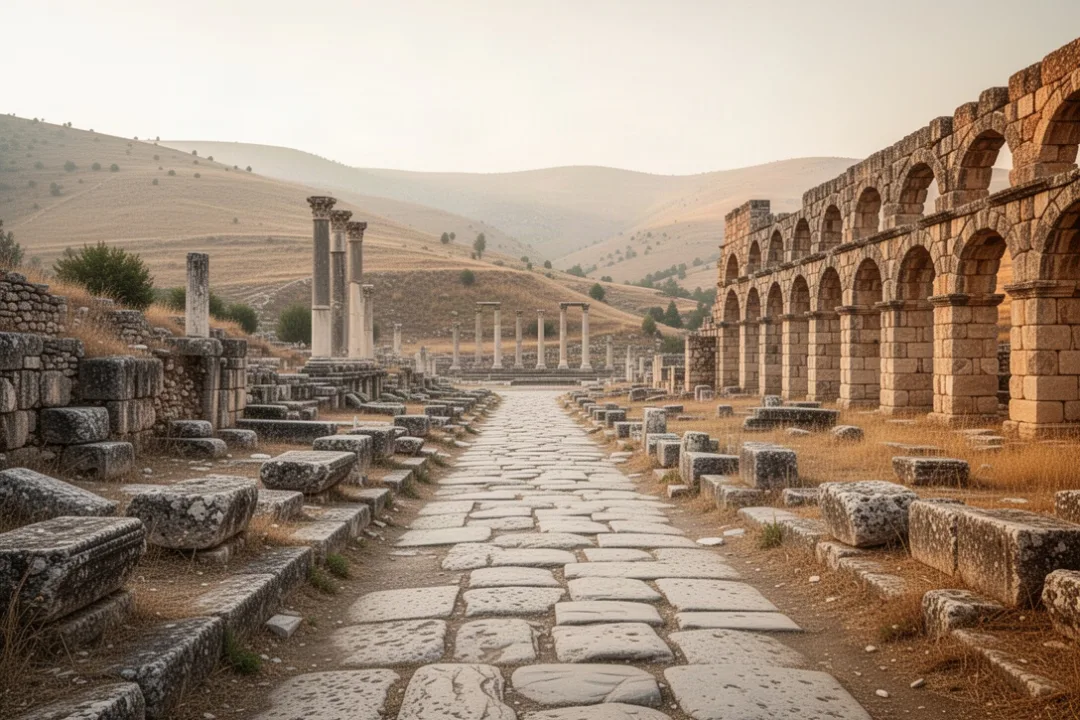
Ancient Laodicea stood in the Lycus Valley, near the cities of Colossae and Hierapolis. It was positioned along important inland routes, which helped it become a center for trade, agriculture, finance, and regional administration. The city was part of the broader Greco-Roman world and eventually belonged to the Roman province of Asia.
The city’s name came from Laodice, associated with the Seleucid ruler Antiochus II, who founded or refounded the settlement in the third century BC. Like many Hellenistic cities, Laodicea was shaped by Greek language and institutions before Roman political control became dominant. Its location in a productive valley gave it access to farmland, while its roads connected it with nearby communities and commercial markets.
Laodicea was not an isolated religious village. It was a prosperous urban community with strong civic identity and a population accustomed to business, public buildings, local institutions, and the movement of goods. That setting matters because the church’s spiritual problem in Revelation is not described as open hostility to Christianity. The problem is self-satisfied religion: a congregation that appears to believe it needs little from anyone, including God.
The city also had a complicated relationship with natural resources. Laodicea did not have the same kind of nearby hot springs associated with Hierapolis or the readily available cold mountain water associated with Colossae. Water had to be brought into the city through an aqueduct or related channel system. By the time it arrived, the water could be warm and mineral-laden, making it unpleasant to drink.
That background may help explain the image of something being lukewarm. The point may not be that hot always means good and cold always means bad. Rather, hot or cold water can serve a useful purpose, while tepid water can be nauseating and disappointing. Revelation uses an ordinary local reality to confront a congregation that has lost its usefulness and urgency.
Context matters: Laodicea’s “lukewarm” image is best understood alongside the city’s water supply, not as an isolated slogan about emotional intensity. The passage addresses spiritual condition, but its language is rooted in a real place.
Laodicea’s wealth, clothing, and medical reputation
Several features of Laodicean life appear to echo through the message in Revelation. The city was known for economic prosperity, including financial activity and commercial trade. Ancient sources and archaeological evidence support the picture of a wealthy urban center, although the exact scale of its banking operations should not be exaggerated.
Laodicea was also associated with a valuable type of dark or glossy wool produced in the surrounding area. This wool supported textile manufacturing and contributed to the city’s reputation for high-quality clothing. When Revelation later describes the church as naked and urges it to receive white garments, the language would have challenged a city proud of its own textile production.
The contrast is sharp. Laodicea could produce clothing for others, but the church’s spiritual condition was exposed before God. The congregation considered itself well supplied, while Revelation describes it as poor, blind, and naked. These terms are not a neutral economic assessment. They expose the distance between public prosperity and spiritual health.
Laodicea was also connected with medical practice, including an eye treatment or powder often associated with the region. The precise nature and production of that remedy are discussed by historians, but the city clearly had a medical reputation. That makes Revelation’s reference to blindness especially pointed. A community associated with treating eyes could still fail to see its own condition.
The message is not a condemnation of clothing, medicine, commerce, or money themselves. The issue is the false confidence that can grow around them. Material resources may give a city or individual a sense of independence, but they cannot provide spiritual sight, reconciliation with God, or moral courage.
Revelation 3:17 records the church’s self-assessment in paraphrased form: it believes it is rich, has acquired wealth, and needs nothing. The reply overturns that judgment. The church does not understand that it is spiritually needy. Its most serious problem is therefore not simply sin that it recognizes and refuses to change; it is unrecognized poverty.
Money can create the impression that every problem has a practical solution.
Clothing can symbolize public respectability while concealing inward weakness.
Medical expertise can suggest insight without guaranteeing spiritual discernment.
Comfort can make dependence on God feel unnecessary.
These contrasts explain why the passage remains relevant. A church, organization, or individual can have excellent facilities, a respected name, financial stability, and polished communication while lacking compassion, repentance, truthfulness, and dependence on Christ. The outward signs may look healthy because the surrounding culture rewards them.
What Revelation says to the church in Laodicea
The message to Laodicea appears in Revelation 3:14–22. It follows the pattern used in the messages to the seven churches: Christ is identified, the congregation is addressed, its condition is evaluated, and a response is required. Unlike some of the other churches, Laodicea receives no clear word of praise before its correction.
Christ is introduced as “the Amen,” a designation associated with reliability and truth. He is also called the faithful and true witness and the beginning, or source, of God’s creation. The opening establishes a contrast between Christ’s trustworthy judgment and the church’s inaccurate judgment about itself.
The church is then criticized for being lukewarm. The familiar language should not be reduced to “you are not passionate enough.” The larger picture includes uselessness, complacency, and a lack of meaningful response. The congregation has settled into a condition that is neither openly resistant nor visibly devoted.
That middle condition can be easy to defend. A person who is openly hostile to faith is at least honest about the conflict. A person who is committed may accept sacrifice and correction. But someone who maintains religious identity while refusing the demands of discipleship can appear stable and respectable. Revelation treats this as dangerous because it disguises need.
The rebuke continues with imagery drawn from the city’s public identity. The church is told, in paraphrase, to obtain refined gold so that it may become truly rich, white clothing so that its shame may not be exposed, and eye salve so that it may see. These images point to faith tested and purified, a life made clean by God, and spiritual perception restored by divine grace.
The instruction to “buy” these things does not mean salvation can be purchased. It is forceful symbolic language aimed at people who think they already possess everything. The congregation must abandon its claim to self-sufficiency and receive what it cannot manufacture. What looks like an economic transaction is actually a call to humble dependence.
The passage also says that Christ rebukes and disciplines those he loves. That statement does not soften the seriousness of the warning, but it explains its purpose. The correction is not presented as proof that the church is beyond recovery. It is a summons to become earnest and to repent.
The final part of the message is strikingly personal. Christ is portrayed as standing at the door and knocking, with an invitation to fellowship with anyone who hears and opens. The image is often applied to an individual’s conversion, and that application can be meaningful, but the original setting addresses a church. A congregation can have Christian language and activity while still needing to welcome Christ afresh into its shared life.
The promise to the one who conquers is participation in Christ’s royal rule, expressed through the image of sitting with him on his throne. The message ends with a broad appeal to hear what the Spirit says to the churches. The warning is directed at Laodicea, but its challenge is meant for every Christian community willing to listen.
What “lukewarm” means in the Laodicean warning
The word lukewarm is commonly used to describe weak enthusiasm. That is part of the idea, but it does not capture the whole force of the passage. In its setting, lukewarm water may suggest something unpleasant, ineffective, or likely to make someone sick. The church has become spiritually distasteful because its profession and practice no longer fit together.
Some interpretations say that hot water represents fervent faith and cold water represents complete unbelief. That reading can make the phrase memorable, but it creates a difficulty: why would Christ prefer coldness to faith? A better approach recognizes that both hot and cold water can be useful for different purposes, while lukewarm water is associated with poor quality and limited usefulness.
The warning is therefore aimed at complacent compromise. Laodicea may not have rejected Christ publicly, but it also did not live with the kind of dependence, generosity, repentance, and witness expected from a Christian church. Its identity had become nominal while its inner life had grown weak.
Lukewarmness can take several forms:
Maintaining Christian language while avoiding obedience that costs something.
Measuring spiritual health by attendance, reputation, or resources alone.
Ignoring suffering because personal comfort feels more urgent.
Resisting correction while insisting that nothing essential needs to change.
Confusing tolerance with love and silence with peace.
None of these conditions is diagnosed by a single bad day. The message addresses a settled posture. Every believer experiences fatigue, doubt, grief, and seasons when prayer feels difficult. Spiritual lukewarmness is different: it is a continuing refusal to face the truth about one’s relationship with God.
The remedy is not manufactured excitement. Scripture does not tell the Laodiceans to create a stronger emotional mood through effort. They are told to recognize their poverty, receive what Christ offers, become earnest, and repent. The central change is honest dependence, not performance.
A useful question: Instead of asking only, “How passionate do I feel?” ask, “Where am I relying on comfort, reputation, or resources instead of receiving correction and obeying Christ?”
How the Laodicean message applies to churches and individuals
Laodicea is often used as a label for another church or group. That can miss the point of the passage. The message is not designed mainly to help readers identify someone else’s lukewarmness. It asks every congregation and every Christian to examine the gap between self-perception and Christ’s evaluation.
A church may be active yet spiritually unhealthy. It may organize many events, maintain attractive buildings, publish excellent material, or have a large budget. Those things can serve good purposes, but they do not prove that the church is faithful. The more searching questions concern truth, prayer, repentance, love, justice, generosity, care for the vulnerable, and willingness to follow Christ when obedience is inconvenient.
Individuals face similar dangers. Employment, savings, education, health, social connections, and personal competence are good gifts, but they can become sources of false security. When life is stable, dependence on God may become a phrase rather than a lived reality.
Laodicea also warns against confusing self-confidence with spiritual maturity. Mature faith is not insecure in every moment, but it remains open to correction. It can admit, “I do not see clearly,” “I have been protecting my comfort,” or “My public image is stronger than my private obedience.” Such honesty is not defeat; it is the beginning of repentance.
A practical examination might include these questions:
Where have I assumed that material success proves God’s approval?
Which areas of my life do I protect from correction?
Do my use of money, time, and influence reflect love for God and neighbor?
Am I willing to hear difficult truth from Scripture and trustworthy people?
What would repentance look like in a specific relationship or decision?
For churches, the same examination can be done collectively. Leaders can ask whether ministry activity is producing humility and love, whether members are cared for beyond public gatherings, and whether the congregation can acknowledge failure without defensiveness. A healthy church does not claim perfection. It remains responsive to Christ.
The invitation in Revelation is also hopeful. The church is not told that its past reputation determines its future. Christ calls it to change, and he offers fellowship to those who hear. That means the warning should produce neither despair nor superiority. Its proper effect is repentance, renewed dependence, and restored communion.
What archaeology and history reveal about Laodicea today
The ruins of Laodicea are located near modern Denizli in Turkey. Excavations have uncovered remains that help visitors picture the city as a substantial Roman-era center rather than a minor settlement. Archaeologists have identified public buildings, streets, theaters, churches, water infrastructure, and other evidence of urban life.
The site also reflects the region’s seismic history. A major earthquake damaged Laodicea during the Roman period. An ancient historical account reports that the city rebuilt without accepting imperial financial assistance, a detail that fits the broader picture of local confidence and resources. The episode should not be treated as a direct explanation of every phrase in Revelation, but it gives useful historical context for a city proud of its ability to recover and provide for itself.
Archaeology cannot prove the spiritual claims made in Revelation, nor can it reconstruct every detail of the first-century congregation. What it can do is clarify the setting in which the message was heard. The references to wealth, clothing, eyesight, water, and self-sufficiency become more vivid when Laodicea is understood as a prosperous city with recognizable civic strengths.
Laodicea is also connected with the early Christian communities mentioned elsewhere in the New Testament. Paul refers to believers in and around Laodicea in Colossians 2:1 and instructs that letters be exchanged between the churches in Colossae and Laodicea in Colossians 4:16. These references show that Laodicea belonged to a network of Christian congregations in the Lycus Valley.
The church in Laodicea was therefore not a religious community appearing from nowhere in Revelation. It had a history, relationships with neighboring churches, and a place within the spread of early Christianity. By the time of Revelation, however, it needed to hear a severe warning about its current condition.
The lasting significance of Laodicea lies in that tension. A church can have a respected history and still require repentance in the present. A city can be wealthy and resilient while its people remain spiritually needy. The message refuses to let past success, public image, or institutional strength substitute for a living response to Christ.
Laodicea ultimately asks a direct question: What does God see when he looks beneath our claims of strength? Revelation’s answer is not meant to crush people who are struggling. It confronts those who have stopped recognizing their need. The way forward is to listen, receive correction, seek true riches from Christ, and open the door to renewed fellowship.
Frequently asked questions
Is Laodicea a real place or only a biblical symbol?
Laodicea was a real ancient city in the Lycus Valley of western Asia Minor, near present-day Denizli, Turkey. It later became a symbol because Revelation’s message to its church uses the city’s known features—wealth, textiles, medicine, and water—to describe spiritual complacency. The historical city and the symbolic meaning belong together rather than competing with each other.
Does “lukewarm” mean a person has weak emotions about faith?
Not necessarily. The word points more broadly to a condition of complacency, uselessness, and self-satisfaction. A person may feel spiritually tired without being indifferent to God. Revelation’s concern is a settled refusal to recognize need, receive correction, and live in faithful dependence on Christ.
Was Laodicea the wealthiest city in the ancient world?
Claims that it was the wealthiest city of all antiquity go beyond what the evidence can establish. Laodicea was clearly prosperous and commercially important, with textile, financial, and medical associations. Its wealth matters in Revelation because the church believed it needed nothing, not because the city held an absolute ranking among every ancient settlement.
What does Revelation offer Laodicea besides criticism?
The message includes a strong invitation to repent and renew fellowship with Christ. Its images of refined gold, white clothing, and eye salve represent resources the church cannot obtain through self-sufficiency. The promise to the one who conquers also shows that correction is directed toward restoration, not merely condemnation.









Leave a Reply