Hittites: the ancient empire of Anatolia explained
Hittites: the ancient empire of Anatolia explained
If you have encountered the Hittites in a Bible passage, a history class, or a documentary about ancient empires, you may wonder who they actually were. The Hittites were an influential Bronze Age people who built a powerful kingdom in central Anatolia, much of modern Turkey, and competed with Egypt, Assyria, and other major states.
At their height, the Hittite Empire controlled important routes across Anatolia and northern Syria. Its rulers governed from Hattusa, a fortified capital filled with temples, archives, gates, and monumental sculptures. The empire lasted for several centuries before breaking apart around the beginning of the twelfth century BCE.
The Hittites emerged as a major power during the second millennium BCE. Their central homeland was the rugged Anatolian plateau, where farming communities, mountain regions, and long-distance trade routes connected the Aegean world with Mesopotamia and the Levant.
Their political center was Hattusa, near modern Boğazkale in north-central Turkey. From there, Hittite kings extended their authority over neighboring kingdoms and eventually established influence across large areas of Anatolia and northern Syria.
The name “Hittite” comes largely through later biblical and historical traditions. The people themselves used names connected with their kingdom, including Hatti, a term that originally referred to the land and its earlier inhabitants. Modern scholars use “Hittite” for the imperial culture and the language recorded in many royal documents.
The short answer: The Hittites were not a minor local tribe. They were one of the great powers of the Late Bronze Age, with a centralized monarchy, a professional military tradition, an extensive diplomatic system, and one of the ancient world’s largest surviving written archives.
A quick historical context for the Hittite world
Before the Hittite Empire formed, Anatolia contained many small kingdoms and city-states. Merchants from Assyria established trading colonies in the region during the early second millennium BCE, leaving behind clay tablets that reveal commercial contracts, loans, family arrangements, and legal disputes.
These early trading communities helped connect Anatolia with the wider Near East. Later Hittite rulers inherited a landscape already shaped by international commerce, competing royal houses, and multiple languages and religious traditions.
The earliest Hittite kings probably ruled a relatively limited territory around central Anatolia. Over time, ambitious rulers expanded the kingdom, absorbed rival states, and turned Hattusa into the center of a much larger imperial system.
How to understand the Hittites step by step
A useful way to study the Hittites is to follow the features that made their kingdom distinctive. The following points provide a practical framework for understanding their rise, government, culture, and eventual collapse.
Locate their homeland. Begin with central Anatolia and Hattusa, then trace Hittite expansion toward the Black Sea, western Anatolia, and northern Syria.
Follow the royal dynasty. Hittite history is organized around kings, succession struggles, military campaigns, marriages, treaties, and changing relationships with powerful neighbors.
Study the written evidence. Thousands of clay tablets record laws, rituals, letters, treaties, prayers, myths, and administrative matters.
Examine their diplomacy. The Hittites treated foreign rulers as partners, rivals, or vassals and used treaties to define obligations and political hierarchy.
Consider their religious world. Their state religion brought together local Anatolian gods, traditions from northern Syria, and influences from Mesopotamia.
Separate different meanings of “Hittite.” The Bronze Age empire, the earlier Hattian population, and the later small kingdoms called Neo-Hittite are related but should not be treated as identical.
How the Hittite kingdom became an empire
Hittite expansion depended on a combination of military force, political negotiation, dynastic marriage, and control of strategic routes. A king might defeat a neighboring ruler, install a loyal governor, accept tribute, or bind the region through a formal treaty.
One of the most significant early rulers was Hattusili I, who helped make Hattusa the center of a growing kingdom. He campaigned beyond central Anatolia and established patterns of conquest and administration that later kings developed further.
Mursili I, a successor of Hattusili I, led a remarkable campaign southward. Hittite forces reached Babylon and captured the city around the sixteenth century BCE, although the Hittites did not establish lasting control over Babylonia. The expedition demonstrated the reach of the Hittite army but also the limits of a campaign far from home.
After periods of internal instability, the kingdom entered a stronger imperial phase under rulers such as Tudhaliya, Suppiluliuma I, Mursili II, and Hattusili III. These kings faced threats from Anatolian rivals, Syrian states, Egypt, and groups moving through the empire’s borderlands.
Why Hattusa was central to Hittite power
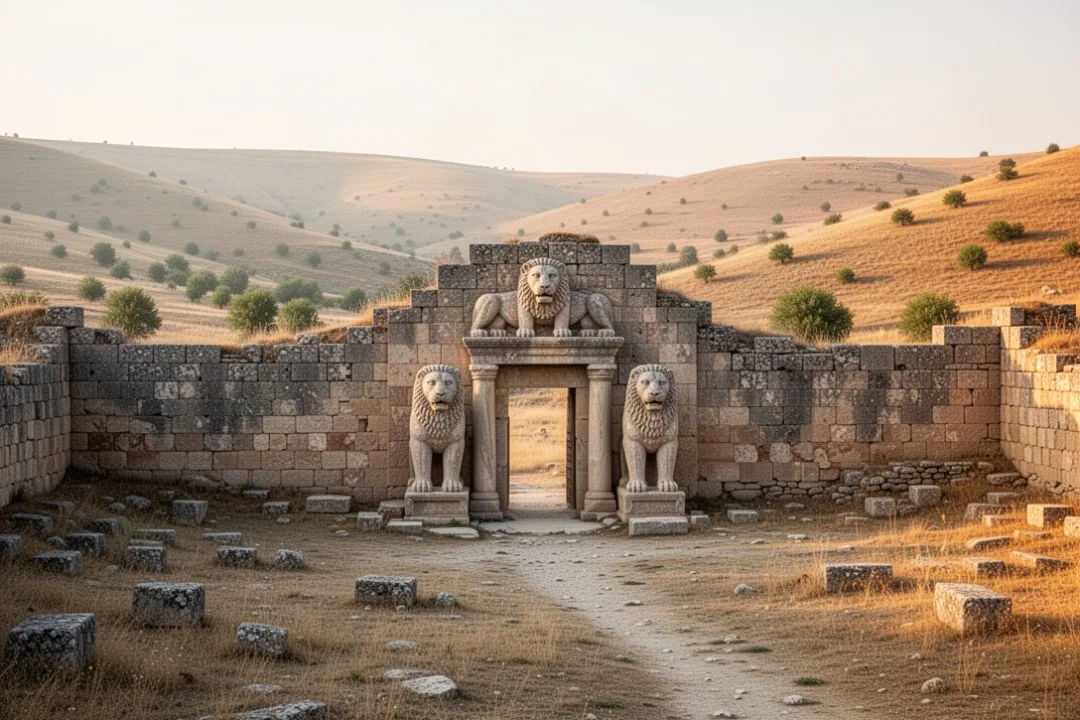
Hattusa was more than a royal residence. It functioned as a political capital, religious center, military headquarters, and archive complex. Its position among hills provided natural defenses, while monumental walls and massive gates emphasized the authority of the state.
Archaeologists have uncovered temples, storage facilities, royal buildings, fortifications, and thousands of clay tablets at the site. The city’s famous gateways include sculpted guardian figures and reliefs that communicated protection, royal power, and sacred presence.
The settlement also included an upper city with numerous religious buildings. Hittite texts describe the capital as a place of ceremonies and divine worship, reflecting the close connection between royal authority and the well-being of the gods.
Hattusa was not isolated from the wider world. Roads linked it with other Anatolian centers and with territories to the south. The capital’s archives show that its rulers exchanged messages with foreign kings, provincial officials, priests, military commanders, and local administrators.
What the Hittite language reveals
The Hittite language is one of the earliest recorded members of the Indo-European language family. It was written mainly in a form of cuneiform adapted for the Hittite court, although the scribes also used other languages when communicating with different populations or preserving older ritual traditions.
Hittite texts often appear on clay tablets. Scribes recorded royal annals, legal rules, prayers, myths, diplomatic agreements, instructions for ceremonies, and letters concerning supplies or military affairs.
The written record is valuable because it reveals both major events and ordinary administrative concerns. A royal annal might describe a campaign, while another tablet lists offerings, assigns duties to officials, or explains how a ritual should be performed.
Hittite scribes also preserved texts in languages such as Hattic, Hurrian, Akkadian, and Luwian. This multilingual record reflects the diverse character of the empire and shows that Hittite administration did not depend on a single cultural identity.
How Hittite government worked
The Hittite state was a monarchy, but the king did not govern alone. Royal relatives, provincial officials, military commanders, priests, and local rulers all played roles in managing the kingdom.
The king was the empire’s chief political and military leader and held major religious responsibilities. Hittite royal ideology presented the king as responsible for maintaining order between the human community and the gods. Military success and ritual correctness were therefore connected to royal legitimacy.
Some territories were governed directly, while others retained local rulers under Hittite supervision. Vassal treaties could require loyalty, military support, tribute, extradition of fugitives, and respect for the authority of the Hittite king.
Succession was not always peaceful. Rival claims, palace conspiracies, and disputes among royal family members could weaken the state. A surviving document associated with Telipinu sets out succession principles and condemns violent palace conflict, although political stability remained difficult to maintain.
What Hittite law says about their society
The collection often called the Hittite Laws is one of the most important sources for Hittite society. These provisions address injury, theft, property, agriculture, marriage, sexual offenses, animals, and compensation.
Many offenses were handled through payments or restitution rather than only through physical punishment. The amounts could vary according to the seriousness of the offense, the status of the people involved, and the circumstances of the case.
The laws should not be read as a complete code that describes every part of daily life. They are a collection of legal provisions copied and revised over time, and they may represent ideals, precedents, or administrative guidance rather than a simple record of courtroom practice.
Even with that limitation, the laws show that Hittite authorities cared about property rights, agricultural production, household relationships, and the restoration of social order. They also reveal a society with clear distinctions of status and responsibilities.
Why Hittite diplomacy mattered
The Hittites were skilled diplomatic participants in a crowded international system. Royal correspondence shows that rulers recognized one another through formal language, gifts, marriage arrangements, and carefully defined political relationships.
The Hittite kings sometimes described major foreign rulers as “brothers,” a diplomatic expression signaling equality or close alliance. Lesser rulers could be treated as dependents who owed service to the imperial center.
One of the best-known examples is the treaty between Hattusili III and the Egyptian pharaoh Ramesses II. It followed the long rivalry between Egypt and the Hittites over northern Syria, including the famous battle near Kadesh.
The treaty addressed peace, mutual assistance, nonaggression, and the return of fugitives. Versions in Egyptian and Akkadian survive, and the agreement is often described as one of the earliest known formal peace treaties, though ancient treaties existed in other forms as well.
The Kadesh agreement matters because it shows that ancient empires could combine military rivalry with formal negotiation and shared political guarantees.
What happened at the Battle of Kadesh
The Battle of Kadesh took place in the thirteenth century BCE, when Egyptian and Hittite forces competed for influence in Syria. Ramesses II led the Egyptian army, while the Hittite side was commanded by Muwatalli II.
Both kingdoms claimed success in their own accounts. Egyptian monuments emphasize Ramesses II’s courage and divine support, while the broader evidence suggests a hard-fought confrontation that did not produce a decisive Egyptian conquest of the region.
The Hittites retained substantial influence in northern Syria for a time. Later, changing rulers and external pressures encouraged Egypt and the Hittite court to establish a more stable peace.
The episode demonstrates why ancient military records need careful reading. Royal inscriptions were not neutral battlefield reports; they were also tools for presenting the king as victorious, protected by the gods, and worthy of loyalty.
How Hittite religion shaped public life
Hittite religion was highly diverse. The empire incorporated gods and rituals from many communities, producing what scholars sometimes describe as a “thousand gods” tradition. This phrase reflects the extraordinary number of divine figures honored across the kingdom rather than a single standardized pantheon.
Important deities included the Storm God, associated with weather and royal power, and the Sun Goddess of Arinna, who held a central place in the state cult. Local gods could be adopted, renamed, combined, or given a place within official ceremonies.
Religious practice involved festivals, offerings, purification, divination, prayers, and rituals intended to restore balance after pollution or divine anger. Priests and palace officials managed many ceremonies, while the king and queen took prominent public roles.
Hittite texts also preserve myths connected with fertility, storms, succession, and conflict among gods. The famous story of the Storm God and the missing or weakened deity reflects concerns about disorder and restoration, themes that also appear in ritual texts.
What Hittite military power looked like
The Hittite army relied heavily on infantry and chariot forces. Chariots were expensive military equipment requiring trained crews, horses, workshops, and logistical support. They were especially useful on open ground and could carry elite fighters into battle.
Hittite campaigns could be lengthy and difficult because Anatolia contains mountains, narrow passes, and varied climates. Armies needed food, animals, weapons, and reliable routes, while distant provinces could rebel when the central government appeared weak.
The empire’s military strength was not based only on battlefield victories. Fortified centers, vassal agreements, hostage arrangements, strategic marriages, and the threat of royal retaliation helped maintain control across a large and diverse territory.
Hittite records also describe the treatment of conquered populations and the relocation of communities. Such policies could provide labor and strengthen strategic areas, but they also created resentment and administrative burdens.
How the Hittites treated neighboring cultures
The Hittite Empire was culturally mixed rather than uniform. Its rulers incorporated older Anatolian traditions and adopted practices from Hurrian, Syrian, Mesopotamian, and other communities.
Instead of eliminating every local tradition, Hittite authorities often preserved it within an imperial framework. Local rulers could continue to govern, local deities could be honored, and regional languages could remain in use alongside the language of the court.
This flexibility helped the empire manage different populations, but it also meant that Hittite identity was not simple. Political loyalty to the king could exist alongside strong local identities, languages, and religious practices.
What “Hittite” means in the Bible
The Hebrew Bible refers to people called Hittites or associated with the land of Heth. These references include individuals living in the southern Levant, such as Uriah the Hittite in the story of David.
The relationship between these biblical Hittites and the Bronze Age imperial Hittites of Anatolia is debated. The biblical references may preserve a memory of the great Hittite kingdom, refer to smaller communities in the Levant, or use a broader name for groups associated with an older political tradition.
It is safest not to assume that every biblical reference describes a citizen of the Hittite Empire centered at Hattusa. The word may have had different meanings in different periods and contexts.
Keep the terms separate: “Hittite” can refer to the imperial people of Bronze Age Anatolia, while “Hattian” describes an earlier non-Indo-European population and “Neo-Hittite” usually describes later Iron Age states in northern Syria and southeastern Anatolia.
Why the Hittite Empire collapsed
The Hittite imperial system disappeared from Hattusa around the early twelfth century BCE, during a period of widespread disruption across the eastern Mediterranean and Near East. Several major states experienced political breakdown, population movement, warfare, and declining trade at roughly the same time.
No single explanation accounts for every problem. Possible pressures include drought or climate stress, internal succession disputes, rebellion in subject territories, attacks or migration by groups often associated with the Sea Peoples, and the interruption of long-distance exchange.
The empire may also have been vulnerable because it depended on a large network of provinces and vassal states. When harvests failed, trade routes became unsafe, or central authority weakened, local communities could stop supplying the capital or assert their independence.
Hattusa was eventually abandoned, but Hittite-related political traditions did not vanish overnight. Smaller kingdoms survived in parts of northern Syria and southeastern Anatolia, carrying forward elements of language, art, royal titles, and religious practice.
What the Neo-Hittite states were
After the collapse of the central empire, several Iron Age kingdoms emerged in areas once connected to Hittite power. Modern scholars often call these states Neo-Hittite or Syro-Hittite kingdoms, although their populations and political traditions were varied.
Examples include states centered at places such as Carchemish, Malida, and other regional capitals. These kingdoms used Luwian hieroglyphic inscriptions and developed their own relationships with Assyria and neighboring powers.
They were not simply the old Hittite Empire continuing unchanged. Their political structures, cultural mixtures, and historical circumstances differed from those of the Bronze Age kingdom. Still, their monuments and inscriptions help explain how Hittite traditions remained visible after Hattusa’s decline.
How archaeologists recovered Hittite history
Hittite history became much clearer after excavations at Hattusa revealed large groups of cuneiform tablets. The site had been identified as the ancient capital, and the archives provided names, dates, treaties, religious texts, and accounts of royal campaigns.
The decipherment of the Hittite language in the early twentieth century transformed the field. Scholars could compare Hittite texts with Akkadian diplomatic documents, Egyptian records, Luwian inscriptions, and archaeological evidence from across Anatolia and Syria.
Evidence comes with limits. Tablets often reflect the concerns of royal institutions, while ordinary farmers, laborers, women, and subject communities appear less directly. Archaeologists therefore compare written records with buildings, pottery, burials, tools, animal remains, settlement patterns, and environmental data.
Some historical questions remain open because royal records can be incomplete or biased. The location of certain battles, the identity of groups mentioned in late texts, and the precise causes of the empire’s collapse continue to receive scholarly attention.
Why the Hittites still matter
The Hittites show how a state can become powerful without being centered in Mesopotamia or Egypt. Their history broadens the picture of the ancient Near East by highlighting Anatolia’s strategic importance and its connections with the Aegean, Syria, and Mesopotamia.
They also provide an unusually detailed view of ancient imperial administration. Their archives allow researchers to study treaties, law, ritual, military planning, royal ideology, and the practical problems of controlling distant territories.
Their diplomacy offers another lasting lesson. The treaty with Egypt demonstrates that warfare and negotiation were not separate worlds; ancient rulers could fight for regional influence and later construct formal agreements designed to prevent renewed conflict.
Finally, the Hittites remind us that civilizations do not simply disappear when a capital falls. Political systems can collapse while languages, artistic styles, religious ideas, and regional institutions survive in new forms.
How to remember the Hittites
If you need a concise way to remember them, connect the Hittites with six ideas: Hattusa, central Anatolia, cuneiform archives, chariot warfare, diplomacy with Egypt, and the collapse of the Late Bronze Age.
Homeland: central Anatolia, with Hattusa as the imperial capital.
Language: Hittite, an early written Indo-European language.
Government: a royal empire supported by officials, vassal rulers, treaties, and military power.
Religion: a diverse state tradition that incorporated many local gods and rituals.
International role: a major rival of Egypt and a participant in Late Bronze Age diplomacy.
Legacy: surviving archives, monuments, inscriptions, and later states that preserved parts of Hittite culture.
Studying the Hittites means looking beyond a single famous battle or biblical reference. Their importance lies in the full combination of political organization, military reach, cultural diversity, written records, and long-term influence across Anatolia and northern Syria.
Frequently asked questions
Were the Hittites related to the people of modern Turkey?
The Hittites lived in central Anatolia, a region within modern Turkey, but they were an ancient population separated from modern national identities by thousands of years. Some cultural and genetic continuity may have existed among Anatolian populations, but modern Turkish identity developed much later. It is more accurate to describe the Hittites as an ancient Anatolian civilization than to equate them directly with modern Turks.
Did the Hittites invent the chariot?
The Hittites did not invent the chariot. Chariots were developed earlier elsewhere and became important across the ancient Near East. The Hittites adopted and refined chariot warfare, using trained crews and organized military forces. Their chariots played a major role in conflicts such as the Battle of Kadesh, although infantry remained essential to Hittite armies.
What happened to the Hittite language?
Hittite stopped being used as a major administrative language after the collapse of the Hittite Empire. Related Anatolian languages, especially Luwian, continued in some regions, and later inscriptions preserved elements of Hittite imperial traditions. Hittite is now known mainly through ancient clay tablets and is studied by specialists in ancient languages and Near Eastern history.
Can you visit Hittite sites today?
Yes. The most important site is Hattusa near Boğazkale in Turkey, where visitors can see city walls, monumental gates, temple areas, and the nearby sanctuary of Yazılıkaya. Archaeological remains associated with later Hittite-related kingdoms can also be found in parts of Turkey and Syria, though access varies by location and current conditions.







Leave a Reply