In Catholic practice, a scapular is a devotional object made from two small pieces of cloth connected by bands and worn over the shoulders. One piece rests on the chest and the other on the back, so the cloth hangs down on both sides of the body. The word comes from the Latin scapulae, meaning shoulders or shoulder blades.
The original scapular was part of a religious habit. Monks and nuns wore a large strip of fabric over the shoulders and down the front and back of the habit. It helped protect the clothing during work and became a recognizable part of certain religious communities. Smaller devotional scapulars developed later for laypeople who wanted to share in a community’s spirituality.
A small scapular is therefore more than a piece of jewelry. It is a visible sign of devotion, a reminder of prayer, and, in some cases, an indication that the wearer has been formally enrolled in a religious confraternity or spiritual association. Its meaning comes from the faith and commitment it represents, not from the material itself.
Central idea: A scapular is not generally understood as a magical object or automatic guarantee of salvation. Catholic teaching treats it as a sacramental—a sacred sign that points toward prayer, conversion, and a closer relationship with God.
Different scapulars are connected with different religious orders, saints, and devotional themes. Some emphasize Mary’s protection, while others focus on the Passion of Christ, the Holy Trinity, the Holy Spirit, or a particular form of prayer. The colors and images vary, but the basic purpose is similar: to help the wearer remember a specific spiritual commitment.
What the Brown Scapular represents
The Brown Scapular of Our Lady of Mount Carmel is the best-known scapular in the Catholic Church. It is associated with the Carmelite tradition and is usually made of two small brown woolen pieces connected by narrow cords or bands. One side commonly bears an image of Our Lady of Mount Carmel, although the image is not what makes the scapular valid.
The devotion is connected with Mount Carmel, a biblical and historical place associated with the prophet Elijah and later with a community of hermits who became the Carmelite order. According to Carmelite tradition, the Virgin Mary gave the scapular to Saint Simon Stock in the 13th century. The details of that tradition have been discussed by historians, so the story should be presented as a longstanding Carmelite tradition rather than as a universally documented historical event.
The Brown Scapular points especially toward Mary’s example of faithful discipleship. A person who wears it is encouraged to imitate her openness to God, prayerfulness, humility, and care for others. The devotion is also linked with the Carmelite emphasis on interior prayer and a life shaped by the presence of God.
Many people associate the Brown Scapular with a promise of Mary’s protection. Catholic explanations of the devotion do not treat that promise as a license to ignore moral responsibility or as a substitute for Christian faith. Instead, the scapular is meant to encourage a life of prayer, participation in the Church, and sincere effort to follow the Gospel.
How the Brown Scapular tradition developed
The Brown Scapular became increasingly popular among lay Catholics as Carmelite communities promoted a smaller version of their religious habit. Over time, confraternities and devotional associations formed around it. Enrollment traditionally involved a priest or another authorized minister and linked the wearer spiritually with the Carmelite family.
Older accounts sometimes connect the scapular with the Sabbatine privilege, a claim about special help for souls in purgatory who fulfill certain conditions. Modern Catholic explanations caution against presenting this as an automatic promise or a simple way to avoid judgment. The safest understanding is that the scapular expresses trust in God’s mercy while calling the wearer to live faithfully, practice chastity according to their state in life, and maintain a serious life of prayer.
The Church has approved the scapular devotion in a general sense, but approval does not mean every popular story or private claim about it has equal authority. A Catholic who wants to understand the Brown Scapular well should distinguish among official liturgical practices, Carmelite tradition, private revelations, and informal customs.
How to wear and receive a Catholic scapular
A traditional scapular is worn with one cloth panel lying against the chest and the other against the upper back. The connecting bands pass over the shoulders. It may be worn under or over clothing, depending on personal preference, local custom, and practical considerations. The object does not need to be displayed publicly to have devotional meaning.
Someone beginning the Brown Scapular devotion can follow these practical steps:
Learn what the devotion involves. Understand that the scapular calls for prayer and Christian living rather than functioning as a protective charm.
Ask a priest or authorized minister for enrollment. The traditional rite includes prayers and may be adapted according to approved Church practice.
Wear the scapular consistently. Keep it in a respectful place when removing it for bathing, sports, work, or another practical reason.
Adopt a regular prayer practice. The exact practice may be explained during enrollment or by a Carmelite parish or community.
Replace worn fabric when necessary. A damaged scapular can be replaced without repeating enrollment in the traditional understanding.
There is no universal rule requiring a particular color, image, size, or brand. For the Brown Scapular, the traditional form uses small pieces of brown wool. Medals bearing a scapular image have also received permission for use in certain circumstances, especially when wearing cloth would be difficult. A person should ask a priest which form is appropriate rather than assuming every piece of religious jewelry has the same status.
Some people wear the scapular on a chain, attach it to clothing, or keep it in a wallet when they cannot wear it around the neck. These practices may express personal devotion, but they differ from the customary form of wearing two cloth panels over the shoulders. The meaning is strongest when the physical sign is joined to the prayer and conduct it represents.
Practical reminder: If a scapular becomes uncomfortable or unsafe during work, exercise, or sleep, remove it temporarily and put it back on afterward. Temporary removal does not turn devotion into a superstition or erase a person’s intention.
Common types of Catholic scapulars
The Brown Scapular is only one of several Catholic scapulars. Each has a distinct history and spiritual emphasis, although none should be treated as a competing guarantee of divine favor. The following examples are among the better-known forms:
Brown Scapular: Associated with the Carmelites and devotion to Our Lady of Mount Carmel.
Green Scapular: Connected with the Immaculate Heart of Mary and often used as an aid to prayer and conversion. It has a different history and does not require the same enrollment as the Brown Scapular.
Red Scapular: Associated with the Passion of Christ and the Sacred Hearts in particular devotional traditions.
Black Scapular: Traditionally connected with the Servite order and devotion to the Seven Sorrows of Mary.
White Scapular: Used by several religious communities, including traditions connected with the Trinity and other forms of devotion.
Blue Scapular: Associated with devotion to the Immaculate Conception in a historical Catholic tradition.
The same color can have different associations in different settings, so color alone does not identify a scapular’s meaning. The images, prayers, religious order, and enrollment requirements matter more. If you receive one from a parish, shrine, or religious community, ask which devotion it represents and whether a particular prayer or ceremony belongs with it.
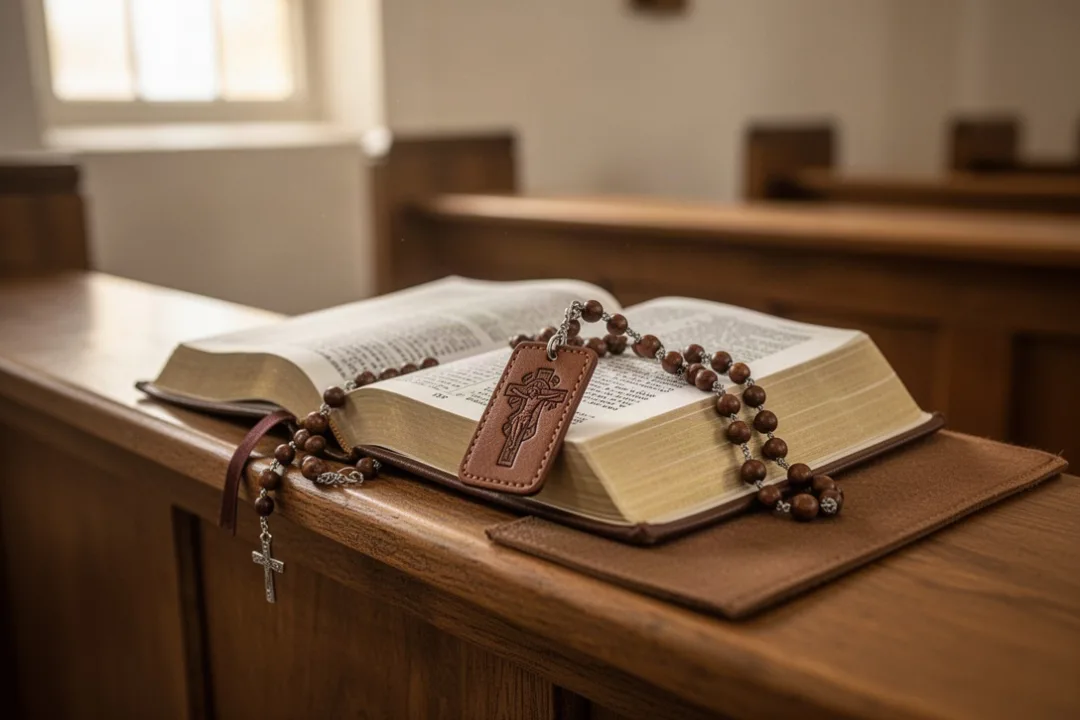
Scapulars are sometimes confused with medals, crosses, and rosaries. These are all sacramentals or devotional aids in broad Catholic usage, but they are not interchangeable. A rosary supports meditation on the mysteries of Christ and Mary; a medal may commemorate a saint or devotion; a scapular traditionally signifies participation in a particular spiritual family or commitment.
Respect for a scapular does not require treating it as an object with independent power. Catholics may kiss it, keep it near a prayer space, or replace it when it wears out, but these actions are expressions of reverence. The spiritual purpose remains prayerful remembrance and a life consistent with the devotion.
What scapular means in anatomy
In medicine, exercise science, and anatomy, scapular describes something related to the scapula. The scapula is the flat, roughly triangular bone commonly called the shoulder blade. You have one on each side of the upper back, where each connects the upper arm bone with the collarbone and helps form the shoulder complex.
The scapula is not fixed directly to the rib cage by a typical bony joint. Instead, it glides across the back of the rib cage and is held in position by muscles, connective tissue, and its connections with the collarbone. This arrangement gives the shoulder a wide range of motion but also means that poor coordination, weakness, injury, or nerve problems can affect how the shoulder blade moves.
Several muscles attach to or influence the scapula. The trapezius, serratus anterior, rhomboids, levator scapulae, and rotator cuff muscles all contribute to shoulder movement and stability. When you raise your arm, the scapula normally rotates and shifts in a coordinated way rather than remaining completely still.
What scapular pain and winging can indicate
Scapular pain may feel like aching, burning, tightness, or tenderness near one shoulder blade. It can be related to muscle strain, prolonged posture, repetitive lifting, neck problems, shoulder injuries, or irritation involving the nerves. Pain in this area can also be referred from another part of the body, so its exact cause cannot be identified from location alone.
Scapular winging describes an abnormal prominence of the shoulder blade, often noticed when a person pushes against a wall or lifts an arm. It can result from weakness or dysfunction in muscles and nerves that stabilize the scapula. A sudden change, substantial weakness, severe pain, numbness, or loss of shoulder function deserves evaluation by a qualified clinician.
Gentle movement, good workstation setup, and attention to lifting technique may help with minor muscular discomfort, but persistent symptoms should not be diagnosed through online descriptions. Seek urgent medical care for shoulder-blade pain accompanied by chest pressure, trouble breathing, sweating, faintness, or pain spreading to the arm or jaw, because those symptoms may signal a medical emergency rather than a simple muscle problem.
Context usually makes the intended meaning clear. A parish notice about enrollment, Our Lady of Mount Carmel, or religious clothing is referring to a devotional scapular. A physical therapy note mentioning movement, winging, retraction, or dyskinesis is referring to the shoulder blade.
Religious context: “Wear the scapular,” “Brown Scapular,” “scapular devotion,” or “Our Lady of Mount Carmel.”
Medical context: “Scapular pain,” “scapular motion,” “scapular winging,” or “scapular stabilizers.”
Historical context: A large fabric panel worn as part of a monastic or religious habit.
Everyday conversation: Usually a reference to the small devotional item or the shoulder blade, depending on the speaker.
For a Catholic considering the devotional object, the most useful question is not whether the scapular will provide automatic protection. The better question is whether the devotion helps you pray, practice charity, turn away from serious wrongdoing, and remember your obligations to God and other people.
For someone asking about the body, the most useful question is what is causing the scapula to move or hurt abnormally. A physical therapist, physician, or other qualified health professional can assess posture, strength, range of motion, nerves, and the neck and shoulder together.
In either meaning, the word points to a connection between an outward sign and something deeper. The devotional scapular points beyond cloth to a way of prayer and life. The anatomical scapula connects the arm, shoulder, and trunk, making coordinated movement possible.
Frequently asked questions
Does wearing a Brown Scapular guarantee salvation?
No. The Brown Scapular is a sacramental and devotional sign, not an automatic guarantee of salvation. Its purpose is to encourage prayer, faithful Christian living, trust in God’s mercy, and devotion associated with the Carmelite tradition. Wearing it while deliberately rejecting faith, repentance, or moral responsibility misunderstands the devotion. Enrollment and the accompanying spiritual commitments matter more than simply possessing the cloth.
Do you need a priest to bless or enroll you in a scapular?
The traditional Brown Scapular devotion includes formal enrollment by a priest or another authorized minister. A priest can also explain the prayers, obligations, and appropriate form. A scapular may be worn as a personal devotional reminder before enrollment, but that is different from formally joining the associated confraternity or receiving the customary rite.
Can a scapular be worn as a necklace?
A traditional scapular is worn over the shoulders, with one panel on the chest and one on the back. A scapular medal may be permitted in circumstances where cloth is impractical, but a regular necklace is not automatically equivalent to the traditional form. Ask a priest or the relevant religious community if you are unsure which form applies to your devotion.
When should scapular shoulder pain be checked by a doctor?
Arrange medical evaluation when pain persists, repeatedly returns, limits movement, follows an injury, or occurs with weakness, numbness, or visible shoulder-blade winging. Seek emergency care for shoulder or upper-back pain with chest pressure, shortness of breath, faintness, sweating, or pain radiating to the arm or jaw. Those symptoms can indicate a serious condition unrelated to ordinary muscle strain.



Leave a Reply