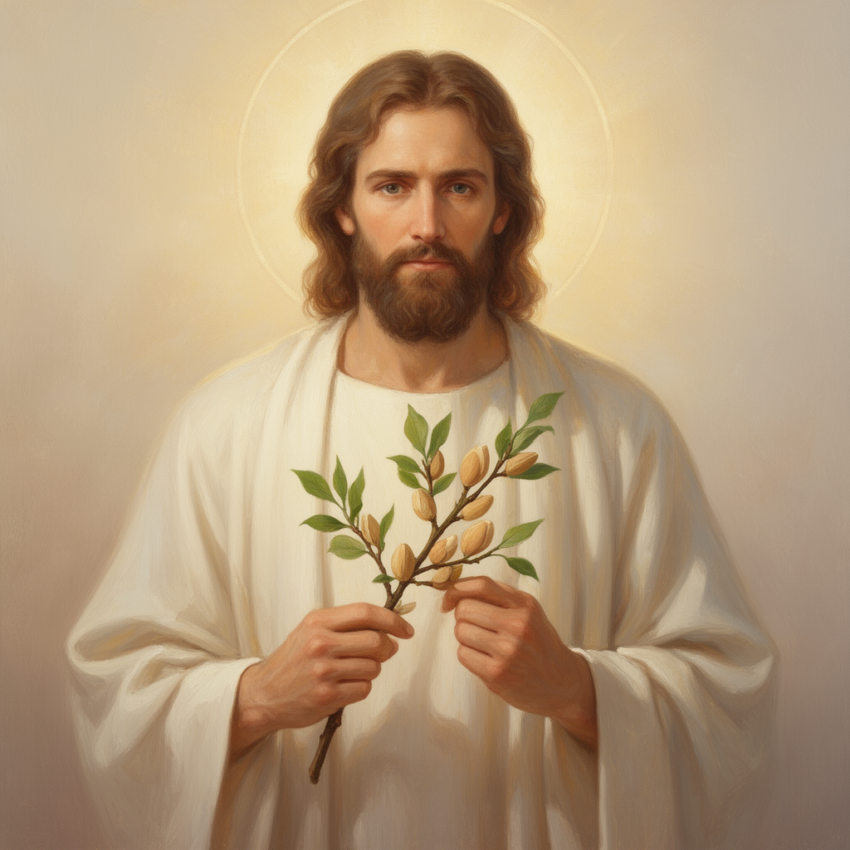
The almond tree is a small to medium deciduous tree, reaching 4-10 meters tall, with a slender, often twisted trunk. Its bark is smooth and gray-brown. Leaflets are lanceolate with a serrated margin, turning golden in fall. In early spring, before the leaves emerge, it produces delicate pink or white flowers with five petals, highly fragrant and strikingly beautiful. Fruit is a drupe with a hard shell and edible seed—the almond nut. The tree prefers warm, well-drained soils and full sun exposure, blooming in late winter to early spring, symbolizing renewal and vigilance.
Scientific Name
Prunus dulcis (Debated; possibly Prunus armeniaca or Prunus scoparia)
Native to the Middle East and South Asia, particularly originated in regions encompassing modern-day Israel, Iran, and surrounding areas. It thrives in Mediterranean climates with hot, dry summers and mild, wet winters. The tree prefers rocky or well-drained soils and full sun exposure, commonly cultivated in orchards throughout Israel and the Levant.
First Biblical Mention
Jeremiah 1:11 (merely the biblical depiction of the almond branch as a divine symbol)
The Lord shows Jeremiah the branch of an almond tree, signifying vigilance and that God’s promises are soon to unfold.
The almond branch symbolizes God’s watchfulness and swift fulfillment of His promises, emphasizing vigilance in faith.
Jeremiah 1:12
God confirms He will watch over His word to perform it, using the image of the almond branch’s rapid growth as a metaphor.
It underscores divine omniscience and the certainty of divine action.
✨ Symbolic Meaning in Scripture
The almond branch embodies watchfulness, rapid fulfillment, and divine assurance. Its early spring blossoms serve as a biblical metaphor for God's promptness in executing His promises. Throughout Scripture, the almond symbolizes alertness and readiness, reminding believers to remain vigilant in faith. The Hebrew name 'Sheqed' (meaning 'watching' or 'delayed') underscores its dual meaning of speed and anticipation. In biblical theology, it encourages trust in God's timing and the hope that divine promises will come to fruition swiftly. As a plant that awakens early after winter, it embodies renewal, hope, and divine fidelity, signaling that God's plans are underway even before visible signs appear.
🏺 Cultural Uses in the Ancient World
Ancient Israelites valued almonds as early-flowering trees signifying renewal and divine favor. The nuts were consumed as food and used in medicinal preparations for various ailments. The wood was appreciated for its hardness and durability in construction, while the shells served as fuel or containers. Almond blossoms also featured in rituals and art, symbolizing divine watchfulness. Trade in almond products contributed to regional economies, and the tree's early bloom marked the start of spring festivals and agricultural cycles, symbolizing hope and renewal.
✡️ In Jewish Tradition
In Jewish tradition, the almond tree symbolizes divine vigil. The almond blossom's early bloom is linked to the month of Shvat (Jewish New Year for Trees), emphasizing renewal and God's watchful care. The fruit and tree appear in rabbinic literature highlighting themes of faith and divine timing. The 'Shaked' is also associated with the mitzvah of planting trees and environmental renewal, reflecting an enduring importance in Jewish environmental ethics and holiday observances.
Christian interpretive tradition sees the almond as a symbol of divine vigilance and resurrection, aligning with themes of renewal in Christ. The early blossom symbolizes hope and God's promises fulfilled in Christ’s resurrection. Artists and theologians have used the almond branch as a motif in religious art to represent watchfulness and divine fidelity, emphasizing the fulfillment of divine promises and the hope of eternal life.
🔬 Modern Botanical Identification
Scholars generally identify the biblical almond with Prunus dulcis, the cultivated almond; however, some suggest it could refer to wild species such as Prunus scoparia or Prunus arabica, which bloom earlier and are native to the Middle East. The identification remains debated due to regional and linguistic considerations, but the early-blossoming characteristic is consistent among candidate species.
🗺️ Where Is It Found Today?
Almond trees are widely cultivated in Israel, Lebanon, Jordan, and other Mediterranean regions. Wild forms can still be found in rocky hillsides and ancient orchards throughout the Levant, thriving especially in well-drained, sunny areas.
❓ Frequently Asked Questions
What does the almond branch symbolize in the Bible?
The almond branch symbolizes vigilance, divine watchfulness, and the swift fulfillment of God’s promises. Its early blossom serves as a sign of renewal and divine fidelity.
Are the biblical almond trees the same as modern almonds?
They are likely related, with the biblical almond possibly referring to both cultivated and wild species native to the Middle East. The early flowering trait is key to its biblical symbolism.
Why did Jeremiah see an almond branch specifically?
The almond’s rapid blossoming signified God’s intention for swift action and fulfillment of His word, emphasizing alertness and divine assurance in times of uncertainty.
✨ Did You Know?
The almond tree blossoms remarkably early in the year, sometimes as early as January, even in regions prone to frost. Archaeological findings suggest almonds were cultivated as far back as 2000 BCE in ancient Israel, indicating their longstanding cultural and economic importance.