You may hear the word catechesis at church, in a parish newsletter, or during a conversation about religious education and wonder what it actually means. Is it the same as Sunday school, a Bible study, or preparation for baptism? The short answer is that catechesis is the process of forming people in Christian faith through teaching, prayer, worship, moral guidance, and participation in the life of the Church.
Catechesis does more than pass along religious information. It helps a person understand the Christian story, respond to God, develop a life of prayer, make ethical choices, and belong meaningfully to a community. It can serve children, teenagers, adults, converts, lifelong believers, parents, and people returning to faith after many years away.
The word catechesis comes from a Greek term associated with teaching by word of mouth or causing something to resound. That background fits the Christian use of the word: faith is received through listening, conversation, explanation, practice, and repeated reflection.
In everyday use, catechesis usually means systematic instruction in the Christian faith. The instruction may include the Bible, the life and teachings of Jesus, worship, prayer, Christian ethics, church history, doctrine, and service to others. It is not limited to memorizing answers, although learning important beliefs and prayers can be part of it.
Catechesis is also more than a single class or course. A class might provide one setting for catechesis, but genuine formation continues through family life, worship, personal study, mentoring, small groups, and service. The goal is not simply to know what Christians say; it is to help a person understand, practice, and embody the faith.
Simple definition: Catechesis is the ongoing formation of Christians in what the Church believes, celebrates, prays, and lives.
Different Christian traditions use the word with different levels of frequency. It is especially common in Catholic, Orthodox, Anglican, and some other historic church settings, while Protestant churches may more often use terms such as Christian education, discipleship, Bible teaching, or faith formation. The names vary, but much of the work overlaps.
How catechesis differs from evangelization, preaching, and theology
Several Christian activities can look similar, so the distinctions are useful. Evangelization focuses on announcing the gospel and inviting people into a relationship with Jesus Christ and the Christian community. Catechesis generally develops that response by offering deeper and more organized formation.
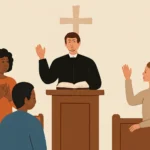
Preaching usually proclaims and applies the Christian message in worship or public ministry. A sermon may inspire, challenge, explain, or comfort, and it can certainly be catechetical. Catechesis, however, normally unfolds over time and covers a wider range of subjects in a more structured way.
Theology is disciplined reflection on God, faith, revelation, and the Church. It often uses technical methods and engages difficult questions at an academic level. Catechesis can draw on theology, but it translates Christian teaching into forms suited to the learner’s age, experience, language, and stage of faith.
Religious education is a broad term that may include the study of religions, ethics, religious history, or classroom instruction. Catechesis has a more specific purpose: it seeks formation in Christian faith and life, not merely knowledge about Christianity from an outside perspective.
Evangelization: announces the gospel and invites a response.
Catechesis: forms people in understanding and living the faith.
Preaching: proclaims and applies the Christian message, often in worship.
Theology: examines faith through careful, sustained reflection.
Discipleship: describes the lived process of following Jesus, often including catechesis.
What catechesis is meant to accomplish
A well-designed catechetical process has several connected purposes. It should give learners a clear account of Christian belief while also helping them develop habits, relationships, and practices that make faith part of ordinary life. Knowledge and lived commitment should support each other rather than remain separate.
Building a clear understanding of Christian belief
Catechesis helps people understand central Christian claims: who God is, what Christians believe about Jesus Christ, the meaning of the Holy Spirit, the role of Scripture, the purpose of the Church, and the hope of resurrection and eternal life. It also addresses the questions people naturally ask about suffering, forgiveness, prayer, human dignity, and the meaning of existence.
Good teaching does not treat difficult questions as signs of disloyalty. It creates room for honest inquiry and explains where Christians have a clear teaching, where traditions differ, and where mystery remains. A learner should be able to distinguish essential beliefs, theological opinions, customs, and personal interpretations.
Developing a life of prayer and worship
Catechesis introduces people to the practices by which Christians turn toward God. These may include personal prayer, reading Scripture, corporate worship, confession, thanksgiving, silence, fasting, sacraments, and the observance of the church calendar, depending on the tradition.
Instruction should explain not only what a practice looks like but why it matters. Someone learning about communion, for example, needs more than directions about when to stand or where to go. The person also needs to understand the tradition’s meaning, the community’s expectations, and the spiritual disposition associated with the practice.
Shaping moral judgment and daily conduct
Christian formation connects belief with action. Catechesis may address honesty, marriage and family life, sexuality, care for the vulnerable, work, money, citizenship, forgiveness, justice, peace, stewardship, and the treatment of people who are different from us.
This moral teaching should not be reduced to a list of prohibitions. It should help people understand human dignity, responsibility, virtue, conscience, mercy, and the common good. Learners benefit from discussing real situations rather than receiving only abstract rules. They also need to see how Christian communities respond when people fail and seek restoration.
Strengthening belonging and participation
Christian faith is not meant to be practiced as a purely private hobby. Catechesis helps people recognize the Church as a worshiping, serving, learning, and imperfect community. It can prepare them to take part in ministries, care for neighbors, welcome newcomers, and share responsibility for the life of the congregation.
Belonging does not mean agreeing that every church custom is perfect. Mature formation teaches people how to participate with commitment, discernment, humility, and responsibility. It also helps them understand the roles of clergy, laypeople, parents, teachers, sponsors, and other members.
Who receives catechesis and when it happens
Catechesis begins in different places for different people. In many families, children first encounter Christian faith through prayer, stories, meals, worship, and the example of adults. A congregation, school, or parish then adds more formal instruction. For others, the first meaningful encounter may happen through a friend, a campus ministry, a service project, or a period of personal searching.
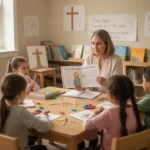
Children’s catechesis should use concrete language, stories, repetition, art, music, movement, and age-appropriate questions. Children need trustworthy adults who can explain faith without mocking their questions or pretending that every issue is simple. Lessons should connect with worship and home life rather than becoming an isolated hour each week.
Youth catechesis needs room for identity, doubt, relationships, technology, social pressure, justice, mental health, and the transition toward adult responsibility. Teenagers are capable of serious theological thought, but they also need conversation, trusted mentors, and opportunities to serve. Treating them only as passive recipients can weaken their connection to the church.
Adult catechesis may take the form of new-member sessions, baptismal preparation, marriage preparation, Bible studies, retreats, small groups, confirmation programs, or courses for people exploring Christianity. Adults bring experience, assumptions, wounds, and prior education, so effective teaching begins by listening to what they already believe and what they genuinely want to understand.
Family catechesis recognizes that parents and caregivers remain important teachers, even when a church provides formal programs. A short prayer at home, a conversation after worship, a discussion about a difficult news story, or a family act of service can reinforce lessons more effectively than a worksheet alone.
Catechesis can also be designed for people with disabilities, different learning needs, limited English proficiency, or unfamiliarity with church customs. Accessibility is not an optional extra. Clear communication, adaptable materials, sensory awareness, physical access, and patient support help more people participate fully.
What subjects catechesis usually includes
The exact curriculum depends on the church and the learner, but a balanced program normally brings several areas together. Teaching one subject while neglecting the others can produce a distorted picture of Christianity. For example, doctrine without prayer may become dry information, while service without theological grounding may lose its connection to the gospel.
Scripture: the Bible’s major story, important passages, literary forms, historical setting, and principles for responsible interpretation.
Christian doctrine: teachings about God, Jesus Christ, the Holy Spirit, creation, sin, salvation, the Church, judgment, and hope.
Worship and sacraments: the meaning and practice of the church’s services, rituals, seasons, and sacramental life.
Prayer: personal and communal forms of prayer, silence, thanksgiving, confession, intercession, and discernment.
Christian ethics: principles for relationships, work, justice, stewardship, sexuality, family life, and care for neighbors.
Church history: major developments, reform movements, councils, divisions, leaders, and examples of faithfulness and failure.
Christian vocation: how believers serve God and others through family life, work, citizenship, ministry, and everyday responsibilities.
Mission and service: sharing the gospel, practicing compassion, supporting the vulnerable, and seeking reconciliation.
The Bible should be handled with care. Catechesis should help learners understand context, genre, audience, and the relationship between individual passages and the larger biblical story. Quoting isolated lines to settle every question can create confusion, especially when a passage is poetic, symbolic, or addressing a particular historical situation.
How effective catechesis teaches people rather than merely information
Strong catechesis starts with the learner’s real questions. A lesson about prayer becomes more meaningful when it addresses distraction, unanswered prayer, grief, or uncertainty. A session on forgiveness should allow people to distinguish forgiveness from denying harm, abandoning boundaries, or excusing abuse.
Teachers should combine several methods because people learn in different ways. Explanation, discussion, reading, storytelling, art, music, role-play, silence, reflection, and service can all support learning. Active participation usually helps people remember and apply ideas better than listening to a long lecture every week.
Repetition also matters. Repeating a central truth in different settings does not have to become mindless drilling. A belief can be explored through a biblical story, a prayer, a worship practice, a moral dilemma, and an act of service, allowing learners to see how the pieces connect.
Memorization has a legitimate place in catechesis. Important prayers, creeds, commandments, biblical books, or core teachings can give people language to use when they are praying or explaining their faith. Memorization works best when learners also understand the meaning and purpose behind the words.
Good catechesis also respects development. A young child may understand trust through a story, while an adult may ask about historical evidence, suffering, or religious pluralism. The core faith can remain consistent while the explanations, examples, activities, and level of complexity change.
Healthy standard: A learner should leave catechesis with clearer understanding, better questions, practical ways to live the faith, and a stronger sense of belonging—not merely a stack of completed worksheets.
Practical tips and common mistakes in catechesis
Whether you are a parent, volunteer, pastor, parish leader, or teacher, a few habits can make catechesis more credible and useful. Preparation matters, but so do listening, patience, and the willingness to acknowledge uncertainty.
Begin with the learner’s experience. Ask what people have seen, heard, practiced, or wondered about before presenting new material.
State the purpose of each session. Explain what learners should understand, practice, or consider by the end.
Use trustworthy sources. Work from Scripture and the teaching resources recognized by your Christian tradition, and check quotations in context.
Connect teaching with worship and life. Show how a belief relates to prayer, community practices, decisions, relationships, or service.
Welcome sincere questions. Distinguish a difficult question from a disruptive attitude, and never shame someone for asking about faith.
Protect vulnerable people. Follow appropriate safeguarding policies, maintain healthy boundaries, and avoid pressuring anyone to disclose personal trauma.
Adapt materials. Consider age, disability, language, literacy, cultural background, and prior familiarity with Christianity.
Invite reflection. Give learners time to put ideas into their own words and identify one practical response.
Several common mistakes can weaken even a well-intentioned program. Avoid treating catechesis as a test of obedience, presenting personal preferences as official doctrine, or assuming that attendance proves understanding. A crowded schedule of topics can also leave learners with disconnected fragments rather than a coherent picture.
Information without relationship: facts are presented, but learners never experience welcome, trust, or community.
Rules without context: moral instructions are given without explaining dignity, mercy, responsibility, or the Christian purpose behind them.
Answers without listening: teachers respond to questions that no one is asking and overlook the concerns people actually carry.
Fear as the main method: shame and threats may produce silence, but they rarely create mature faith.
Activities without substance: games or crafts fill time without helping learners understand or practice anything significant.
Ignoring disagreement: differences among Christian traditions are hidden instead of explained with accuracy and respect.
Separating faith from life: lessons stay inside the classroom and never address work, family, suffering, justice, or service.
What catechists do and what training they need
A catechist is a person who helps others learn and live the Christian faith. Depending on the church, a catechist may be a pastor, priest, deacon, religious educator, teacher, volunteer, parent, sponsor, or trained lay minister. The title and formal responsibilities differ, but the role requires more than enthusiasm.
Catechists need a sound grasp of the faith tradition they represent. They should know how to use Scripture responsibly, understand the church’s core teachings, and recognize which issues require pastoral or theological guidance. They also need practical skills in communication, classroom management, age-appropriate teaching, group discussion, and conflict resolution.
Character matters as much as competence. Learners notice whether a teacher is patient, honest, prepared, respectful, and willing to admit a mistake. A catechist does not need an answer to every question. Saying “I do not know, but I will help us find a reliable answer” models intellectual humility and trustworthiness.
Safeguarding is part of responsible catechesis. Churches should have clear policies for supervision, reporting concerns, digital communication, transportation, physical contact, and the handling of confidential information. No spiritual goal justifies manipulation, secrecy, coercion, or the misuse of authority.
If you are choosing a program for yourself or your family, look beyond attractive materials and a convenient schedule. Ask how the program understands its purpose and how it connects teaching with worship, prayer, community, and service.
A healthy program usually welcomes questions while clearly explaining its tradition. It uses age-appropriate material, supports families, trains its teachers, and provides reasonable access for people with disabilities or language barriers. It also treats learners as whole people rather than as attendance numbers or projects to complete.
You can ask practical questions such as:
What beliefs and practices does the program teach?
How are Scripture and other teaching resources selected?
How are questions, disagreement, and doubt handled?
What preparation and support do catechists receive?
How are children and vulnerable adults protected?
How does the program involve parents and caregivers?
How do lessons connect with worship, prayer, and service?
How are materials adapted for different abilities and backgrounds?
The strongest sign may be the kind of people the program is helping to form. Look for learners who are growing in understanding, compassion, prayer, responsibility, honesty, and participation. No program will be perfect, but its direction should be visible in the way it treats both questions and people.
Why catechesis continues throughout a Christian life
Catechesis is not finished when someone completes a class, receives a sacrament, joins a congregation, or learns a set of doctrines. Christian life brings new questions at every stage: leaving home, forming a family, changing careers, facing illness, experiencing loss, caring for aging parents, dealing with conflict, or rethinking inherited beliefs.
Continued formation gives people ways to connect the faith they learned earlier with the circumstances they face now. An adult may need to revisit prayer after grief, ethics after a workplace dilemma, Scripture after encountering a difficult passage, or church history after discovering that a familiar tradition has a complicated past.
Lifelong catechesis also protects faith from becoming either stagnant or shallow. It invites deeper reading, honest self-examination, wiser participation in community, and renewed attention to the needs of neighbors. Its purpose is not to make every Christian an academic specialist. It is to help believers keep growing in faithful understanding and practical love.
For that reason, catechesis belongs in ordinary Christian life: in homes, congregations, classrooms, small groups, worship, conversations, and acts of service. It is the continuing work of learning what the faith means and allowing that understanding to shape how you pray, choose, relate, and serve.
Frequently asked questions
Is catechesis only for children?
No. Catechesis serves people at every age and stage of faith. Children may learn through stories and practice, while adults may explore Scripture, doctrine, ethics, church history, or questions raised by major life events. Many churches offer catechesis for new members, parents, converts, sponsors, married couples, and people returning to Christian practice.
Is catechesis the same as Sunday school?
Sunday school can be one setting for catechesis, but the terms are not identical. Sunday school may include Bible learning, fellowship, childcare, or general religious education. Catechesis has the more specific purpose of forming people in Christian belief and practice through teaching, worship, prayer, moral formation, and participation in church life.
Can someone receive catechesis outside a church building?
Yes. Catechesis can happen at home, online, in small groups, during retreats, through mentoring, or while preparing for baptism or another church rite. The setting matters less than the quality and purpose of the formation. Effective catechesis connects trustworthy Christian teaching with prayer, community, questions, and daily living.
What should I do if a catechist cannot answer my question?
Treat that response as an opportunity for careful learning rather than an immediate problem. A responsible catechist should acknowledge uncertainty, consult reliable sources, and follow up. You can also ask a pastor, priest, trained religious educator, or denominational resource person. Be cautious of anyone who refuses honest questions or uses shame to silence them.







Leave a Reply