A thurible is a metal vessel used to burn incense during Christian worship. It usually consists of a bowl, a perforated lid, several chains, and a handle or ring that lets a server carry and swing it safely.
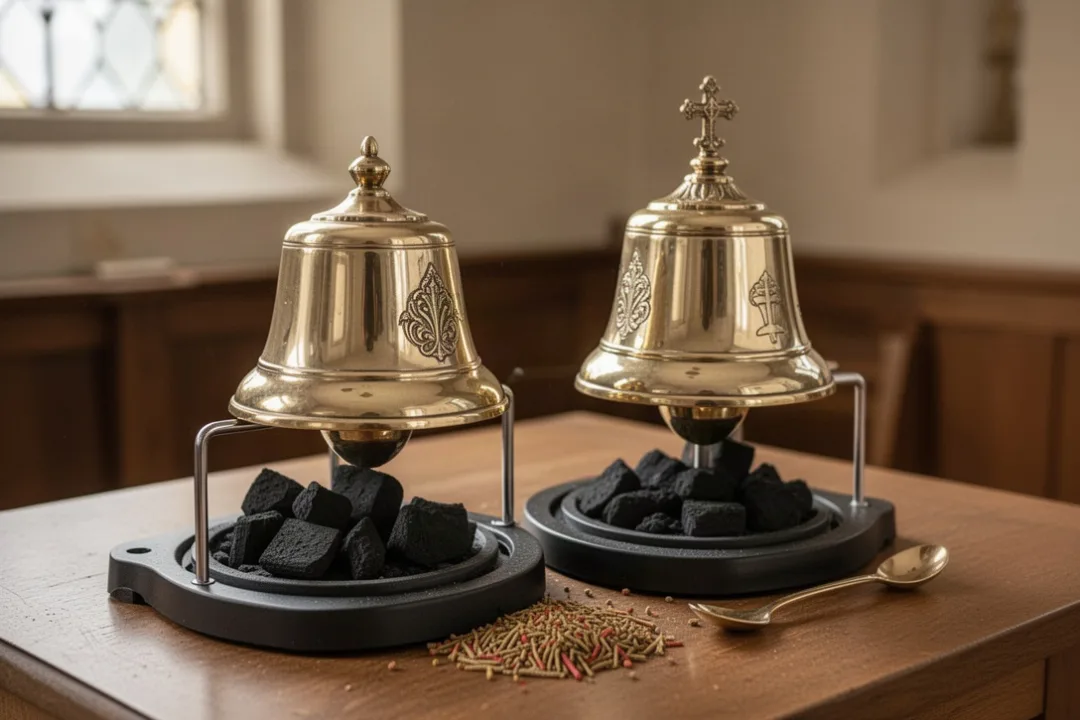
When incense is used, a small amount of charcoal is placed in the bowl and grains of fragrant resin or incense blend are added on top. The resulting smoke rises through openings in the lid, creating both a visible sign of prayer and a distinctive part of the service.
What a thurible is and how it differs from a censer
The word thurible refers specifically to a vessel used for burning incense, especially in Christian liturgical settings. The word comes through Old French and Latin terms associated with incense. In everyday speech, people may use censer as a broader or interchangeable term, although the two words can carry different associations depending on the church tradition.
A thurible is generally designed to be suspended from chains. This makes it possible for the thurifer—the person carrying it—to lift, lower, or swing the vessel during appointed parts of worship. A censer can also mean a container for incense that is not suspended, including a small bowl or burner used in other religious settings.
Most traditional thuribles have a rounded lower bowl and a movable upper cover. The bowl holds the hot charcoal, while the cover helps contain ash and controls the movement of smoke. Decorative openings in the cover may be shaped as crosses, geometric patterns, leaves, or other Christian designs, but the openings also serve the practical purpose of allowing incense to escape.
Bowl or body: holds the charcoal and incense.
Perforated lid: covers the burning material while allowing smoke to pass through.
Chains: connect the bowl and lid to the handle assembly.
Handle or suspension ring: gives the server a secure point for carrying and swinging.
Internal support or grate: may keep charcoal raised above the base and improve airflow.
Many thuribles are made from brass, bronze, silver, or another heat-resistant metal. Some have a silver-colored finish over a less costly base metal. The choice of material affects weight, appearance, heat retention, and maintenance, but a well-made thurible must remain stable when heated and should not have parts that loosen during use.
Practical distinction: A thurible is not simply a decorative container. It is a heated vessel, so its construction, balance, chain strength, and safe handling matter as much as its appearance.
What the parts of a thurible do
The body is the lower chamber where the burning charcoal rests. It needs enough depth to keep embers contained when the thurible is moved. A shallow decorative bowl may look attractive but can be unsuitable for active use if ash or hot fragments can fall out.
Some models include a small metal grate, cup, or raised insert inside the body. This helps air circulate around the charcoal and prevents direct contact between the hottest embers and the bottom of the vessel. If the thurible does not have an internal support, users should follow the manufacturer’s instructions for placing charcoal and incense.
The lid is attached to the same chain system as the bowl and can usually be raised by pulling a separate ring or chain. The lid must move smoothly and stay in the desired position. A cover that drops unexpectedly can scatter ash, while one that cannot open fully makes lighting, refilling, and cleaning difficult.
Openwork designs in the lid allow the fragrant smoke to leave the vessel. They also provide ventilation, which helps the charcoal continue burning. The size and arrangement of these openings affect how much smoke escapes and how quickly heat spreads through the upper section.
The chains carry the weight of the thurible and distribute movement from the handle to the bowl. Traditional designs often use three or four chains, though construction varies. Chains should be checked for bent links, worn connectors, or damaged attachment points before every service in which the thurible will be swung.
The handle assembly may include a crosspiece, a sliding ring, or a fixed suspension ring. These parts help the thurifer control the vessel while keeping hands away from hot metal. A longer chain can create a more pronounced swing, but it also requires more room and greater control.
How a thurible is prepared before worship
Preparation begins with placing quick-lighting or natural charcoal in the bowl according to the church’s usual practice. Charcoal should be ignited with an appropriate tool in a well-ventilated area. It should not be handled with bare fingers, and the thurible should be placed on a heat-resistant surface while the charcoal catches.
Once the charcoal is glowing and covered with a light layer of ash, the thurifer or another minister adds a small amount of incense. Resin-based incense, wood-based blends, herbs, and fragrant oils may be combined in different formulas. The amount should be modest at first because too much incense can produce excessive smoke, smolder poorly, or overwhelm people who are sensitive to fragrance.
Inspect the bowl, lid, chains, and handle for damage.
Place the thurible on a stable, heat-resistant surface.
Light the charcoal with suitable equipment and allow it to ignite fully.
Confirm that the charcoal is positioned securely inside the bowl.
Add a small amount of incense after the charcoal is ready.
Close the lid carefully and carry the thurible by its handle or ring.
Incense is normally added in stages rather than all at once. This allows the person controlling the thurible to adjust the amount of smoke during the service. A pinch may be added before a procession, at an altar, during a Gospel reading, or at another appointed moment, depending on local custom and the rite being celebrated.
How thuribles are used during Christian worship
The exact use of a thurible depends on the denomination, rite, parish, and occasion. In many churches, incense is used to honor sacred objects, people, and moments in the service. It may accompany a procession, be directed toward an altar, or be used around the reading of the Gospel and the preparation of the gifts.
In Western liturgical traditions, the person using the thurible is commonly called the thurifer. Another server may carry a boat containing incense grains and a small spoon. The celebrant or another authorized minister often places incense on the charcoal and blesses it according to the custom of that church.
The thurifer must learn more than how to swing the vessel. Good service requires awareness of timing, spacing, posture, and direction. The server needs to know where clergy, servers, musicians, and worshipers will stand and must keep the hot vessel away from robes, furniture, and people.
Common moments when incense may appear
Processions: The thurifer may walk ahead of the cross or other ministers, allowing smoke to mark the movement into the worship space.
Altar or table: Incense may be directed toward the altar, cross, or gifts as an act of reverence.
Gospel reading: In some traditions, the Gospel book and the proclamation are honored with incense.
People gathered for worship: The congregation may be incensed as a reminder of prayer offered by the whole assembly.
Funerals and memorial rites: Incense can accompany prayers for the departed and honor the body or urn.
Special blessings and solemn services: A church may use incense on major feast days or at other particularly ceremonial services.
The pattern of movement is not universal. Some communities use three measured swings, while others use a different number or a simple lifting motion. The significance of a particular gesture should be learned from the church’s service book or from the clergy responsible for worship rather than assumed from another tradition.
In Eastern Christian traditions, a hand-held censer called a katsion or a chain-suspended censer may be used, depending on local practice. Orthodox thuribles often have a distinctive design and may include small bells attached to the chains. The bells can create a gentle sound as the censer moves, adding an audible element to the ritual.
Anglican, Lutheran, Roman Catholic, and other churches may all use thuribles, but their customs are not identical. Some congregations use incense frequently, some use it only on major occasions, and some do not use it at all. A thurible therefore identifies a form of liturgical practice, but it does not by itself determine a church’s theology or worship style.
Respect local practice: Before using a thurible in a new church, ask the priest, pastor, sacristan, or head server about the approved incense, gestures, routes, and ventilation requirements.
Why incense and the thurible have religious meaning
Incense has a long history in religious worship, including worship described in the Hebrew Bible and the Christian Scriptures. Biblical references connect incense with offerings, sacred service, and prayer. Revelation 8:3–4 presents incense alongside the prayers of the holy people, while Psalm 141 uses rising incense as an image associated with prayer. These passages are often part of the background for Christian use of a thurible.
The smoke provides a visible image of prayer rising toward God. The symbol does not mean that prayer must be accompanied by smoke, nor does the physical act earn divine favor. Instead, incense gives the congregation a sensory way to express reverence, offering, holiness, and the movement of prayer through worship.
Incense can also mark the boundary between ordinary activity and a sacred action. Its fragrance and smoke change the atmosphere of a room, helping worshipers recognize that a particular moment has begun. The effect is especially noticeable in a large church, where smoke can make a procession or blessing visible from a distance.
When incense is directed toward the altar, Gospel book, ministers, or congregation, the gesture is commonly understood as an act of honor rather than worshiping an object. The meaning comes from the liturgical action and the community’s faith. Different traditions explain these gestures in their own language, but the purpose is generally reverence and prayer.
Incense may also symbolize purification or sanctification. In this context, purification is a ritual sign that a person, place, object, or action is being set apart for holy use. It should not be confused with the idea that smoke physically removes moral wrongdoing or replaces repentance, prayer, or ethical conduct.
Because incense engages sight, smell, and sometimes sound, it can make worship memorable. That sensory quality is useful for some people, especially during processions and solemn rites. For others, fragrance or smoke can cause discomfort, so thoughtful churches balance tradition with the needs of the congregation.
How to use a thurible safely
A thurible contains live charcoal and hot metal, so safety procedures are essential. It should never be treated like a prop or swung casually. Even when the visible smoke is light, the charcoal may remain hot for a long time after the service.
Before use, inspect every connection between the bowl, chains, lid, and handle. The bowl should hang evenly, and the lid should open and close without sticking. If a chain is frayed, a ring is bent, or a fastener is loose, the thurible should be taken out of service until it has been repaired.
Clear the route before processing. Pay attention to low ceilings, hanging decorations, candles, wooden furnishings, loose sleeves, veils, and crowded aisles. The thurifer should walk at a controlled pace and keep the vessel at a safe distance from people and combustible materials.
Use only the fuel and incense approved for that thurible.
Light charcoal in an area with adequate ventilation.
Keep a heat-resistant stand available during preparation and storage.
Do not pour water into a hot thurible unless the church’s safety procedure specifically requires it.
Allow the bowl and ashes to cool completely before cleaning.
Dispose of charcoal and ash in a noncombustible container.
Ventilate the worship space and respect people with asthma or fragrance sensitivities.
Some incense mixtures contain ingredients that produce more smoke than others. Synthetic fragrance, loose powder, or unfamiliar fuel can behave unpredictably when heated. The safest practice is to use a known product in a small quantity and avoid experimenting during a service.
Churches should also consider smoke detectors, fire alarms, and local building requirements. A thurible may need to be used only in spaces with suitable ventilation, and a fire marshal or building manager may have specific instructions. Alarm systems should never be disabled informally to accommodate incense.
People who operate a thurible for the first time should practice with an experienced server in an empty or lightly occupied space. Practice should include carrying, opening the lid, adding incense, stopping movement, and placing the vessel on its stand. The aim is steady control, not dramatic motion.
After use, remove ash only when the charcoal is fully extinguished and the vessel has cooled. A metal scoop or designated tool can help transfer residue to a noncombustible container. Do not place warm charcoal in a trash can, cardboard box, paper bag, or other container that could ignite.
A thurible’s finish should be cleaned according to its material and the maker’s guidance. Soft cloths are generally safer than abrasive pads, which can scratch plated surfaces. Strong chemicals may discolor metal, weaken decorative finishes, or leave residues that affect the fragrance of later incense.
Resin and ash can collect around the grate, lid openings, and chain attachments. Regular light cleaning helps maintain airflow and keeps the mechanism working. A thurible used often may need a more thorough inspection of its hinges, rings, and chain connectors by someone familiar with liturgical metalwork.
Store the vessel in a dry place where it cannot be knocked from a shelf. Keep incense and charcoal separately in labeled, closed containers away from heat and moisture. Charcoal that has absorbed dampness may light poorly or break apart, while incense exposed to excessive moisture can become difficult to burn evenly.
What to look for when buying a thurible
Choose a model based first on safe function and suitable weight, not ornament. A very heavy thurible may be difficult for a young server or anyone with limited strength to control. A very light model may move too abruptly or become excessively hot in the wrong places.
Stable bowl: The body should contain ash and charcoal securely.
Reliable chains: Links and attachment points should feel strong and evenly fitted.
Smooth lid action: The cover should lift and lower without jamming.
Useful ventilation: Openings should permit smoke to escape without exposing embers.
Heat-resistant construction: Materials and finishes should be intended for burning incense.
Appropriate size: The vessel should suit the worship space, service length, and server.
Available replacement parts: Chains, handles, grates, or lids may eventually need repair.
Consider who will use the thurible and where. A small chapel may need a compact vessel with limited smoke production, while a large sanctuary may use a heavier ceremonial design. If the church has people with respiratory sensitivities, choose a setup that permits careful control of the amount and type of incense.
A thurible can be both a practical tool and a piece of sacred furnishing. Its value comes from reliable service, respectful handling, and its place within worship—not simply from precious metal or elaborate decoration. The best choice is one that supports the rite safely and consistently.
Frequently asked questions
Is a thurible the same thing as a censer?
The terms are often used interchangeably, but they can have slightly different meanings. Thurible usually describes a suspended incense vessel used in Christian liturgy, while censer is a broader word for a container that burns incense. A censer may be suspended, hand-held, or stationary, depending on the religious tradition and the design.
Who carries a thurible during a church service?
The person carrying it is usually called the thurifer. This server prepares the charcoal, carries the vessel, adds incense when directed, and uses it at the appointed moments. A thurifer normally learns the church’s specific movements and safety procedures from a priest, pastor, sacristan, or experienced senior server.
What is burned inside a thurible?
Most thuribles use charcoal as the heat source and fragrant incense placed on top. The incense may contain resins such as frankincense, woods, herbs, spices, or oils. Churches typically use a particular blend chosen for its fragrance and smoke level, and the product should be suitable for use with the specific thurible.
Can incense from a thurible trigger a fire alarm?
Yes. Smoke from incense can activate smoke detectors, particularly in a small or poorly ventilated room. Churches should follow building and fire-safety requirements, consult responsible facilities personnel, and use ventilation appropriately. Fire alarms should not be disabled casually, and worship leaders should also consider people who are sensitive to smoke or fragrance.







Leave a Reply