What is a disciple? Meaning, examples, and daily practice
What is a disciple? Meaning, examples, and daily practice
A disciple is a learner and follower who commits to shaping life around a teacher’s way. In the Bible, the word most often refers to someone who follows Jesus, learns from him, trusts him, and increasingly lives according to his teaching.
Discipleship is therefore more than agreeing with religious ideas or attending a church service. It involves a continuing relationship marked by learning, obedience, transformation, and participation. A disciple receives from a teacher, but also practices what that teacher teaches and helps pass it on to others.
The English word disciple comes from a Latin term associated with a learner or pupil. In the New Testament, the Greek word commonly translated as disciple is mathētēs, which describes a student, apprentice, or committed learner. The word carries more weight than simply “someone who hears a lesson.”
A disciple usually attaches himself or herself to a teacher’s instruction and way of life. In the ancient world, learning often happened by staying close to a teacher, observing that person’s conduct, asking questions, practicing the teaching, and gradually becoming like the teacher.
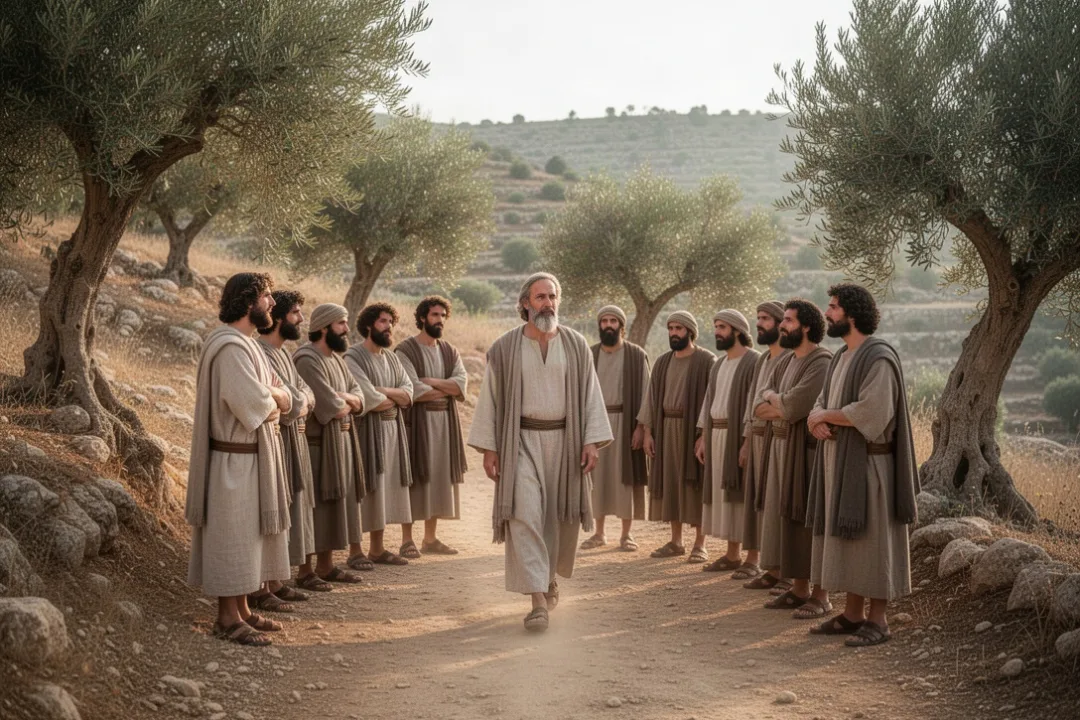
That background helps explain why the Bible calls Jesus’ followers disciples. They did not merely collect information about him. They traveled with him, listened to his interpretation of Scripture, watched how he treated people, tried to follow his commands, and eventually represented his message to others.
The term can also be used in a broader sense. Someone may be described as a disciple of a philosopher, school of thought, or particular teacher. In Christian usage, however, a disciple usually means a follower of Jesus Christ, and the relationship includes faith, allegiance, and a changed way of living.
How Jesus’ disciples learned from him
Jesus’ disciples learned through several connected activities rather than through formal classroom instruction alone. They heard his public teaching, received private explanations, observed his actions, and were given opportunities to serve. Their education included both words and practice.
The Gospel accounts show Jesus asking his followers questions, correcting their misunderstandings, and using ordinary situations to reveal spiritual truths. He taught them while they walked along roads, shared meals, encountered suffering people, and faced opposition. Their formation took place in the middle of real life.
Jesus also sent disciples to announce God’s kingdom, care for people, and depend on God rather than personal status. Their assignments exposed weaknesses that needed correction. Discipleship was not presented as instant perfection; it was a process in which followers learned through faith, failure, correction, and renewed obedience.
Several features stand out in the Gospel picture of discipleship:
Listening: disciples pay attention to Jesus’ teaching and seek to understand it.
Trusting: they rely on Jesus rather than treating him as merely an interesting speaker.
Following: they reorder priorities around his call.
Practicing: they put his commands into action in relationships and decisions.
Serving: they use their lives for the good of others rather than personal recognition.
Witnessing: they tell others what they have learned and experienced.
These elements belong together. Learning without obedience can become religious information, while activity without learning can become restless effort. Biblical discipleship joins knowledge of Jesus with a life increasingly shaped by Jesus.
What Jesus asked of those who followed him
Jesus invited people to follow him, but he did not describe discipleship as a way to add a spiritual hobby to an otherwise unchanged life. In passages such as Luke 9:23-25, he connected following him with self-denial, taking up one’s cross, and placing loyalty to him above the desire to preserve comfort or status.
“Taking up your cross” refers to accepting the cost of faithful obedience, not seeking pain for its own sake. In Jesus’ setting, the cross represented shame, suffering, and submission to an authority that could demand a person’s life. For a disciple, the phrase points to surrendering self-rule and remaining faithful even when obedience is costly.
Jesus also spoke about loving him above family, possessions, and personal ambition, as recorded in Luke 14:25-33. This teaching does not command hatred of family or careless rejection of responsibilities. It uses strong language to emphasize that loyalty to Jesus must be supreme, not one preference among many competing loyalties.
The call is demanding, but it is not a system for earning God’s acceptance. Christian discipleship begins with God’s grace and responds to it. A person does not become worthy of Jesus by performing perfectly; rather, a disciple follows Jesus because of who he is and because of the mercy Christians believe God gives through him.
Key distinction: Discipleship is not a competition to prove that you are a better Christian than someone else. It is a lifelong response of trust and obedience that depends on God’s grace.
How a disciple differs from an apostle
The words disciple and apostle are related but not interchangeable. A disciple is a learner and follower. An apostle is a person sent with authority or a commission. The New Testament sometimes uses “the disciples” for a large group of Jesus’ followers, while “the Twelve” identifies a particular group chosen for a distinctive role.
The twelve apostles were disciples, because they followed and learned from Jesus. Yet not every disciple belonged to the Twelve. The Gospels refer to wider groups of men and women who followed Jesus, supported his ministry, listened to his teaching, and witnessed his resurrection.
Women played a significant role among Jesus’ followers. Luke 8:1-3 describes women who traveled with Jesus and helped support the group’s ministry. The Gospel accounts also present women as witnesses to Jesus’ death and resurrection. This matters because discipleship is not limited to one gender, social class, ethnicity, or public position.
After Jesus’ resurrection, the book of Acts continues to call believers disciples. The term applies to people in places such as Jerusalem and Antioch, not only to the original group that walked with Jesus in Galilee. A disciple, then, is not defined by having met Jesus during his earthly ministry but by belonging to him and living as his follower.
What discipleship looks like in the Bible
The Bible presents discipleship through patterns of life rather than one short checklist. Jesus’ teachings in Matthew 5-7 connect loyalty to him with honesty, mercy, purity of heart, reconciliation, love for enemies, prayer, generosity, and trust in God. These commands show that discipleship reaches beyond church activities into motives, relationships, money, speech, and private choices.
In John 13:34-35, Jesus connects his followers’ identity with their love for one another. The point is not that disciples become flawless or never disagree. It is that their community should display a distinctive kind of self-giving love that reflects Jesus.
Jesus’ parables also describe different responses to God’s message. In Matthew 13, the soils represent people who hear the word with varying levels of receptivity and endurance. The fruitful response suggests that genuine hearing produces a changed life over time.
The letters of the New Testament describe similar growth using different images. Romans 12:1-2 presents a life offered to God and a mind renewed rather than conformed to the surrounding culture. Galatians 5:22-23 names qualities such as love, joy, peace, patience, kindness, goodness, faithfulness, gentleness, and self-control as the fruit produced by God’s Spirit.
These passages do not suggest that every disciple has the same personality or assignment. One person may serve publicly, another may care for children, another may provide practical help, and another may teach. The common center is allegiance to Jesus, not identical gifts, careers, or outward routines.
Why discipleship involves community
A person can begin following Jesus in a private moment, but biblical discipleship is not intended to remain private. Jesus formed a community, and his followers were taught to encourage, correct, forgive, serve, and bear one another’s burdens.
Christian community gives disciples a setting in which character becomes visible. It is easy to imagine yourself patient, generous, or forgiving when no one challenges you. Daily relationships reveal where pride, fear, resentment, or selfishness still shape your responses.
Community also protects discipleship from becoming a purely individual interpretation of Jesus. Other believers can provide wisdom, accountability, historical perspective, and practical support. Healthy community does not eliminate personal responsibility, but it helps people test their assumptions and persevere when obedience is difficult.
Acts 2:42-47 describes early believers sharing teaching, fellowship, meals, prayer, and material care. That passage portrays discipleship as a shared pattern of worship and practical love. It does not require every church to copy every detail of that community, but it shows that following Jesus includes how believers treat one another.
Community should also be marked by humility and safety. Leaders and members alike remain accountable to Jesus rather than receiving unlimited control over other people. Any group that uses the language of discipleship to demand secrecy, financial exploitation, unquestioning loyalty to a leader, or separation from family deserves serious caution.
How Christians make disciples
In Matthew 28:18-20, Jesus commissions his followers to make disciples among all nations, baptizing them and teaching them to observe his commands. The instruction includes both sharing the gospel and helping people grow into an obedient relationship with Jesus.
Making disciples is therefore broader than persuading someone to make a profession of faith. It includes welcoming people into Christian community, teaching the story and teachings of Scripture, modeling faithfulness, and providing opportunities to practice love and service.
Disciples make disciples through ordinary relationships as well as organized ministry. Parents teach children through words and patterns of life. Friends study Scripture together and pray for one another. Churches train new believers, care for the vulnerable, and send people to serve their communities and share the gospel.
Effective disciple-making keeps Jesus at the center. A mentor is not trying to create followers of personal style, political preference, or ministry brand. The goal is to help another person know Jesus, understand Scripture, obey faithfully, and grow in maturity.
Build a trustworthy relationship. Listen carefully, keep commitments, and treat the other person with dignity.
Open Scripture together. Ask what a passage says about God, people, faith, and obedience rather than relying only on personal opinions.
Connect belief with practice. Identify one concrete response, such as confessing wrong, forgiving someone, praying consistently, or serving a neighbor.
Follow up honestly. Discuss what happened, what was difficult, and what needs further understanding.
Encourage multiplication. Help the growing disciple support someone else without creating dependence on the mentor.
Making disciples requires patience. People grow at different rates, and mature faith includes the ability to ask difficult questions. Pressure may produce outward compliance for a time, but genuine discipleship grows through truth, love, conviction, and the work of God’s Spirit.
Practical ways to live as a disciple today
A disciple’s everyday life is shaped by repeated choices. Prayer and Scripture are central practices, but they are not meant to function as religious checkboxes. They help you attend to God, understand Jesus’ teaching, recognize sin, receive encouragement, and respond with obedience.
You might begin by reading a short Gospel passage slowly and asking what it reveals about Jesus. Write down one teaching that needs a response, then take a specific step. A practice such as apologizing, giving generously, refusing dishonest speech, or making time for a lonely person makes discipleship tangible.
Worship also forms a disciple by redirecting attention from self-importance to God. Corporate worship, singing, prayer, communion where practiced, teaching, and service can remind believers that they belong to a people rather than living as isolated spiritual consumers.
Service is another essential expression. Jesus linked greatness with serving others, as seen in Mark 10:35-45. Service may involve visible responsibility, but it often takes quieter forms: caring for a sick relative, welcoming a stranger, doing unrecognized work, or using professional skills for someone who cannot repay you.
Discipleship includes the way you respond when you fail. Peter’s denial of Jesus in the Gospel accounts shows serious failure, but his story does not end there. The resurrection narratives and John 21 present restoration and renewed responsibility. A disciple does not treat sin lightly, yet neither does a disciple assume failure makes restoration impossible.
Useful habits include:
Read one portion of Scripture regularly and ask how it calls you to think or act.
Pray honestly, including confession, gratitude, requests, and intercession for other people.
Meet with believers who can encourage you and speak truthfully into your life.
Choose a practical form of service that benefits people without seeking applause.
Examine how your use of money, time, words, and attention reflects Jesus’ priorities.
Share your faith with humility, allowing room for questions and refusing manipulation.
Receive correction from trusted Christians and make changes when correction is justified.
Common mistakes that distort discipleship
People can use the word disciple while reducing it to one narrow activity. A person may attend many services, memorize Christian information, or speak confidently about doctrine without becoming more loving, truthful, humble, and obedient. External activity can be valuable, but it does not automatically demonstrate spiritual maturity.
Other mistakes come from treating discipleship as self-improvement. Christian growth is not simply an effort to become more disciplined, successful, calm, or admired. It is a response to Jesus that includes dependence on God, repentance, love for others, and faithfulness when results are not visible.
Reducing discipleship to information: knowing Bible facts is not the same as practicing Jesus’ commands.
Confusing legalism with obedience: adding human rules and measuring worth by performance can obscure grace.
Seeking suffering for its own sake: costly obedience may involve hardship, but abuse and needless harm are not spiritual achievements.
Following a personality instead of Jesus: teachers can help, but no human leader deserves absolute loyalty.
Ignoring justice and mercy: private religious habits cannot excuse cruelty, exploitation, dishonesty, or indifference to suffering.
Expecting instant perfection: growth usually involves setbacks, patient correction, and gradual change.
Turning evangelism into pressure: sharing faith should respect people’s dignity and leave no room for coercion.
Practical test: Ask whether your understanding of discipleship is making you more truthful, merciful, teachable, courageous, and willing to serve. Those qualities provide a better measure than religious activity alone.
How discipleship relates to salvation
Christians describe the relationship between salvation and discipleship in slightly different ways, but the New Testament consistently connects belonging to Jesus with following him. Salvation is God’s gracious rescue and reconciliation; discipleship is the life of trust and obedience that flows from belonging to him.
This relationship prevents two opposite errors. One error treats salvation as something earned through religious performance. The other treats faith as a moment of agreement that has no effect on conduct. The biblical pattern presents grace as the source of new life and discipleship as its continuing expression.
Jesus received people who came with weakness, doubt, guilt, and need. He did not wait for them to become impressive before calling them. At the same time, he called them toward repentance and a new way of living. Grace welcomes people as they are, while discipleship refuses to leave them unchanged.
Growth may be uneven. A disciple can experience seasons of confidence and seasons of confusion. Questions do not automatically prove a lack of faith, and struggles do not automatically cancel a person’s identity as a disciple. What matters is a continuing return to Jesus in trust, repentance, and obedience.
What a disciple ultimately becomes
The goal of discipleship is not merely to become knowledgeable about Christianity. It is to become a person whose character, relationships, choices, and hopes increasingly reflect Jesus. This transformation includes inward motives as well as outward behavior.
A disciple learns to love God and neighbor, tell the truth, practice mercy, resist injustice, forgive, receive forgiveness, and use resources for the good of others. These qualities develop through ordinary decisions, not only through dramatic religious experiences.
Jesus’ disciples remain learners throughout life. Even mature Christians continue to discover areas where pride, fear, greed, resentment, or self-protection need to be surrendered. The word disciple therefore carries a permanent posture: still listening, still learning, still following, and still being formed.
In the Christian sense, to ask “What is a disciple?” is to ask what it means to belong to Jesus in practice. The answer is a person who trusts him, learns his way, obeys his teaching, participates in his community, serves others, and helps more people become faithful followers of him.
Frequently asked questions
Can someone be a Christian without being a disciple?
Christian traditions explain this relationship in different language, but the New Testament normally presents faith in Jesus and following Jesus as connected. A person’s discipleship may be immature, inconsistent, or just beginning, yet Christian faith is not meant to remain only an intellectual belief. It grows toward trust, repentance, obedience, love, and participation in Christ’s community.
Were all of Jesus’ followers part of the Twelve apostles?
No. The Twelve were a specific group chosen by Jesus for a distinctive role, but many other men and women followed him as disciples. The Gospel accounts describe larger groups of followers, and the book of Acts continues to use “disciples” for believers in different places. Every apostle was a disciple, but not every disciple was one of the Twelve.
How long does it take to become a mature disciple?
There is no fixed timetable. A person can begin following Jesus immediately, but maturity develops over a lifetime through Scripture, prayer, community, obedience, service, repentance, and perseverance. Growth is rarely perfectly steady. Seasons of failure or doubt can become opportunities for deeper dependence on God when they are met with honesty and faithful support.
What is the difference between discipleship and mentoring?
Mentoring is a broad relationship in which one person helps another develop knowledge, skills, or character. Christian discipleship may include mentoring, but its focus is specifically following Jesus. A disciple is not being shaped merely for career success or personal improvement; the aim includes faithfulness to Jesus, love for others, spiritual maturity, and participation in his mission.










Leave a Reply