Nicodemus: His questions, faith, and place in John’s Gospel
Nicodemus: His questions, faith, and place in John’s Gospel
Nicodemus was a Pharisee and a respected Jewish leader who came to Jesus at night to ask questions about his teaching. His conversation in John 3 introduces Jesus’ teaching about being born from above, while later scenes show Nicodemus becoming more willing to defend and honor Jesus.
He appears only in the Gospel of John, in John 3, John 7, and John 19. The Bible does not give a complete account of his life or explicitly describe a final conversion, so his story is best understood through the gradual movement visible in those three passages.
John identifies Nicodemus as a Pharisee and a ruler of the Jews. The Pharisees were a Jewish religious movement known for careful attention to the Law of Moses and to traditions used in interpreting it. Nicodemus also seems to have held a position of authority, likely connected with the Jewish ruling council mentioned in John’s Gospel.
These details matter because Nicodemus was not approaching Jesus as an uninformed passerby. He was educated in Scripture, familiar with religious debate, and responsible for making judgments about religious teachers. His questions come from someone whose existing understanding of God is being challenged.
The name Nicodemus is Greek, although the man himself was Jewish. John does not explain his family background, occupation beyond his religious role, or later history. Much of what has been attached to him in later tradition goes beyond what the biblical text actually says.
Why Nicodemus came to Jesus at night
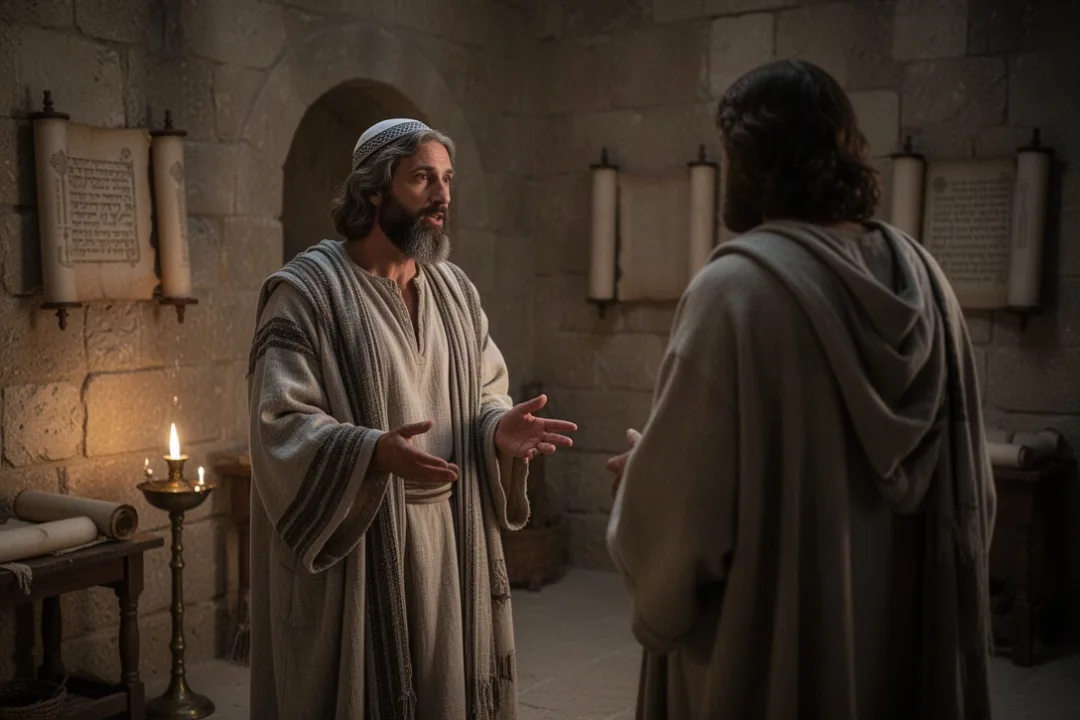
Nicodemus first visited Jesus at night, according to John 3. The timing may have been practical, allowing a private conversation away from crowds, but John often uses darkness as a meaningful image. Throughout the Gospel, light represents revelation and truth, while darkness can suggest misunderstanding, concealment, or resistance.
It is therefore reasonable to see several possibilities at once. Nicodemus may have wanted privacy, may have been cautious because of his position, or may have been uncertain about what Jesus meant. The passage does not explicitly say that fear motivated him, so calling him a secret unbeliever would go beyond the evidence.
His opening words show respect. He acknowledges that Jesus is a teacher who has come from God because of the signs he performs. Yet recognition of Jesus’ divine authority is not the same as complete understanding. Nicodemus appears to perceive something important while still struggling to interpret it.
Reading tip: Nicodemus’ nighttime visit should not be reduced to a simple label such as “coward.” John presents a person who is cautious, informed, interested, and still confused—a more complex picture than either total faith or total rejection.
What Jesus meant by being born from above
Jesus responds to Nicodemus with the teaching that a person must be born from above or born again to see the kingdom of God. The original language allows both senses, which helps explain the conversation’s tension. Nicodemus hears the phrase in a physical sense, while Jesus is speaking about a new work of God in a person’s life.
The point is not that someone must repeat physical birth. Jesus is describing a transformation that human ancestry, social rank, religious knowledge, and personal effort cannot produce by themselves. Entry into God’s kingdom requires life given by God through the Spirit.
Nicodemus asks how such a thing can happen. His question reflects genuine confusion, but it also exposes the limits of relying on visible and ordinary categories. Jesus presses him to recognize that Scripture and spiritual reality cannot be confined to what can be measured or explained in familiar terms.
The phrase “born of water and Spirit” in John 3 has been interpreted in several ways. Some readers connect water with baptism, others with cleansing imagery from the Hebrew Scriptures, and others with natural birth followed by spiritual birth. The surrounding discussion emphasizes the Spirit’s action, so the central idea is a cleansing and renewing work that comes from God.
How Nicodemus’ questions reveal his spiritual position
Nicodemus asks questions rather than making a confession of faith. That can make him seem slow to understand, but his questions are also the means by which the conversation develops. He does not walk away immediately or dismiss Jesus as irrelevant; he stays engaged with claims that challenge his assumptions.
Jesus points Nicodemus toward the Hebrew Scriptures, including the episode in which Moses lifted up a bronze serpent in the wilderness, described in Numbers 21. In John 3, that earlier event becomes a pattern for Jesus’ own being lifted up. The image suggests that people receive life by looking in trust toward God’s provision rather than relying on their own resources.
Jesus also explains that God’s purpose is not limited to one nation or group. The passage presents God’s love as directed toward the world and connects belief with life rather than condemnation. Because Bible translations differ and these words are widely quoted, the safest way to state the idea is this: God sends the Son so that those who trust him may receive life, not face judgment as their final destiny.
Nicodemus does not respond with a dramatic statement in the text. His silence leaves room for the reader to consider the same questions: What kind of change does God bring? Can religious status substitute for spiritual life? What does it mean to trust the one Jesus identifies as sent by God?
Why Jesus’ teaching challenged Nicodemus
Nicodemus was likely accustomed to thinking about faithfulness through Scripture, moral practice, communal identity, and religious discipline. Jesus does not say that those things are worthless. Instead, he insists that they cannot replace the inward work of the Spirit.
That message would have been especially demanding for a man with authority. Nicodemus’ education and standing gave him reasons to expect that he could evaluate Jesus from a position of competence. Jesus turns the situation around: the teacher of Israel must become a learner who receives life from God.
The conversation also challenges a narrow idea of control. Wind cannot be directed merely by observing it, and the Spirit’s work cannot be managed by human credentials. Jesus’ comparison does not mean spiritual life is random. It means its source is God, and its effects become visible even though the Spirit cannot be controlled like a human institution.
Nicodemus’ defense of Jesus in the ruling council
Nicodemus appears again in John 7:45–52. Religious officers have returned without arresting Jesus, and a dispute begins over whether Jesus can be a legitimate teacher. Some leaders dismiss him because they believe no prophet or ruler should come from Galilee, and they also condemn the crowd as ignorant of the Law.
Nicodemus does not openly declare himself a disciple. Instead, he asks whether their law judges a person before hearing that person and learning what he has done. His question is procedural, but it carries moral force. The leaders are rushing to a verdict without giving Jesus a fair hearing.
That moment shows meaningful development. In John 3, Nicodemus comes privately to question Jesus. In John 7, he speaks in a hostile gathering where his colleagues are criticizing Jesus. His words are cautious, yet he is willing to interrupt the group’s certainty and appeal to principles of justice.
The other leaders answer by ridiculing him and suggesting that he also comes from Galilee. Their response does not address the substance of his question. Instead, it attempts to discredit him by association. Nicodemus has not resolved every theological issue, but he has begun to act on the recognition that Jesus deserves a fair hearing.
What Nicodemus did after Jesus’ death
Nicodemus appears for the third and final time in John 19:38–42. After Jesus’ crucifixion, Joseph of Arimathea receives permission to take Jesus’ body. Nicodemus comes with a large quantity of myrrh and aloes, and together they prepare the body for burial according to Jewish burial customs.
This is a striking change in visibility. The first meeting happened at night, and the second involved a guarded question inside a council. After the crucifixion, Nicodemus participates in a public and costly act of honor toward Jesus at a moment when association with a condemned man could carry serious social risk.
John does not describe Nicodemus as making a formal confession at the tomb. He also does not tell readers what happened to him later. Still, his action communicates respect, courage, and identification more clearly than his earlier words did. He treats Jesus’ body with dignity when many of Jesus’ supporters are absent or unable to act.
The burial scene connects Nicodemus with Joseph of Arimathea, another figure associated with the Jewish leadership who is described as a disciple of Jesus. Their cooperation places two people from the religious establishment on the side of honoring Jesus after his death, even though the Gospel does not give either man a complete life story.
Does the Bible say Nicodemus became a Christian?
The Bible never uses a direct sentence saying that Nicodemus became a Christian. It also does not record a baptism, a public confession, or a later missionary role. Claims that he definitely became a prominent Christian should be treated as later tradition rather than as a clear biblical fact.
At the same time, the three scenes create a deliberate progression. Nicodemus begins with private interest, then challenges an unfair judgment, and finally helps bury Jesus. These actions suggest growing openness and increasing courage, even if John leaves the final state of his faith unstated.
Readers should resist two opposite mistakes. One is to declare that Nicodemus remained an unbeliever because he never gives a dramatic confession. The other is to claim certainty about details that John does not provide. The strongest interpretation respects both the development in his actions and the silence of the text.
What Nicodemus teaches about faith and understanding
Faith can begin with honest uncertainty
Nicodemus does not arrive with perfect language or complete comprehension. He asks what Jesus means and struggles with an idea that sounds impossible when understood literally. His example shows that serious questions need not be treated as proof of bad faith.
Questions become spiritually productive when they remain open to correction. Nicodemus is not praised simply for being curious; the significance of his curiosity appears in the way he continues to encounter Jesus and later acts with greater boldness.
Religious knowledge is not the same as spiritual renewal
Nicodemus knows the Scriptures and holds a respected position, yet Jesus tells him that he needs new life from the Spirit. The lesson is not that learning is unimportant. Rather, knowledge about God must not be confused with receiving God’s transforming work.
A person can understand religious vocabulary, belong to a respected community, and be recognized as morally serious while still needing a deeper surrender to God. John presents spiritual renewal as something God gives, not a status a person earns.
Courage often grows in stages
Nicodemus’ behavior changes gradually. Private conversation comes before public questioning, and cautious questioning comes before costly service. That pattern offers a more realistic picture of courage than an instant transformation that removes every fear.
His story does not excuse indefinite hesitation. It does show that faithful action can develop as understanding deepens. A person may not know every answer and still take the next honest step.
Justice requires hearing before judgment
Nicodemus’ question in John 7 is a practical reminder that religious certainty can become unfairness when people refuse to investigate. He asks his colleagues to follow their own legal standards instead of condemning Jesus through rumor and group pressure.
This principle applies beyond the specific debate in John. A fair judgment requires attention to evidence, willingness to hear the person involved, and caution about arguments based only on status or association.
Calling him a coward without qualification: The nighttime setting may imply caution, but John does not explicitly state that fear was his motive.
Treating “born again” as only a slogan: Jesus’ words concern a profound work of God through the Spirit, not merely a label for a religious decision.
Assuming Nicodemus understood everything immediately: The dialogue shows that he needed clarification and continued reflection.
Ignoring John 7 and John 19: His later defense and burial service are essential to understanding his development.
Claiming details the Bible does not provide: His later career, death, and explicit conversion are not recorded in the Gospel.
Using his story to dismiss religious study: Jesus challenges self-reliance, not careful learning or sincere engagement with Scripture.
Practical ways to study Nicodemus’ story
Reading the three passages together gives a clearer picture than focusing only on the nighttime conversation. Pay attention to what Nicodemus says, what he does, and what other people say about him. His development is conveyed through contrasts rather than through a narrated explanation of his inner thoughts.
Read John 3:1–21 slowly. Mark every question Nicodemus asks and every image Jesus uses, especially birth, water, Spirit, wind, and the lifted serpent.
Read John 7:45–52 next. Notice how Nicodemus responds to group pressure and whether his question receives a genuine answer.
Read John 19:38–42. Compare the privacy of his first meeting with the visibility of his burial service.
Separate observation from interpretation. First record what the text states; then consider what the nighttime setting, questions, and burial may suggest.
Apply the central questions personally. Ask whether religious knowledge has replaced dependence on God, and whether fear or social pressure affects your willingness to act justly.
Keep the progression in view: Nicodemus moves from private inquiry to public fairness and then to visible honor. The Gospel invites you to notice that growth without pretending to know more than the text reveals.
How Nicodemus compares with other people in John’s Gospel
Nicodemus is one of several people in John who encounter Jesus without immediately understanding him. Unlike the Samaritan woman in John 4, he does not become a visible messenger to his community. Unlike the man born blind in John 9, he is not shown moving from limited knowledge to an explicit confession. His role is quieter and more incomplete.
He also contrasts with leaders who reject Jesus without serious examination. Nicodemus has influence within the same broad religious world, but he does not simply follow the group’s judgment. His willingness to ask a fair question places him between public opposition and open discipleship.
John may use this contrast to show that proximity to religious authority does not guarantee insight, while social or institutional position does not make faith impossible. Nicodemus must still respond personally to Jesus’ claims, just as every other character must.
Why Nicodemus remains a significant biblical figure
Nicodemus matters because his story addresses a common human experience: recognizing that someone has authority while not yet understanding what that authority requires. He has information, status, and questions, but he must confront the possibility that God’s work cannot be controlled by those advantages.
His story also makes room for gradual movement. John does not portray faith as a performance in which every uncertainty disappears at once. Nicodemus’ actions become more public and costly over time, allowing readers to see how conviction may become visible through decisions before it is expressed in polished language.
Most of all, Nicodemus directs attention back to Jesus’ central teaching. New life comes from the Spirit, God’s love reaches the world, and Jesus’ identity cannot be evaluated only through ordinary expectations. Nicodemus begins by asking what Jesus means and ends by helping honor Jesus’ body, leaving readers to consider how they themselves respond to what they have heard.
Frequently asked questions
Was Nicodemus a disciple of Jesus?
The Gospel of John does not explicitly call Nicodemus a disciple. It does show increasing openness: he meets Jesus privately, challenges an unfair attempt to judge him, and helps prepare his body for burial. Those actions may indicate growing belief or allegiance, but the Bible does not provide a formal statement confirming his discipleship.
What does “born again” mean in Nicodemus’ conversation?
In John 3, the expression can also mean “born from above.” Jesus is describing spiritual renewal that comes from God through the Spirit, not a second physical birth. The teaching emphasizes that ancestry, religious standing, and human effort cannot substitute for the new life God gives.
Why did Nicodemus bring spices for Jesus’ burial?
Nicodemus brought myrrh and aloes when he joined Joseph of Arimathea in preparing Jesus’ body. The spices were associated with Jewish burial customs and expressed honor. His participation was also significant because it publicly aligned him with Jesus after the crucifixion, when such association could be socially and politically dangerous.
Is Nicodemus mentioned anywhere outside the Gospel of John?
No other biblical book names Nicodemus. Later Christian and other traditions tell additional stories about him, but those accounts are not part of the biblical record. For a careful study, the clearest evidence comes from John 3, John 7:45–52, and John 19:38–42.








Leave a Reply