Tobit is a short religious narrative set during the Assyrian exile, but it was written much later than the events it describes. Its central characters are Tobit, a devout Israelite living in Nineveh; his son Tobias; Tobit’s wife Anna; and Sarah, a young woman living in Media. The book follows their separate struggles and shows how those struggles become connected through an unexpected journey.
The book is part of the Deuterocanonical books accepted by the Catholic Church and included in the Old Testament of many Orthodox Christian traditions. Most Protestant Bibles do not place Tobit among the canonical books, although some editions include it in a section called the Apocrypha. Jewish traditions generally do not include it in the Hebrew Bible.
These differences concern the book’s status in a biblical canon, not whether the text has historical or religious value. Tobit has influenced Christian teaching about prayer, almsgiving, marriage, angelic protection, and care for the dead. It also gives readers a vivid picture of Jewish identity outside the land of Israel.
The exact date of composition is uncertain, but scholars generally place the work in the second century BCE, or near that period. Copies and fragments in Hebrew and Aramaic were found among the Dead Sea Scrolls, showing that versions of the story circulated in Jewish communities before the rise of Christianity.
Key idea: Tobit is best read as a faith-centered wisdom story. It is not simply a chronicle of exile, but a narrative about how righteousness can remain meaningful when a person cannot control illness, injustice, danger, or loss.
The book exists in more than one ancient textual form. The Greek manuscripts differ in length and wording, and translations based on different Greek witnesses can vary in their details. That is why readers may notice differences between Catholic, Orthodox, and older English editions.
Who Tobit, Tobias, Sarah, and Raphael are
Tobit is an Israelite from the northern kingdom who has been taken into exile in Nineveh. He comes from the tribe of Naphtali and tries to remain faithful to the laws and customs of his ancestors. He gives alms, observes religious practices, and performs acts of mercy, including burying fellow Israelites whose bodies have been left exposed.
His commitment to burying the dead creates danger for him. The Assyrian king has forbidden the practice, so Tobit must act secretly. This detail establishes one of the book’s recurring themes: mercy may require courage, especially when authorities or circumstances make compassion costly.
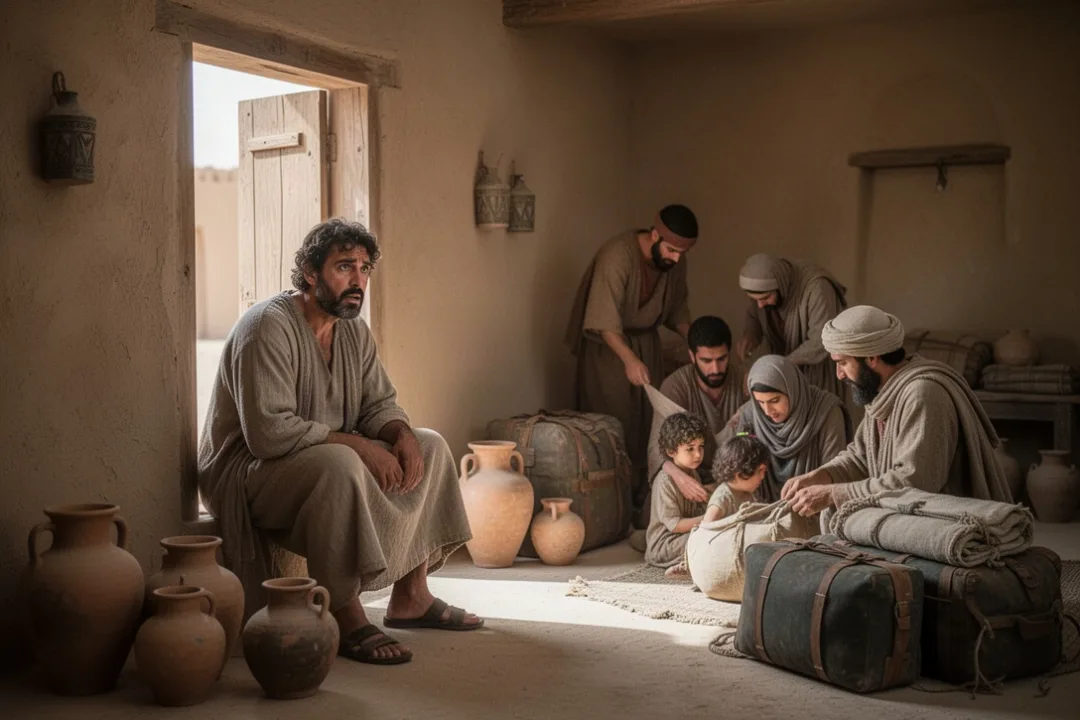
Tobit’s life changes after he becomes blind. The blindness is presented as the result of an accidental event rather than as punishment for a particular sin. His physical suffering leads to frustration, dependence, and conflict within his household. His wife Anna works to support the family, and her earnings become a source of tension when Tobit doubts her honesty.
Anna’s response reveals the emotional realism of the story. Tobit is a righteous man, but he is not portrayed as calm or flawless. He can be suspicious, discouraged, and harsh. His faith exists alongside fear and pain, which makes his character more recognizable than a simple model of perfect virtue.
Tobias, Tobit’s son, is young when the main action begins. Tobit wants him to recover money deposited with a relative in Media, so Tobias must travel a long distance. Because the journey is dangerous, he needs a companion who knows the route.
That companion is the angel Raphael, although Raphael initially appears under an ordinary human name and does not reveal his identity. The disguise allows the story to explore a familiar biblical idea: divine help may be present without being immediately recognized.
Sarah lives in Ecbatana, a city in Media. She has suffered repeated tragedies in her marriages because a demon named Asmodeus kills each husband before the marriage can be completed. Her suffering has made her the subject of cruel accusations, and she reaches a point of despair.
Sarah’s prayer and Tobit’s prayer are presented together. Both are distressed, and both ask God for relief. Their prayers establish a narrative connection before they ever meet, suggesting that their lives are being brought together through providential care.
Raphael is one of the most distinctive figures in the book. He guides Tobias, protects him, teaches him how to use parts of a fish, and helps restore both Tobit and Sarah. At the end, Raphael identifies himself as one of the angels who stand before God and present the prayers of the faithful.
What happens in the Book of Tobit
Tobit’s faithfulness and blindness
The story opens by presenting Tobit as a man who tries to practice righteousness while living far from Jerusalem. He gives food to the hungry, clothing to the needy, and burial to the dead. His generosity is not merely private kindness; it is an expression of loyalty to God and to his people.
After burying a murdered Israelite, Tobit sleeps outdoors. A physical accident causes material to fall into his eyes, and he becomes blind. His disability affects the entire household. He cannot work as before, Anna must earn money, and the family’s economic and emotional security becomes fragile.
During this period, Tobit remembers money held by a relative in Media. He sends Tobias to retrieve it, but he also worries about his son’s safety. Tobit gives Tobias extensive instructions about conduct, family responsibility, and the dangers of travel. These instructions make the journey a practical mission as well as a spiritual one.
The journey with Raphael and the fish
Raphael joins Tobias as a traveling companion. On the way, Tobias catches a large fish. Raphael tells him to preserve particular parts of it: the heart and liver will later be used to drive away the demon troubling Sarah, while the gall will help restore Tobit’s sight.
The fish is one of the book’s most memorable symbols. It is an ordinary creature obtained during an ordinary journey, yet it becomes the means through which healing occurs. The story does not present healing as detached from physical life. Instead, God’s help works through material signs, practical knowledge, and human obedience.
Raphael tells Tobias that Sarah is the right woman for him to marry. Tobias is afraid because of what happened to her previous husbands, but Raphael instructs him to use the fish’s heart and liver during the wedding night. Tobias follows the instructions, and the demon flees to a distant region where Raphael binds it.
The episode combines elements of a marriage story, a healing story, and a conflict with evil. Sarah is not rescued simply because a man arrives; she is freed from a burden that has shaped her entire life. Tobias also has to act with trust despite knowing the danger.
The marriage of Tobias and Sarah
Tobias and Sarah marry, and Sarah’s parents fear that the same tragedy will happen again. The wedding night passes safely, however, and Tobias and Sarah begin their life together. The household’s fear gradually gives way to relief.
While Tobias remains with Sarah, Raphael retrieves Tobit’s money. The family had expected Tobias to return quickly, so his delay causes anxiety in Nineveh. Tobit and Anna fear that something has happened to their son, and Anna repeatedly watches for him.
Their concern gives the story an especially human dimension. The journey has spiritual importance, but it is also a family separation filled with uncertainty. Anna’s grief shows how little control people have over events that may later prove beneficial.
Tobit’s healing and Raphael’s revelation
When Tobias returns, he applies the fish’s gall to Tobit’s eyes. Tobit’s sight is restored. The healing confirms that the journey’s strange instructions had a purpose, even though their meaning was not fully clear at the beginning.
Tobit welcomes Sarah into the family and celebrates the restoration of his household. Tobias then tries to reward his traveling companion. Raphael refuses the payment and reveals his identity as an angel sent by God.
Raphael explains that he has been present because Tobit and Sarah prayed. He also teaches the family to praise God, practice righteousness, and give alms. The ending shifts from adventure to instruction, making clear that the story’s miracles are meant to direct attention toward God’s mercy rather than the angel’s power.
What the Book of Tobit teaches about faith and daily life
Righteousness can continue during exile
Tobit lives outside the land associated with Israel’s worship and identity. Yet he continues to observe religious customs and care for other Israelites. His example suggests that faithfulness is not limited to a particular location. Exile changes his circumstances, but it does not erase his obligations.
The book also avoids presenting exile as a simple spiritual failure. Tobit is not condemned because he lives in Nineveh. His difficulty is that he must live faithfully under foreign rule, among people who do not share his religious commitments. That setting makes his choices costly and concrete.
Almsgiving is a central moral practice
Tobit repeatedly emphasizes giving to the poor. In the story’s moral framework, wealth is not secure merely because someone possesses it. What matters is how resources are used, especially when another person lacks food, clothing, or protection.
Almsgiving is linked with righteousness, but the book does not reduce charity to a way of earning rewards. Tobit gives because he recognizes a duty toward vulnerable people. His generosity also forms part of the family’s religious identity and teaches Tobias how to live.
Give practical help when another person lacks basic necessities.
Protect the dignity of the dead and those who have been abandoned.
Share family resources instead of treating possessions as private rights without responsibilities.
Practice mercy quietly, even when recognition or approval is unlikely.
Prayer can hold grief, fear, and hope together
Tobit and Sarah both pray while overwhelmed by suffering. Their prayers do not pretend that everything is fine. Each character expresses distress directly, and the narrative allows those emotions to remain serious.
The book therefore treats prayer as more than a request for a particular outcome. Prayer places pain before God and reconnects the sufferer with a larger moral order. The answer comes through an extended chain of events rather than an immediate change in circumstances.
Raphael’s statement that prayers are brought before God gives the book a distinctive view of angelic ministry. Angels are servants and messengers, not substitutes for God. Raphael’s role directs attention to divine care while showing that help can arrive through a complicated process.
Marriage involves family, trust, and shared responsibility
The marriage of Tobias and Sarah is not presented as an isolated romantic decision. Their union affects two families, requires courage from both households, and unfolds amid fear. Sarah’s parents worry about losing her, while Tobit and Anna worry about Tobias’s safety.
Tobias must trust the guidance he receives, and Sarah must face a future shaped by previous trauma. Their marriage becomes possible through honesty, prayer, and mutual vulnerability. The story’s emphasis is less on idealized attraction than on faithful partnership under difficult conditions.
Healing includes more than the body
Tobit regains his sight, but the book presents healing as a restoration of relationships and hope as well. Sarah is freed from the demon that has destroyed her marriages. Tobias returns safely. Anna’s fear ends, and the family is reunited.
These changes show that suffering can affect an entire household. A physical disability, a recurring spiritual threat, or prolonged grief can shape family life. The book’s healing reaches across those connections rather than treating each person’s pain as separate.
Reading tip: Pay attention to the two prayers near the beginning and the praise near the end. The story’s plot moves from private distress toward shared thanksgiving, linking personal healing with restored community.
Why Tobit matters for biblical study today
Tobit helps readers understand how Jewish communities preserved identity in foreign lands. The story mentions burial customs, marriage expectations, almsgiving, dietary concerns, family honor, and prayer. These details show religion as a pattern of daily practices rather than only a set of beliefs.
It also offers an important perspective on the experience of disability. Tobit’s blindness affects his independence and his relationship with Anna. The narrative includes impatience and misunderstanding, but it does not treat blindness as proof that Tobit is morally inferior. His suffering is real, and the restoration of his sight is portrayed as mercy.
The book’s treatment of Sarah is equally significant. She is not merely a future wife waiting for rescue. Her grief, public shame, and prayer receive serious attention. She has a voice in the story, and her restoration includes safety, belonging, and the possibility of a future.
For readers interested in angels, Tobit provides one of the clearest biblical narratives about an angel acting as a traveling companion. Raphael protects, teaches, and heals, but he does not encourage worship of himself. His revelation reinforces the distinction between created spiritual beings and the God whom they serve.
The book also raises questions about genre. Its setting uses recognizable places and historical rulers, but its structure resembles a wisdom tale or religious family narrative. Repeated prayers, dramatic reversals, symbolic objects, and moral instruction all shape the story. Readers do not need to treat every scene as a modern historical report in order to take its theological message seriously.
Its influence appears in Christian discussions of several subjects:
Charitable giving as a duty toward the poor.
Prayer for the dead and respectful burial practices.
Marriage as a relationship shaped by faith and family responsibility.
Angelic protection and the role of Raphael.
Healing as the restoration of bodies, relationships, and hope.
Readers should also be aware that Tobit contains cultural assumptions from the ancient world. Its ideas about family authority, marriage arrangements, travel, medicine, and social status belong to its historical setting. Understanding those assumptions makes it easier to distinguish the book’s enduring concerns from customs that may not be directly transferable to modern life.
The book remains especially meaningful for people who have experienced displacement, chronic illness, financial uncertainty, or anxiety about a family member’s safety. Tobit does not promise that every problem will be resolved quickly. Instead, it presents a world in which faithful action, prayer, and unexpected help can matter even when the outcome is not visible.
How to read the Book of Tobit responsibly
Begin by identifying the edition you are using. A Catholic Bible, an Orthodox Bible, and a Protestant Bible with the Apocrypha may place Tobit differently and may follow different ancient textual traditions. Reading the notes can clarify why names, verses, or details vary.
Next, keep the whole narrative in view. Isolated passages can make the book seem to focus only on almsgiving, marriage, demons, or angels. Those themes gain their full meaning when read together through the family’s movement from suffering to restoration.
A useful reading approach is to follow these questions:
What does each character fear? Tobit fears dependence and dishonor, Sarah fears another loss, and their families fear separation.
What acts of faithfulness are possible? The answer includes generosity, burial of the dead, prayer, obedience, hospitality, and family care.
Where is help already present? Raphael’s identity is hidden, and practical actions become part of the healing process.
What changes at the end? The story restores sight, marriage, family unity, public honor, and gratitude.
It is also helpful to read Tobit alongside other biblical books that address exile, wisdom, prayer, and suffering. Its emphasis on righteous conduct recalls wisdom literature, while its concern for displaced Israelites connects it with exile narratives. Its prayers can be compared with other biblical prayers of lament that move from distress toward trust.
Finally, read the story with sensitivity to people whose suffering has not been resolved. Tobit ends with healing, but not every faithful person receives the same outcome in this life. The book can offer hope without becoming a promise that disability, grief, or hardship is evidence of insufficient faith.
Frequently asked questions
Is the Book of Tobit part of the Bible?
It depends on the Christian tradition. Tobit is included in Catholic and many Orthodox Bibles as a Deuterocanonical book. Most Protestant Bibles exclude it from the Old Testament, though some print it in the Apocrypha. It is not part of the Jewish Tanakh. These differences reflect distinct histories of biblical canon formation and should be considered when comparing editions.
Is Raphael in the Book of Tobit an archangel?
Tobit identifies Raphael as one of the angels who stand before God, but different traditions use titles such as archangel in different ways. Raphael’s role in the story is to guide Tobias, carry out God’s purposes, and help bring healing. The narrative does not present him as a figure to worship independently of God.
What is the meaning of the fish in Tobit?
The fish represents how ordinary parts of creation can become instruments of healing within the story. Raphael tells Tobias to preserve its organs for specific uses: one treatment helps Sarah escape the demon troubling her, and another helps restore Tobit’s sight. The fish also connects the travel adventure with the book’s wider theme of providential care.
Why do some versions of Tobit have different wording or length?
Tobit survives in several ancient textual forms, including Greek, Hebrew, and Aramaic evidence. Ancient translators and copyists sometimes preserved different readings, and later Bible editions may rely on different manuscript traditions. As a result, chapter wording, verse numbering, and occasional details can vary without changing the book’s central story.






Leave a Reply