Theologian Dietrich Bonhoeffer: Life, Ideas, and Legacy
Theologian Dietrich Bonhoeffer: Life, Ideas, and Legacy
Theologian Dietrich Bonhoeffer is best known for connecting Christian belief with costly, public responsibility. His central challenge was that faith cannot remain an abstract confession: it must shape how Christians live, worship, resist injustice, and care for other people.
Bonhoeffer was a German Lutheran pastor and theologian who opposed Hitler’s regime, helped lead the Confessing Church, trained pastors at an illegal seminary, and became involved in resistance networks. The Nazi government imprisoned him in 1943, and he was executed at Flossenbürg concentration camp on April 9, 1945. His books, especially The Cost of Discipleship, Life Together, and Ethics, continue to influence Christians, theologians, and readers concerned with moral courage.
Dietrich Bonhoeffer was born in Breslau, Germany, in 1906 into a prominent, highly educated family. His father was a psychiatrist and professor, while his mother came from a family with strong cultural and religious connections. Bonhoeffer studied theology at the University of Tübingen and the University of Berlin, where he completed doctoral work under the theologian Adolf von Harnack’s academic influence and developed his own distinctive theological voice.
His early academic success did not make him detached from practical ministry. He served in Barcelona, studied and taught in the United States, worked with churches in London, and returned to Germany as the political situation became increasingly dangerous. His theology grew through preaching, pastoral work, community life, political crisis, and personal risk.
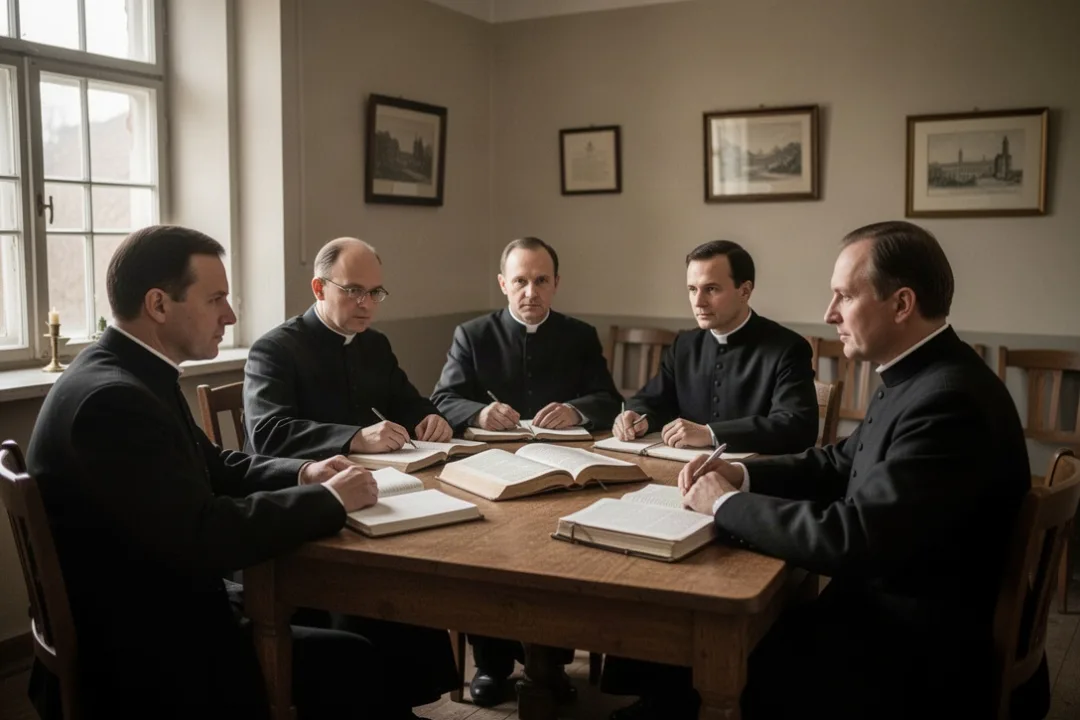
Bonhoeffer became a leading figure in the Confessing Church, a movement that resisted the Nazi attempt to control German Protestant churches. He helped organize and teach at the seminary at Finkenwalde, where pastors practiced a disciplined life of prayer, worship, study, confession, and mutual service. After the seminary was closed by the authorities, Bonhoeffer continued writing and working against the regime.
The central point: Bonhoeffer did not treat theology as a private collection of ideas. For him, Christian doctrine had consequences for the church’s public witness and for the believer’s concrete decisions.
A brief timeline of Bonhoeffer’s life and work
1906: Dietrich Bonhoeffer is born in Breslau, then part of Germany.
1920s: He studies theology, completes doctoral work, and begins teaching and pastoral service.
1930–1931: He studies and teaches at Union Theological Seminary in New York, where his experience of Black churches and social Christianity affects his thinking.
1933: Hitler comes to power. Bonhoeffer publicly challenges the church’s accommodation to Nazi racial ideology.
1935–1937: He directs the underground seminary at Finkenwalde and develops the community practices later described in Life Together.
1939: He returns to Germany after a brief period in the United States, believing that he must share the fate of German Christians.
1940–1943: He works within networks connected to military intelligence and the German resistance while continuing theological writing.
1943: He is arrested and imprisoned.
1944–1945: Prison letters reveal new reflections on Christian faith, responsibility, and a “religionless” interpretation of Christianity.
April 9, 1945: He is executed at Flossenbürg concentration camp, shortly before the war ends in Europe.
How to understand Bonhoeffer’s theology step by step
Bonhoeffer’s thought covers many subjects, but several connected ideas provide a useful way to read him. Each idea answers a different question about Christian life and public responsibility.
Start with Christ and discipleship. Bonhoeffer asks what it means to follow Jesus rather than merely agree with Christian teachings.
Examine the church’s visible life. He considers how worship, preaching, confession, community, and service make Christian faith concrete.
Distinguish cheap grace from costly grace. Grace is free to the recipient, but it is not permission to remain unchanged or indifferent to suffering.
Consider responsibility in a broken world. Ethical decisions may involve risk, guilt, competing duties, and action on behalf of others.
Read his prison writings carefully. His late reflections are unfinished and exploratory, not a complete replacement for his earlier theology.
What Bonhoeffer meant by costly grace
The phrase “cheap grace” is Bonhoeffer’s criticism of Christianity reduced to easy forgiveness without repentance, obedience, or transformation. Cheap grace may preserve religious language while leaving the believer’s habits, loyalties, and treatment of others untouched. It can also become a way for churches to offer comfort without confronting sin or injustice.
Costly grace, by contrast, means that God’s grace calls a person into a life of discipleship. Bonhoeffer did not mean that people earn salvation through good works. He meant that genuine grace creates a new relationship to Christ, and that relationship carries a real cost. Following Jesus may require surrendering status, security, convenience, or social approval.
In The Cost of Discipleship, Bonhoeffer develops this theme through a sustained reading of Jesus’ Sermon on the Mount. He emphasizes that Jesus’ commands are not merely ideals to admire. They address actual conduct, including reconciliation, truthfulness, forgiveness, non-retaliation, generosity, and love of enemies.
This does not make Bonhoeffer’s theology a simple program of moral self-improvement. The disciple acts in response to Christ’s call and depends on grace. The tension matters: Christians must not use grace as an excuse for passivity, but neither should they imagine that moral effort makes them worthy before God.
Why discipleship mattered more than religious agreement
For Bonhoeffer, a person can affirm correct doctrines and still fail to follow Christ. Discipleship includes learning to see the world through Jesus’ teaching and allowing that vision to reshape everyday choices. It is not limited to clergy, missionaries, or unusually courageous people; it belongs to ordinary Christians in ordinary responsibilities.
Bonhoeffer’s account of discipleship has a strong communal dimension. Christians do not create themselves as isolated spiritual heroes. They receive instruction, correction, encouragement, and forgiveness through the life of the church. The individual disciple needs a community that practices the faith rather than merely discussing it.
His emphasis on obedience can sound demanding because it is demanding. Bonhoeffer rejected the idea that Christianity is chiefly an inner experience or a cultural identity. Yet his goal was not religious severity for its own sake. He wanted a faith that could remain truthful when political power, fear, propaganda, and public pressure made truth costly.
Life Together presents Christian community as a gift rather than a personal project. Bonhoeffer warns that people often carry an idealized picture of what a church community should be. When real people fail to match that ideal, disappointment can turn into criticism, control, or withdrawal.
Healthy community begins when Christians receive one another through Christ instead of demanding that others satisfy private expectations. This does not mean ignoring abuse, dishonesty, or injustice. It means that Christian fellowship is grounded in grace, not in the fantasy that a group can remain free from weakness and conflict.
Bonhoeffer identifies several ordinary practices that sustain community:
Shared worship: The community gathers around Scripture, prayer, and praise rather than around personality or ideology.
Silence and listening: Members learn to stop filling every moment with their own opinions and become more attentive to God and to one another.
Private prayer: Public fellowship needs an inward life of prayer that cannot be replaced by group activity.
Confession: Honest acknowledgment of sin breaks the isolation that secrecy creates.
Practical service: Members serve one another in concrete ways instead of seeking recognition.
Reconciliation: Conflict is addressed through truth, humility, forgiveness, and appropriate accountability.
Bonhoeffer’s teaching on community should not be used to pressure vulnerable people into tolerating harmful behavior. His vision assumes truthfulness and responsible care. Forgiveness is not the same as removing boundaries, excusing abuse, or avoiding legal and pastoral accountability.
How Bonhoeffer responded to Nazism and the church struggle
When Hitler became chancellor in 1933, many German church leaders accommodated the new government or tried to preserve church influence by cooperating with it. Nazi racial policies also encouraged the removal and exclusion of Christians of Jewish descent from church life. Bonhoeffer recognized that this was not merely a political dispute. It was a direct assault on the church’s confession that its authority comes from Christ.
He spoke publicly against the “Aryan paragraph”, a policy used to exclude people classified as Jewish under Nazi law from certain positions. He also criticized the church for failing to defend those being persecuted. His response included three responsibilities: challenge the government’s unjust actions, help victims of those actions, and resist the machinery of oppression when necessary.
The Confessing Church opposed the state’s attempt to dictate Christian doctrine and church leadership. Its Barmen Declaration, adopted in 1934, insisted that the church must hear and obey Jesus Christ rather than political authorities claiming ultimate loyalty. Bonhoeffer was not the sole author of that declaration, but its theological resistance reflects concerns central to his work.
His opposition was not based on a general preference for political activism. It came from a theological claim: when a government destroys human dignity and the church remains silent, the church has failed in its vocation. The church’s task is not to become a political party, but it must speak and act when the state turns power against its neighbors.
Why Bonhoeffer became involved in resistance
Bonhoeffer’s resistance developed over time and involved more than one form of action. He opposed Nazi church control, supported the Confessing Church, helped train pastors, assisted people endangered by the regime, and later became connected with resistance circles associated with military intelligence. Through those contacts, he participated in efforts to oppose Hitler and explore ways to end the regime.
His involvement created a difficult ethical problem. Bonhoeffer was committed to Jesus’ teaching about enemy love and rejected the glorification of violence. At the same time, he concluded that refusing to act against mass murder could itself become a form of guilt. He therefore accepted that responsible action might require entering a morally compromised situation.
This is one reason Bonhoeffer’s ethics cannot be reduced to a simple rule. He did not argue that Christians may do anything if they believe the goal is good. Nor did he offer a universal permission for political violence. Instead, he examined responsibility, concrete neighbors, foreseeable harm, confession, and dependence on God’s mercy.
A necessary caution: Bonhoeffer was not a flawless symbol detached from history. His resistance, his use of force, and the moral risks he accepted should be studied with seriousness rather than turned into a simplistic heroic story.
What Bonhoeffer’s ethics say about responsibility
Bonhoeffer’s unfinished work Ethics begins from the conviction that Christian moral reasoning starts with the reality of Christ, not with an abstract system of rules. The responsible person asks what faithfulness requires in a particular situation, especially when social institutions have become corrupt or when every available choice carries harm.
He contrasts responsible action with two temptations. One is to hide behind rigid principles while refusing to face the consequences of inaction. The other is to make personal freedom an excuse for selfishness. Responsible action accepts that a person must make a decision for the good of others and then remain accountable for it.
Bonhoeffer’s ethical language includes the idea of vicarious representative action: acting on behalf of those who cannot protect themselves. This does not mean speaking over people or treating them as helpless. It means recognizing that privilege, position, and opportunity create obligations. A Christian may have to take a risk because another person is exposed to danger.
His approach also includes confession. A person who acts in a tragic situation cannot always claim moral purity. Bonhoeffer believed that responsible action may involve guilt in the ordinary human sense, even when it is undertaken for a neighbor’s sake. Such guilt must be brought before God rather than concealed behind self-righteousness.
What “religionless Christianity” means in Bonhoeffer’s prison letters
Bonhoeffer’s letters from Tegel Prison contain some of his most discussed and least settled ideas. He wondered how Christians should speak about God in a world where traditional religious language no longer automatically commands respect or answers people’s deepest questions. He used terms such as “religionless Christianity” and described people as coming of age.
These phrases do not necessarily mean that Bonhoeffer wanted Christianity without worship, prayer, Scripture, or the church. His earlier writings clearly value those practices. A better reading is that he was questioning a form of religion that uses God as a solution for human weakness, a gap-filler for unanswered questions, or a way to avoid mature responsibility.
Bonhoeffer asked how Christians might speak about God when people are not looking for religious authority to manage their lives. His answer was still developing when he was killed. He pointed toward a faith centered on Christ’s presence in the world, responsible service, and participation in human life rather than withdrawal from it.
Because the prison writings are unfinished, readers should avoid treating a few striking phrases as a complete theological system. They are exploratory letters written under imprisonment and wartime pressure. They invite careful interpretation, especially alongside Discipleship, Life Together, Ethics, and his academic works.
How Bonhoeffer’s understanding of the church developed
Bonhoeffer viewed the church as more than a voluntary association for private spiritual benefit. The church is a community gathered by Christ and sent toward the world. Its worship and teaching matter, but so do its relationships, its treatment of the vulnerable, and its willingness to speak truth when silence is safer.
He strongly resisted the idea of a church defined by nationalism or racial identity. A church that accepts the state’s categories as its own loses the universal character of the gospel. For Bonhoeffer, the church belongs to Christ before it belongs to a nation, class, culture, or political movement.
That conviction gives his ecclesiology a practical test: Can the church stand with people who are being excluded? Can it confess its own failures? Can it maintain worship without using worship to escape responsibility? Can it serve neighbors without demanding control over them? These questions remain relevant whenever churches become absorbed in institutional survival.
How to read Bonhoeffer without oversimplifying him
Bonhoeffer is often presented either as a pure martyr or as a revolutionary theologian who abandoned traditional Christianity. Both portraits are incomplete. His work contains strong commitments to Jesus Christ, Scripture, prayer, confession, the church, and Christian community, alongside serious engagement with political responsibility and moral conflict.
A careful reading can follow these practices:
Read complete works rather than isolated quotations. Short phrases about grace, religion, or responsibility can sound different when read within their surrounding argument.
Separate periods of his life. His academic writings, seminary reflections, resistance-era work, and prison letters do not all have the same purpose or style.
Keep the historical setting visible. His decisions arose under dictatorship, persecution, war, and the collapse of legal institutions.
Distinguish description from instruction. Bonhoeffer’s account of what he did is not automatically a command for every reader in every circumstance.
Read with other voices. Historians and theologians continue to debate his political involvement, ethical reasoning, and late theology.
It is also wise to resist using Bonhoeffer to endorse a predetermined political position. His emphasis on responsibility may challenge both passivity and reckless activism. His work asks readers to examine whether their actions protect neighbors, tell the truth, and submit to accountability rather than merely express group loyalty.
Bonhoeffer’s major books and what each contributes
Sanctorum Communio
This early doctoral work explores the church as a social and theological community. Bonhoeffer considers how individual persons relate to one another and how the church reflects God’s work in human community. It provides a foundation for his later interest in community, fellowship, and the church’s concrete social form.
In this academic work, Bonhoeffer examines theological approaches that emphasize human action and approaches that emphasize human existence or being. The book is more difficult than his pastoral writings, but it shows his engagement with major debates in modern theology and his concern that Christian theology remain centered on revelation in Christ.
The Cost of Discipleship
This is the most accessible starting point for many readers. It focuses on Jesus’ call, the Sermon on the Mount, obedience, faith, and the contrast between cheap and costly grace. Its tone is demanding, but its purpose is to show that Christian faith involves a living relationship with Christ rather than passive assent.
Life Together
This short work describes the practices and dangers of Christian community. Bonhoeffer discusses common worship, Scripture, prayer, confession, service, and the need to release idealized expectations of other Christians. It is especially useful for readers thinking about church life, small groups, pastoral ministry, or spiritual formation.
Ethics
Ethics is unfinished and more complex. It addresses responsibility, the church, history, natural life, guilt, freedom, and action in a fallen world. Readers should approach it as a collection of developing manuscripts rather than as a polished ethical textbook.
Letters and Papers from Prison
This collection contains letters and reflections written during Bonhoeffer’s imprisonment. It includes personal correspondence, theological questions, poetry, and observations about Christian speech in a changing world. The book is indispensable for understanding his final period, but its fragmentary form makes overconfident interpretations risky.
Why Bonhoeffer remains relevant for Christians and public life
Bonhoeffer remains influential because he refused to separate spiritual language from public consequences. His life raises difficult questions about what churches owe to persecuted people, how Christians should respond when authorities demand false loyalty, and whether moral responsibility sometimes requires personal danger.
His work also speaks to less dramatic settings. Costly discipleship can involve telling the truth at work, refusing dehumanizing speech, admitting wrongdoing, serving without recognition, or protecting someone who has less power. Christian community can be tested by ordinary habits of gossip, resentment, control, and exclusion.
For readers outside the church, Bonhoeffer offers a serious example of how moral convictions can be tested by history. He shows that institutions may preserve religious language while abandoning their deepest commitments. He also shows that resistance is not only a matter of personal courage; it depends on communities, relationships, resources, and willingness to accept consequences.
His legacy is strongest when it leads to careful action rather than admiration alone. Bonhoeffer’s question is not simply whether a person has the right beliefs. It is whether those beliefs produce truthful speech, responsible service, protection of neighbors, and faithful action under pressure.
Frequently asked questions
Was Dietrich Bonhoeffer a Lutheran theologian?
Yes. Bonhoeffer was a German Lutheran pastor and theologian. His work developed within Lutheran theology while engaging broader Protestant, ecumenical, philosophical, and political questions. He is associated with the Confessing Church, which opposed Nazi control of German Protestant churches and rejected the effort to reshape Christianity around racial nationalism.
Did Bonhoeffer support the assassination of Hitler?
Bonhoeffer became connected with German resistance circles that considered ways to remove Hitler and end the Nazi regime. Historians continue to discuss the exact extent of his operational involvement. He accepted that responsible resistance could involve morally serious action, but his writings do not provide a simple, general rule approving political violence.
What book by Bonhoeffer should I read first?
Life Together is a concise starting point for his ideas about Christian community, while The Cost of Discipleship presents his best-known teaching on grace and obedience. Readers interested in his final theological reflections can turn to Letters and Papers from Prison after gaining some context from his earlier works.
What does Bonhoeffer mean by “cheap grace”?
“Cheap grace” describes forgiveness treated as consequence-free religious comfort, without repentance, obedience, or changed conduct. Bonhoeffer contrasts it with costly grace, which is freely given by God but calls people to follow Christ in concrete ways. The phrase criticizes passive Christianity, not the belief that salvation is earned through human effort.










Leave a Reply