Congregationalism: beliefs, history, and church structure
Congregationalism: beliefs, history, and church structure
Congregationalism is a Christian approach to church life in which each local congregation governs itself under Christ, rather than answering to a bishop or centralized church authority. Congregational churches may cooperate through associations, conferences, and denominations, but those wider bodies normally do not control the membership, worship, ministers, or finances of the local church.
Congregationalism is both a theological tradition and a form of church polity, meaning a way of organizing authority and decision-making. Its central claim is that a local church, made up of believers who have covenanted together, has the responsibility to discern God’s will and order its common life.
The word does not describe one perfectly uniform denomination. Congregational churches differ in their views of baptism, communion, biblical interpretation, ordained ministry, worship style, and social questions. What unites them is usually a commitment to the authority of the gathered church and a reluctance to place final control in a bishop, presbytery, or national governing office.
Congregationalism developed most clearly among English Puritans and Separatists in the sixteenth and seventeenth centuries. It later became especially influential in New England, where Congregational churches shaped religious, educational, and civic life. Over time, some churches retained strongly Reformed theology, while others became liberal Protestant, evangelical, or broadly Christian.
Central idea: Congregationalism gives the local church the final earthly authority to make decisions, while encouraging churches to seek counsel and cooperate with one another.
How congregational church government works
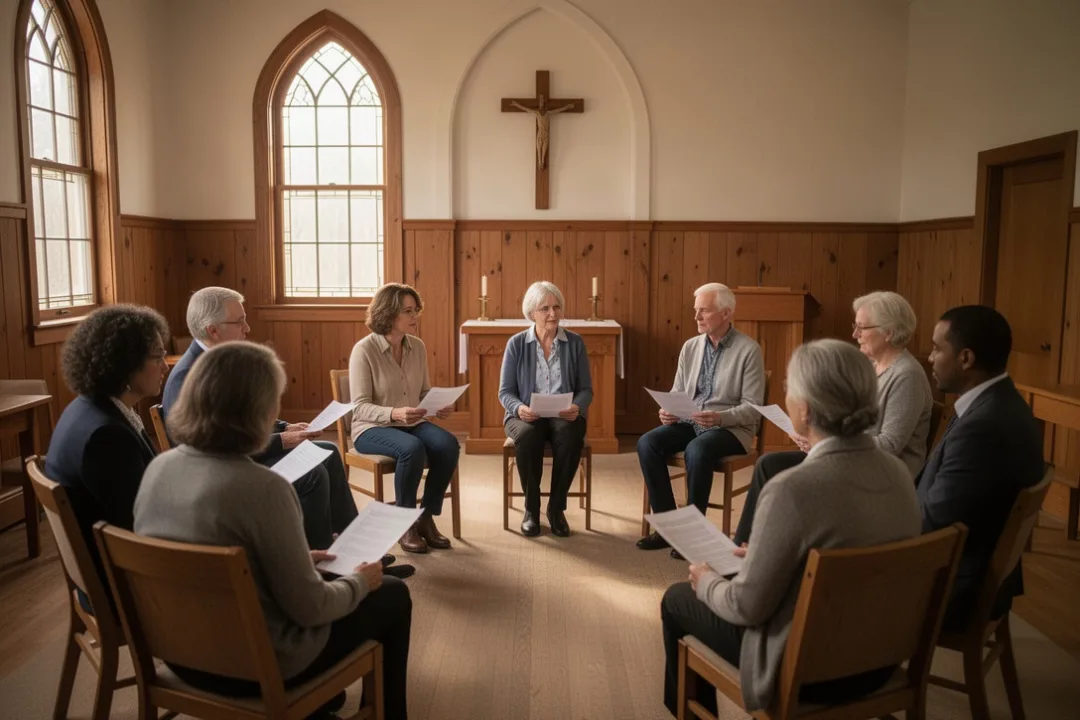
In a congregational church, authority is normally exercised by the members of the local congregation. Members may vote at church meetings, approve budgets, call or dismiss a pastor, receive new members, decide whether to purchase property, and determine the congregation’s mission.
Many congregational churches use elected boards, councils, deacons, trustees, or committees to handle regular responsibilities. These groups serve the congregation rather than replacing it as the source of authority. Their exact roles vary widely, and some churches operate with a highly structured leadership team while others make most major decisions in open meetings.
The pastor usually provides preaching, teaching, pastoral care, worship leadership, and administrative guidance. However, the pastor does not ordinarily possess unilateral authority over the congregation. A healthy congregational system distinguishes between pastoral leadership and congregational consent.
Congregational churches may belong to larger bodies that offer training, mission programs, church planting support, ministerial resources, or theological fellowship. These organizations generally exercise influence through shared commitments and persuasion rather than through direct legal control of each congregation.
Key principles that shape congregationalism
Although churches use the tradition in different ways, several principles appear repeatedly. They explain why congregationalism looks different from episcopal and presbyterian systems.
Local church autonomy: each congregation governs its own internal affairs and is not normally subject to a higher church court.
Membership covenant: members commit themselves to worship, mutual care, Christian discipline, and shared service.
Congregational participation: major decisions belong to the gathered church, often through meetings and votes.
Christ’s headship: the church understands Christ, not a bishop or national office, as its ultimate head.
Religious liberty: congregations and individual Christians should not be forced to accept beliefs or practices through an imposed ecclesiastical hierarchy.
<strong Voluntary cooperation: independent churches can work together in missions, education, relief, and public witness without surrendering their local authority.
The principle of autonomy does not mean that a congregation should act in isolation. Congregationalists have often argued that independent churches still have moral and spiritual responsibilities toward one another. Associations can provide advice, mediation, accountability, and practical help while leaving final decisions with the local church.
How a congregational church typically makes decisions
The process differs from one congregation to another, but major decisions often follow a recognizable pattern. The purpose is not simply to count preferences. Ideally, the congregation seeks prayerful discernment, careful information, and honest discussion before voting.
A matter is identified. The pastor, board, committee, or members bring forward an issue such as a pastoral call, building project, mission partnership, or policy change.
Information is gathered. Leaders present financial details, legal considerations, ministry goals, and relevant theological or practical concerns.
Members discuss the question. Meetings, listening sessions, small groups, or written materials may give members time to ask questions and express concerns.
Leaders recommend a course of action. A board or committee may offer a proposal, but the congregation retains authority to accept, revise, postpone, or reject it.
The church decides. The governing documents specify whether the vote requires a simple majority, a larger threshold, or another form of consent.
The congregation carries out the decision. Staff, officers, and committees implement the action and report back to the church.
This process works best when members understand their responsibilities. Congregational authority is not merely the right to vote; it includes the duty to listen, speak truthfully, protect vulnerable people, respect the church covenant, and accept legitimate decisions even when a personal preference does not prevail.
Congregationalism compared with other church government systems
The main distinction concerns where final authority rests. Every church system has strengths and risks, and actual practice can be more complicated than a simple label suggests.
Congregational polity: the local congregation holds final authority over its own life, usually through members’ meetings and elected leaders.
Presbyterian polity: authority is shared through representative bodies such as sessions, presbyteries, and broader assemblies. A local church normally belongs to a connectional system with formal higher courts.
Episcopal polity: bishops exercise oversight over congregations and clergy within a diocese or comparable structure.
Hierarchical Roman Catholic structure: authority is organized through bishops in communion with the pope, with defined teaching and governing offices.
Independent or nondenominational structure: a congregation may have local control without belonging to a historic denominational family, though its practical leadership may range from elder-led to pastor-led.
Congregationalism and independence are related but not identical. A congregational church may be fully self-governing while maintaining strong relationships with other churches. An independent church may also use congregational meetings, but it may not identify with the historic beliefs, covenantal language, or cooperative associations commonly associated with Congregationalism.
The historical roots of congregationalism in England
Congregationalism emerged during the English Reformation, when Christians debated how far the Church of England should be reformed. Some Puritans wanted to reshape the established church from within. Others concluded that a true church should be formed by believers who voluntarily covenanted together rather than by membership imposed through the state.
These Separatist communities emphasized the gathered church. In their understanding, a church was not simply everyone living in a parish. It was a body of people who professed Christian faith, entered a covenant, and accepted responsibility for worship and discipline together.
Early congregationalists faced political and religious pressure. Some worshiped secretly, some moved to the Netherlands, and others later migrated to North America. The movement was not politically or theologically uniform, but it shared a strong concern for the freedom and responsibility of the local Christian community.
English Congregationalists eventually developed confessions, church covenants, and associations to define their identity. They generally valued cooperation, but they resisted the idea that a distant body should have automatic jurisdiction over a local congregation.
How Congregationalism developed in New England
Congregationalism became especially influential in colonial New England. Puritan settlers established churches that shaped public life, education, moral expectations, and community organization. The New England model was not identical to later understandings of religious liberty, since colonial governments sometimes supported particular churches and restricted dissent.
Local church membership was central to the system. In many communities, the church was a major institution, and participation involved public expectations as well as private belief. Over the centuries, patterns of membership, revival, immigration, disestablishment, and denominational change transformed Congregationalism.
The Cambridge Platform of 1648 became an important statement of New England Congregational church order. It described the church as a particular gathering of believers and defended local government while also recognizing the value of councils and fellowship among churches. Its influence extended beyond the immediate period in which it was written.
Congregational churches also played a significant role in American higher education and missionary activity. Institutions connected historically with the tradition include Harvard in its early colonial setting and Yale, although the religious identities of these institutions changed over time. Congregational missionaries worked in the United States and abroad through organized societies and voluntary partnerships.
Congregationalist beliefs and theological diversity
Historically, many Congregationalists were shaped by Reformed theology. They emphasized the sovereignty of God, the authority of Scripture, the seriousness of sin, salvation by grace, and the importance of preaching. Reformed influence remains strong in some congregations, especially those connected with conservative or evangelical associations.
Other Congregational churches moved toward theological liberalism during the nineteenth and twentieth centuries. Some emphasized moral transformation, social reform, religious experience, and the continuing work of reason in interpreting Christian faith. In certain historical settings, Congregational churches became associated with Unitarian or liberal Protestant developments.
Because church government does not determine every doctrine, two congregations may both call themselves Congregational and still differ substantially. They may disagree about infant baptism, the ordination of women, biblical inerrancy, the nature of communion, or the relationship between Christianity and other religions.
Common areas of emphasis may include:
Scripture and preaching: the Bible is treated as a central source for Christian teaching, though interpretation varies.
Christian community: faith is practiced through worship, service, mutual care, and shared responsibility.
Freedom of conscience: members are often encouraged to study, pray, and reach convictions without excessive coercion.
Lay participation: nonordained members may lead worship, teach, serve on governing bodies, and take part in ministry.
Mission and social action: many churches connect Christian faith with education, relief work, justice, and local service.
Worship, baptism, and communion in Congregational churches
Congregational worship has no single required style. A service may include hymns, contemporary music, a sermon, Scripture readings, prayers, confession, testimonies, silence, and a celebration of communion. Some churches follow a formal liturgy, while others use a less structured order of worship.
Historically, Congregationalists have practiced both infant baptism and believer’s baptism, depending on the church’s theology. Churches influenced by traditional Reformed teaching may baptize infants as a sign connected with the covenant community. Evangelical congregations may reserve baptism for people who personally profess faith.
Communion, also called the Lord’s Supper or Eucharist, is likewise interpreted in different ways. Most Congregational churches treat it as a central act of Christian worship and remembrance. They may describe it as a means of grace, a sign of unity, or a proclamation of Christ’s death and resurrection, without adopting the same sacramental theology as every other Christian tradition.
Some congregations practice open communion, inviting all baptized Christians or all who trust in Christ to participate. Others limit participation according to their own theological statement or membership practices. Visitors should not assume that every Congregational church handles communion in the same way.
Why congregationalism values church covenants
A church covenant states how members promise to live together. It may include commitments to worship regularly, support the church financially, care for people in need, pursue reconciliation, participate in ministry, and practice Christian discipline.
The covenant is more than a membership form. It expresses the belief that a church is a voluntary spiritual community whose members have mutual obligations. Since no bishop or central office can manage every aspect of local life, the covenant gives the congregation a shared standard for faithfulness.
Covenants also create a framework for accountability. When conflict develops, members can return to the promises they made to one another. This does not remove the need for wise pastoral care, formal policies, or legal protections, especially in cases involving abuse or misconduct. Spiritual language must never be used to silence victims or avoid responsible reporting.
Practical safeguard: Local autonomy should never mean secrecy or immunity from accountability. Churches need clear policies for finances, safeguarding, employment, discipline, and responding to allegations of abuse.
The strengths and challenges of congregational government
Congregationalism can give members a strong sense of ownership. People participate directly in decisions that affect worship, mission, staffing, and spending. This can encourage active discipleship rather than treating members as spectators.
Local control also allows a congregation to respond quickly to its community. A church can organize a food pantry, change its schedule, call a pastor, or begin a neighborhood ministry without waiting for approval from a distant governing body.
At the same time, local authority can create serious challenges. A congregation may lack expertise in legal, financial, pastoral, or safeguarding matters. Strong personalities can dominate meetings, and a majority can overlook the concerns of a minority. Disagreements may become especially painful when the church must decide on a pastor, property, doctrinal statement, or denominational relationship.
Congregational churches can reduce these risks through transparent procedures and outside counsel. Helpful practices include:
using written bylaws that explain authority and voting procedures;
publishing financial reports and approving budgets openly;
separating pastoral, financial, and personnel responsibilities;
providing independent support for abuse investigations and conflict mediation;
training members and leaders in respectful decision-making;
inviting denominational or associational advice without confusing advice with control.
Major Congregational bodies in the United States
There is no single worldwide Congregational authority. In the United States, churches with Congregational heritage belong to several different families.
The United Church of Christ includes Congregational roots alongside other Protestant traditions. Its structure combines local church autonomy with covenantal relationships and wider conferences. Individual churches may differ considerably in theology and worship.
The National Association of Congregational Christian Churches supports churches that emphasize local autonomy and voluntary fellowship. It provides resources and connection while generally preserving the congregation’s authority over its own affairs.
The Conservative Congregational Christian Conference represents churches with a more conservative evangelical orientation. Its member churches remain locally governed while cooperating for ministry, missions, and mutual support.
Other churches use names such as Congregational Christian, Community Congregational, or simply Congregational without belonging to one of these bodies. The name alone does not tell you the church’s complete theology. A congregation’s statement of faith, membership covenant, bylaws, and worship practices provide better evidence.
If you are considering visiting a Congregational church, begin with its public materials. Look for a statement of faith, information about membership, the church covenant, leadership structure, and any affiliation with a wider association or denomination.
During a visit, ask practical questions rather than relying only on the name. Useful questions include:
Who makes major decisions, and how are members involved?
How are pastors and other leaders selected?
What does the church teach about baptism and communion?
How does the congregation handle disagreement and discipline?
What safeguards exist for children and vulnerable adults?
How does the church cooperate with other congregations?
What responsibilities come with membership?
Pay attention to whether the church’s actual practices match its stated principles. A congregation may describe itself as congregational but operate informally through one dominant pastor or a small inner circle. Conversely, a church may use little traditional language while practicing meaningful member participation and accountable local governance.
What membership usually involves
Membership in a Congregational church commonly involves a profession of Christian faith, baptism according to the church’s practice, agreement with the church covenant, and a willingness to participate in its life. The specific requirements are determined locally.
Members may be expected to attend worship, contribute financially, serve in ministry, participate in meetings, and support the church’s mission. Some congregations distinguish between members and regular attendees, while others welcome broad participation without emphasizing formal membership.
Joining a congregational church means accepting both freedom and responsibility. You may have a genuine voice in the church’s decisions, but you also share responsibility for the quality of those decisions and for the care of the wider community.
Why congregationalism still matters
Congregationalism continues to offer a clear answer to a basic question: who should take responsibility for the life of a local church? Its answer is the gathered congregation, equipped by Scripture, guided by prayer, served by leaders, and connected to other churches through voluntary cooperation.
The tradition’s value does not depend on pretending that local decision-making is easy. Congregational government requires patience, transparency, theological maturity, and safeguards against abuse of power. When those conditions are present, it can combine local freedom with shared Christian responsibility.
For anyone trying to understand a particular Congregational church, the most useful starting point is not its label alone. Examine how authority is exercised, what members promise, how leaders are held accountable, what the church teaches, and how it treats people when disagreement arises.
Frequently asked questions
Is congregationalism a denomination?
Congregationalism can refer to a broad Protestant tradition, a system of church government, or a church family. Some Congregational churches belong to denominations or associations, while others are independent. The shared feature is usually local congregational authority, not membership in one worldwide organization.
Do Congregational churches believe in the Trinity?
Many Congregational churches affirm the historic Christian doctrine of the Trinity, but Congregationalism itself does not impose one universal statement of faith. Individual churches may be Reformed, evangelical, liberal Protestant, or connected with other theological traditions, so their official beliefs should be checked separately.
Can a Congregational church leave its denomination?
Often, a locally governed church has substantial authority to decide whether it will join, remain in, or leave a wider association. The result can depend on the congregation’s bylaws, property documents, affiliation agreements, and applicable state law. Churches commonly seek legal and denominational advice before making that decision.
What is the difference between Congregationalism and Baptist church government?
Both traditions commonly emphasize local church authority and may use congregational meetings. Baptists are especially associated with believer’s baptism and typically reject infant baptism, while Congregational churches vary on baptism and may include Reformed, liberal, or evangelical beliefs. The two traditions can overlap in practice without being identical.





Leave a Reply